Journalists, military members held at gunpoint at Space Force base

Daftar Isi
Journalists and Military Escorts Detained at Gunpoint During Convoy to Vandenberg Space Force Base
Cybersecarmor.com – A group of reporters and two uniformed military escorts were stopped, searched, and briefly held under armed guard at the gates of Vandenberg Space Force Base on August 18, 2026, after base security personnel mistook the media convoy for unauthorized vehicles attempting to breach the installation. The roughly 30-minute ordeal left every member of the press party unable to attend the event they had been formally invited to cover: a groundbreaking ceremony for a new missile operator training facility on the base.
Vandenberg’s Role and Location
Vandenberg Space Force Base sits in Santa Barbara County, approximately nine miles northwest of Lompoc, California. Operated under Space Launch Delta 30, the installation serves as one of the United States’ two principal space launch sites and hosts a steady stream of national-security missions, including intercontinental ballistic missile tests, satellite deployments, and crewed-spaceflight support operations. Its proximity to the Pacific coast makes it a critical node for polar-orbit launches, and its perimeter security protocols are calibrated accordingly. The base routinely hosts invited media for milestone events, though the volume of daily traffic—contract vehicles, logistics trucks, and personnel shuttles—means that gate screening remains a constant operational priority.
What Happened at the Gate
On the morning of August 18, a public-affairs staff vehicle from the base departed to escort a convoy of press cars belonging to Noozhawk, KEYT, KSYB, and the Santa Maria Times/Lompoc Record toward the training-facility groundbreaking. Two military officers accompanied the journalists as escorts. As the combined group approached the security checkpoint, the public-affairs vehicle and the press cars pulled to the shoulder of the road so that remaining media vehicles could clear the gate area.
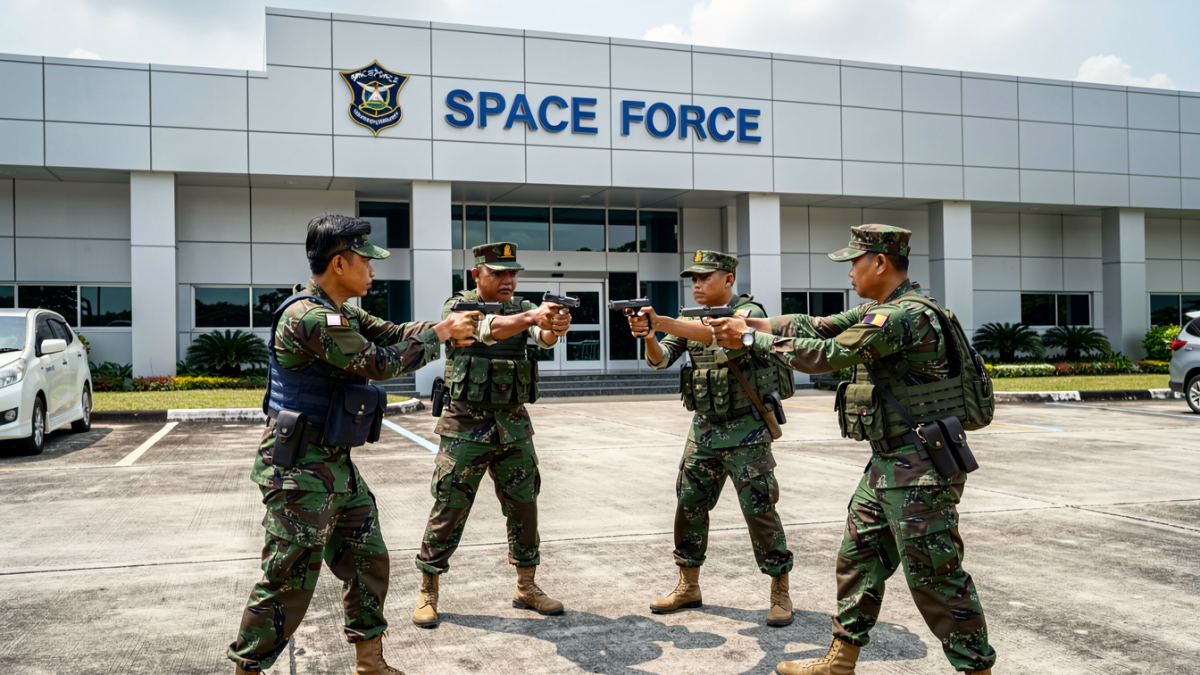
At that moment, at least one member of the base security detail sounded an alarm, identifying the stopped vehicles as suspected “gate runners”—a colloquial term for drivers who attempt to slip through a checkpoint without proper credentials. Sirens activated and physical barriers were deployed across the roadway. Base police then advanced on the group with firearms drawn, ordering each vehicle in sequence to pull forward into the inspection lane.
“One by one, with firearms pointed at the group, base police ordered each vehicle to pull forward. Police then demanded that the drivers and passengers exit individually with hands raised.”
The two military officers were handcuffed and placed inside base-owned vehicles for the duration of the screening. Reporters were instructed to remain seated on the adjacent curb while their vehicles were checked. No injuries were reported, and all members of the press party were ultimately released without further confrontation. However, the elapsed time consumed the entire window allotted for the groundbreaking, meaning none of the invited journalists were able to file coverage of the ceremony.
Editorial Reaction
Tom Bolton, editor in chief of Noozhawk, called the episode a systemic failure of basic media-coordination procedure.
“It appears some members of the Vandenberg security team are seriously in need of additional training. This was a failure on multiple levels, and the base owes apologies to the affected journalists.”
A representative of the installation delivered an on-scene apology to the detained reporters shortly after their release. No formal written statement of apology from the base command was made public beyond the explanatory remarks described below.
The Base’s Explanation
In a written statement issued to local broadcast media, a Space Launch Delta 30 spokesperson attributed the incident to a “breakdown in communication” that occurred as the media convoy entered the installation. The spokesperson noted that the base has been “experiencing an increased number of unauthorized entry attempts” in recent weeks, a condition that heightens alertness at every checkpoint.
“Every potential unauthorized presence must be treated as a legitimate threat until proven otherwise. While we recognize this may have been unsettling, the security of the base and its personnel is our priority.”
In a separate statement directed to USA TODAY, the same spokesperson characterized the episode as a “coordination gap” that allowed the media convoy to proceed toward the gate “before the credentialing process was fully completed.” The installation commander has since ordered a review of “the media coordination processes” to determine where the handoff between public-affairs scheduling and gate-screening broke down.
“Vandenberg takes both installation security and our responsibility to invited media seriously,” the statement concluded.
Broader Implications
The incident raises questions about how military installations balance the need for rapid, decisive gate security with the logistical realities of scheduled media access. At a base that supports daily launch operations and houses sensitive missile-systems infrastructure, treating every unknown vehicle as a potential threat is standard doctrine. Yet the distinction between a genuine gate runner and a credentialed press convoy escorted by uniformed officers should, in principle, be resolvable within seconds through radio confirmation or a quick visual check of escort insignia.
For the affected newsrooms, the practical consequence was straightforward: a day of planned coverage lost, with no opportunity to file same-day reporting on a milestone event tied to taxpayer-funded missile training infrastructure. For the base, the episode underscores the operational cost of over-caution when coordination channels between public affairs and security are not fully synchronized before a convoy departs. The ordered review of media-coordination procedures will determine whether procedural changes—such as pre-arrival radio check-ins, dedicated escort radio channels, or temporary credentialing fast-tracks for scheduled press events—will be implemented to prevent a recurrence.
Related Reading
Frequently Asked Questions
What is Journalists military members held at gunpoint?
Journalists military members held at gunpoint is the main topic of this guide. The article explains the context, practical details, and next steps readers should understand.
Why does Journalists military members held at gunpoint matter?
Journalists military members held at gunpoint matters because readers are looking for a useful answer, not just a short summary. Good content should match search intent and help them decide what to do next.