A drop in US births due to smartphone use? These researchers say so.

Smartphones and Birth Rates: A New Study Points to a Possible Link
Cybersecarmor.com – Two decades after its debut, the iPhone may be more than a symbol of technological progress—it could be a factor in the shifting patterns of family formation in the United States, according to a recent working paper. Researchers argue that the smartphone’s rise in the early 2000s, particularly its initial availability through AT&T, coincided with a significant drop in birth rates among women aged 15 to 44. While the study is not yet peer-reviewed, its findings suggest a correlation between widespread smartphone adoption and reduced fertility rates.
Methodology and Regional Analysis
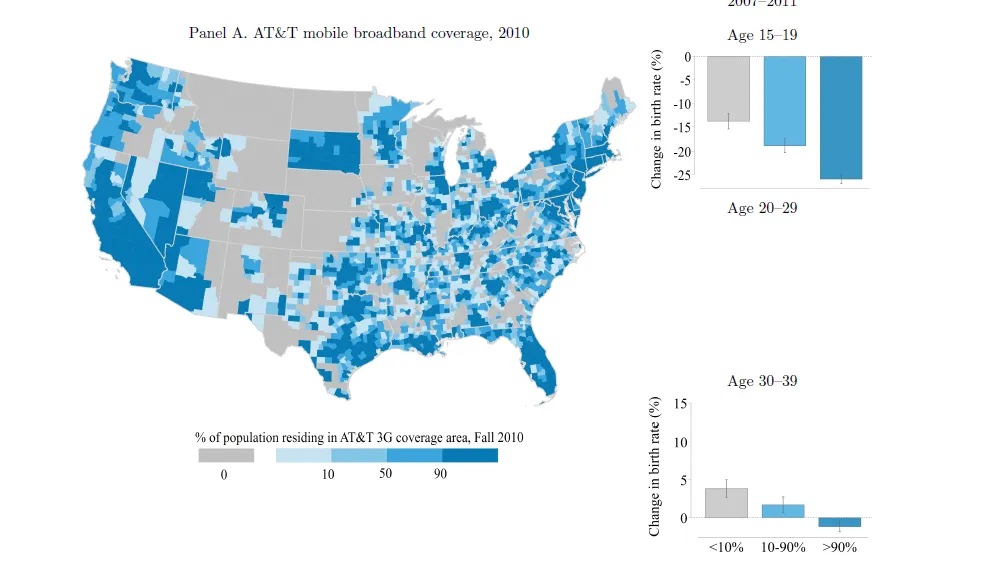
The study, led by Caitlin Myers, a professor of economics at Middlebury College, and her stepson Ezekiel Hooper, a recent graduate of the same institution, focuses on the geographic spread of iPhone access. Between 2007 and 2011, when AT&T held the exclusive contract for the device, the team mapped out birth rates county by county. Their hypothesis: the expansion of iPhone availability could have influenced social behaviors, particularly among younger demographics, by altering how people spend time together.
Hooper and Myers compared counties with extensive AT&T coverage—where smartphones were more accessible—to those with limited or no access. The results revealed a stark contrast in birth rates. Women in their 20s living in areas with robust coverage saw a 14.6% decline in births over the four-year period, while those in less connected regions experienced only a 10% drop. For teenage mothers, the gap was even more pronounced: counties with near-universal access reported a 26% decrease in births, compared to a 13.8% decline in areas without such connectivity.
These findings are based on data spanning from the iPhone’s launch in 2007 to 2011, a time when the device was still relatively new and its impact on daily life was becoming evident. The researchers suggest that the smartphone’s convenience and constant connectivity might have disrupted traditional patterns of in-person interaction, which are often foundational for romantic relationships and family planning.
Broader Implications of Digital Technology
The study is part of a growing body of research exploring how digital tools have reshaped human behavior. Another working paper, published earlier this year by the Social Science Research Network, expands this idea to a global scale. According to the authors, the digital revolution—driven by smartphones and other technologies—has led to a decline in fertility rates worldwide. They argue that as people spend more time engaged with screens, the time available for deep, in-person connections diminishes.
One such study, authored by Hernan Moscoso Boedo and Nathan Hudson of the University of Cincinnati, highlights the cost and quality improvements of digital technology as a key factor. The research indicates that the affordability and accessibility of smartphones and other devices accounted for approximately 43% of the fertility decline in the U.S. since 2007. Hudson explained that these technologies are not just replacing older forms of communication but are fundamentally altering the way people form and maintain relationships.
Boedo and Hudson emphasize that the shift toward digital interaction has prioritized fleeting, superficial connections over sustained, meaningful ones. They cite the American Time Use Survey, which documented a 44% drop in in-person socializing among teens aged 15 to 19 between 2003 and 2019. This decline in unstructured, face-to-face time, they suggest, has led to fewer romantic opportunities and weaker partnerships, ultimately affecting birth rates.
Skeptical Perspectives and Long-Term Trends
While the study’s conclusions are provocative, some experts remain cautious. Sarah Hayford, director of the Institute for Population Research at Ohio State University, acknowledged the potential for smartphones to influence fertility but questioned the narrow focus of the research. “I’m open to considering how technology might affect birth rates in the U.S. and globally,” she said. “However, I’m not sure this five-year trend is the most significant factor in the long-term changes we’re seeing in family structures.”
Hayford pointed out that the study’s approach might overlook broader societal shifts, such as economic factors, cultural changes, or access to contraception. “Fertility decline is rarely a single cause—it’s a complex interplay of variables. Focusing on a five-year period risks oversimplifying the issue,” she added. This critique highlights a common debate in social sciences: whether short-term trends like the iPhone’s rise can be linked to long-term demographic changes or if they’re merely coincidental.
Despite these concerns, the researchers maintain that their analysis offers a fresh angle on the topic. Myers and Hooper’s work builds on earlier studies that have identified a link between smartphone adoption and declining teen births. They note that the teenage demographic saw the most dramatic effects, with a 4.5% to 8% drop in birth rates between 2007 and 2011. This aligns with the idea that younger generations are more susceptible to the influence of digital devices, which provide instant access to information, entertainment, and social networks.
The Role of Digital Connectivity in Relationship Dynamics
One of the central arguments in the research is that smartphones are not inherently reducing the desire for children. Instead, they are altering the way relationships are formed and maintained. The studies suggest that digital technology reallocates time away from in-person interactions, which are critical for building the deep connections necessary for long-term commitments like marriage and parenthood.
Hooper, reflecting on the study’s implications, noted that the results were surprising in their magnitude. “We expected a noticeable effect, but the percentage drops were quite significant,” he told USA TODAY. The researchers emphasize that the iPhone’s impact is not isolated to its features but is tied to its role in transforming how people engage with each other. For instance, the ability to communicate instantly might lead to more casual dating and less time spent on nurturing relationships, which could delay or reduce childbearing.
However, the debate continues. Critics argue that while smartphones may contribute to the decline, they are unlikely to be the sole driver. Other factors, such as economic uncertainty, changing gender roles, and increased educational opportunities for women, are also frequently cited as reasons for the fertility drop. Nonetheless, the studies raise an important question: as digital tools become more integrated into daily life, how might they reshape the future of family formation?
Global Trends and the Future of Fertility
With the proliferation of smartphones across the globe, the implications of these findings extend beyond the U.S. The researchers suggest that the digital revolution is a common thread in fertility declines observed in various regions. They propose that as technology becomes more ubiquitous, it will continue to influence how people allocate their time and prioritize relationships.
Myers and Hooper’s study, which specifically examines the impact on teen birth rates, adds to the discussion about generational differences in social behavior. They argue that teens, who are more likely to adopt new technologies early, have experienced the most pronounced shifts. The data from the American Time Use Survey supports this, showing a marked decrease in face-to-face social activities among younger individuals. This trend, they say, is part of a larger pattern of how digital tools are redefining human interaction in the modern era.
As the research community continues to explore these connections, it remains to be seen whether smartphones will be recognized as a significant factor in global fertility trends. For now, the studies offer an intriguing perspective on the intersection of technology and human behavior, challenging traditional views of what drives family formation in the 21st century.