This astronaut set to make history during next spacewalk outside ISS

Daftar Isi
First French Woman to Walk in Space: What to Expect From Tuesday’s Historic EVA
Cybersecarmor.com – The vacuum of space is about to welcome a new kind of pioneer. When NASA astronaut Anil Menon and European Space Agency astronaut Sophie Adenot step outside the International Space Station on Tuesday, August 18, they will accomplish something no Frenchwoman has ever done: conduct a spacewalk. The event marks a milestone not only for France’s space program but for the broader history of human activity beyond Earth’s atmosphere.
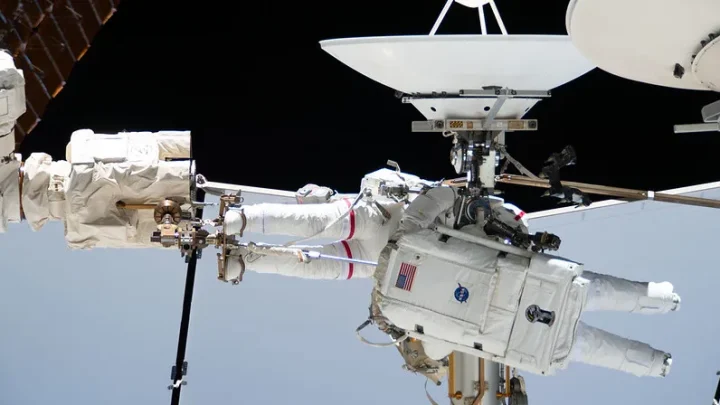
The operation, scheduled to begin around 8:35 a.m. Eastern Time, is expected to run for fewer than seven hours. Its primary objective is practical rather than symbolic: Menon and Adenot will swap a degraded high-speed communications antenna for a spare unit mounted on the station’s truss structure. Menon will work while positioned in Canada’s 56-foot Canadarm2 robotic manipulator, giving him mobility along the truss, while Adenot will remain tethered directly to the station’s exterior.
A Second Consecutive EVA for Menon
For Menon, this outing carries particular weight. It will be only his second spacewalk ever, and his second in consecutive weeks. Just twelve days earlier, on August 6, he joined NASA astronaut Jessica Meir for the previous EVA. Menon himself is on his first flight to space, having arrived at the station in mid-July aboard the Roscosmos Soyuz MS-29 spacecraft alongside cosmonauts Pyotr Dubrov and Anna Kikina. His eight-month mission means he will be aboard through at least early next year.
Adenot, by contrast, is making her very first spacewalk. She will become the fifth French astronaut ever to perform an EVA and the first woman from France to do so, according to the European Space Agency. Her presence on the crew underscores the growing role ESA astronauts play in routine station maintenance, not just in research payloads.
Where to Watch the Broadcast
NASA’s live coverage kicks off at 7 a.m. ET on August 18, offering viewers roughly an hour of pre-EVA briefing before the hatch opens. Streams will be available through the agency’s free NASA+ application, Amazon Prime Video, and YouTube. Netflix, which carried the July spacewalk on its platform, will not host a livestream for this particular event.
Commercial partners including Amazon will also distribute the feed, ensuring broad accessibility for audiences who prefer streaming services over traditional broadcast channels.
Context: The Station’s Quarter-Century of Continuous Habitation
The International Space Station has occupied a low-Earth orbit roughly 260 miles above the planet for more than 25 years. During that span it has hosted astronauts from every inhabited continent, served as a microgravity research platform, and gradually opened its docking ports to private commercial vehicles. More than 290 spacefarers representing 26 nations have visited the outpost, with 173 of those visitors coming from the United States alone.
The station operates under a multinational partnership that includes NASA, Roscosmos, the European Space Agency, Japan’s JAXA, and the Canadian Space Agency. Each agency contributes hardware, crew rotations, and scientific campaigns, making the ISS one of the most complex collaborative engineering projects ever sustained in orbit.
Expedition 75 and the Crew Rotation
Seven astronauts currently live and work aboard the station as members of Expedition 75. Four of them arrived together on the Crew-12 mission in mid-February: NASA’s Jessica Meir and Jack Hathaway, ESA’s Sophie Adenot, and Russian cosmonaut Andrey Fedyaev. That quartet is slated to depart in September once the Crew-13 team docks and completes its handover.
The remaining three crew members include Menon, Dubrov, and Kikina, who came aboard in July. Their presence means the station will maintain a full complement through the transition period.
What a Spacewalk Actually Involves
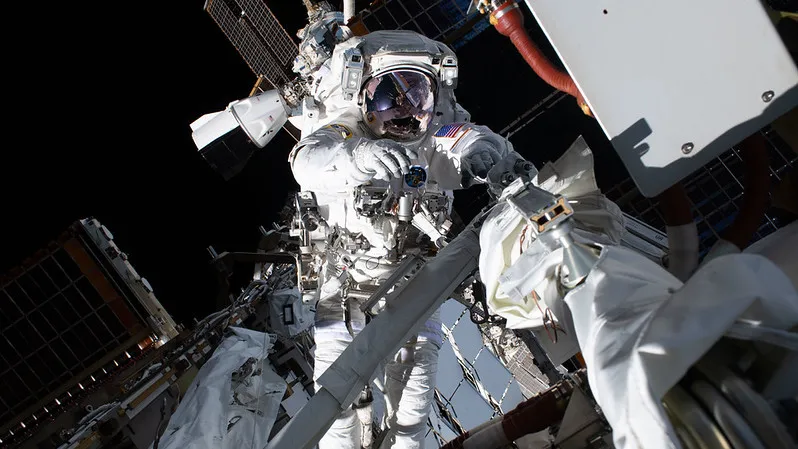
In industry terminology the event is called an extra-vehicular activity, or EVA. The process demands that astronauts don multi-layered pressure suits rated for the full vacuum of outer space, then physically exit the pressurized module through an airlock. Once outside, they work in an environment where temperatures swing between roughly +250 °F in direct sunlight and −250 °F in shadow, where there is no atmosphere to carry sound, and where every movement must be planned in advance because a single misstep can cost hours of mission time.
This particular EVA is catalogued as U.S. spacewalk number 97 and represents the 282nd EVA in the station’s operational history. It is the fifth spacewalk of calendar year 2026 and the fourth this year to include at least one American astronaut. NASA has announced two additional EVAs planned later in August, making this the second of three consecutive outings within the month.
Why the Antenna Swap Matters
High-speed antennas on the truss structure carry data links between the station and ground stations as well as between orbiting spacecraft. When one degrades, the station’s ability to downlink experiment results, telemetry, and high-bandwidth video is compromised. Replacing the unit restores full communications capacity and removes a single point of failure from the station’s data architecture. Tasks like this are routine in the station’s maintenance calendar, yet they remain among the most physically demanding work an astronaut can perform, requiring hours of precise manipulation in a suit that limits dexterity and adds significant thermal load.
For Adenot, the task also carries a personal dimension: completing her first EVA will place her among a very small group of French citizens who have worked outside a spacecraft, and as the first woman from her nation to do so. The achievement will be noted by ESA and by French space authorities as a marker of continued national participation in long-duration orbital operations.
Viewers tuning in at 7 a.m. ET on Tuesday will see the full sequence: suit-up, airlock cycling, hatch opening, and the slow emergence of two figures into the black. What follows is not spectacle for its own sake but the continuation of a quarter-century of human presence in orbit, one bolt, one antenna, one historic first at a time.
Related Reading
Frequently Asked Questions
What is This astronaut set to make history?
This astronaut set to make history is the main topic of this guide. The article explains the context, practical details, and next steps readers should understand.
Why does This astronaut set to make history matter?
This astronaut set to make history matters because readers are looking for a useful answer, not just a short summary. Good content should match search intent and help them decide what to do next.