Tropical Storm Dolly forms days after Dolly Parton’s death

Daftar Isi
A Fourth Named Storm Arrives in the Atlantic, Echoing a Name That Just Became a Memorial
Cybersecarmor.com – The 2026 Atlantic hurricane season gained its fourth named storm on Thursday morning, Aug. 27, when the National Hurricane Center confirmed that Tropical Storm Dolly had organized sufficiently to earn a designation at 11 a.m. EDT. The timing of that confirmation landed just two days after the passing of country-music legend Dolly Parton on Aug. 25, creating an almost surreal overlap between a meteorological event and a cultural loss that has dominated headlines across the country.
The coincidence, while striking to the public, is entirely mechanical. Atlantic and eastern Pacific storm names are drawn from a fixed alphabetical roster maintained by a committee of the World Meteorological Organization headquartered in Geneva, Switzerland. That list cycles on a six-year rotation, meaning each name reappears on a predictable schedule regardless of who is alive or dead. The name Dolly, specifically, replaced Diana following the 1990 hurricane season and had been in active rotation since its first deployment in 1996. No editorial judgment, no tribute, and no cultural reference informed the assignment.
The Storm’s Brief Life Expectancy
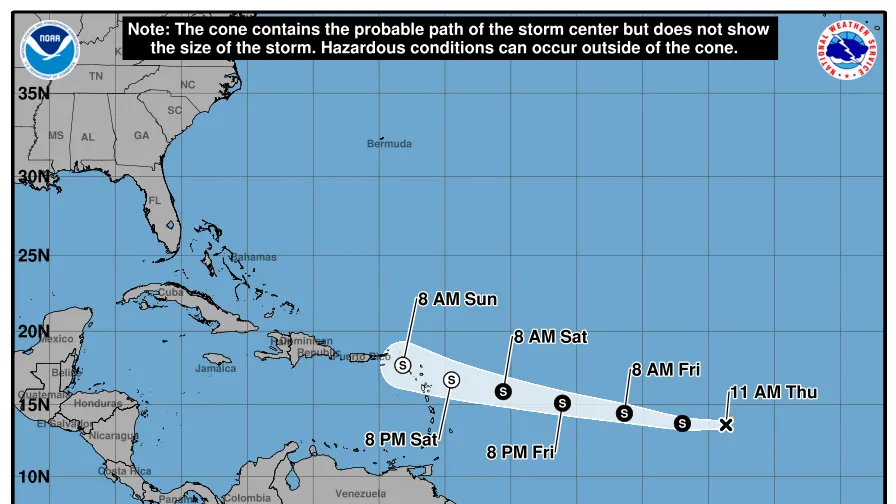
Despite its official designation, forecasters at the hurricane center cautioned that Dolly faces an unfavorable atmospheric environment beginning Aug. 28. Shear, dry air, and other hostile conditions are expected to strip the system of its tropical character well before it reaches the Caribbean basin. In an afternoon online forecast discussion issued on Aug. 27, the center laid out the expected trajectory:
“Global and regional models all show Dolly degenerating into a strong tropical wave on Friday [Aug. 28] or Saturday [Aug. 29] before it reaches the Leeward Islands, and our forecast shows this decay by the weekend.”
The system had been tightening its circulation overnight into the morning of Aug. 27, which is what tipped the center into issuing the formal tropical-storm advisory. By 5 p.m. EDT that same day, Dolly sat roughly 1,425 miles east of the Leeward Islands in the Caribbean, tracking westward at 24 mph. Its compact structure and modest wind field placed it firmly in the weak-tropical-storm category, with little indication of rapid intensification ahead.
Rainfall Risks for the Caribbean and Beyond
Even as the cyclone weakens, its associated moisture field will not vanish instantly. The hurricane center warned that heavy rainfall could begin affecting the Leeward Islands late Saturday, Aug. 29, into Sunday, Aug. 30, before spreading to the U.S. Virgin Islands, Puerto Rico, and the island of Hispaniola (shared by the Dominican Republic and Haiti) on Sunday and into Monday, Aug. 31. The center specifically flagged flash-flooding potential in higher-terrain areas where runoff accumulates quickly.
“Although Dolly is forecast to no longer be a tropical cyclone when it passes near the Leeward Islands, heavy rainfall could begin to affect the Leeward Islands late Saturday [Aug. 29] into Sunday [Aug. 30] and the Virgin Islands, Puerto Rico and Hispaniola Sunday [Aug. 30] and Monday [Aug. 31]. This heavy rain may produce flash flooding, especially in areas of higher terrain.”
For residents of those islands, the practical takeaway is straightforward: monitor local weather offices through the weekend, keep drainage clear, and avoid low-lying roads during periods of intense downpour. The tropical wave that replaces the cyclone can still generate organized bands of rain even after the eye and wind structure have dissipated.
What Happens Next: Two Scenarios
AccuWeather lead hurricane expert Alex DaSilva outlined two broad pathways in an email sent Aug. 26, the day before Dolly received its name. If the system stays loosely organized and drifts westward as a weak tropical storm, it could present a concern for the Bahamas and, in a less-likely branch, for the southeastern U.S. mainland. Conversely, if the storm manages to strengthen before encountering the worst of the shear, it may turn northward and head out into the open Atlantic, carrying its impacts well away from populated coastlines.
DaSilva noted that the broader Atlantic environment this season has been suppressive, limiting the growth of tropical systems. That suppression is precisely what forecasters expect to finish off Dolly within 48 to 72 hours of its formation. The storm’s brief existence underscores a recurring theme of the 2026 season: named storms can form, earn a designation, and then unravel before ever threatening a coastline.
The Naming Coincidence, Put in Perspective
Retired NOAA meteorologist and longtime Parton fan Roger Edwards called the overlap an “astounding coincidence,” a phrase that captures how the human brain instinctively seeks narrative links between unrelated events. In practice, the alphabetical list has been cycling since the mid-20th century, and the name Dolly would have appeared on the 2026 roster whether or not the singer was alive. The six-year rotation means the name will next reappear in 2032, by which time the cultural resonance of this particular pairing will have faded.
Still, the juxtaposition gave the Aug. 27 advisory an emotional texture that routine tropical-storm bulletins rarely carry. For millions of fans mourning Parton’s death, seeing her name flash across weather maps and morning news cycles added an unexpected layer of poignancy to what is, meteorologically speaking, a short-lived and ultimately harmless weather event. The storm will be gone by the weekend. The name, however, will sit on the shelf for another six years before the cycle turns again.
Related Reading
Frequently Asked Questions
What is Tropical Storm Dolly forms days after?
Tropical Storm Dolly forms days after is the main topic of this guide. The article explains the context, practical details, and next steps readers should understand.
Why does Tropical Storm Dolly forms days after matter?
Tropical Storm Dolly forms days after matters because readers are looking for a useful answer, not just a short summary. Good content should match search intent and help them decide what to do next.