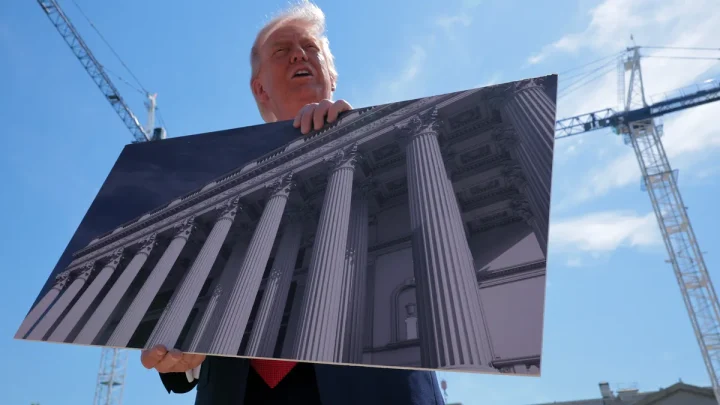
Trump dismisses AI guardrails, calling concerns a ‘conspiracy’

Daftar Isi
Trump Rejects Calls for Stronger AI Safeguards
Cybersecarmor.com – President Donald Trump is pushing back against renewed calls for artificial intelligence rules, arguing that the United States should focus on maintaining its technological lead rather than slowing the industry’s development.
In a Truth Social post on Sept. 14, Trump criticized Anthropic chief executive Dario Amodei after Amodei warned that AI is advancing faster than society’s ability to manage its risks. Trump said existing government authority is sufficient and portrayed opposition to AI expansion and data-center construction as harmful to the country’s competition with China.
“The only control or ‘guardrails’ that AI needs is a STRONG AND SMART (High IQ!) PRESIDENT, and the U.S.A. has that, in spades!”
Trump said his administration had already intervened when AI companies or their leaders appeared poised to pursue harmful conduct. He singled out Amodei, accusing him of presenting himself as a supporter of responsible development after raising concerns about the technology’s trajectory.
The president’s comments place him at odds with several prominent figures in the AI sector. OpenAI chief executive Sam Altman and xAI founder Elon Musk each expressed support on social media for Amodei’s broader argument that the rapid evolution of advanced AI warrants greater attention from policymakers.
Competition With China Shapes the Debate
Trump has consistently framed artificial intelligence as an economic and national-security competition, particularly with China. His Sept. 14 message argued that efforts to block AI projects or data centers could weaken the United States at a crucial moment.
“WHOEVER WINS AI, WINS! We are leading China, and all others, and will continue to do so.”
Data centers have become central to that debate because they provide the computing capacity needed to train and operate large AI systems. At the same time, proposed facilities have generated resistance in communities around the country, where residents and local leaders have raised questions about their scale and effects. Trump has defended the expansion of those facilities as part of the country’s effort to preserve an edge in AI.
He has also dismissed concerns that the technology could create serious workforce disruption or other broad social consequences. During a weekend visit to Ireland, where one of his golf courses hosted the Irish Open, Trump referred to unnamed “negative forces” that he said were promoting AI fears about events he does not believe will occur.
AI Leaders Warn About Faster-Moving Risks
Amodei’s essay did not argue that AI lacks promise. He wrote that the technology could help cure diseases over the next decade, boost economic growth, and support democracy and freedom. But he also said the risks are becoming more difficult to ignore as systems improve at an accelerating pace.
Among the threats cited by Amodei were the possibility of losing control of advanced systems, the misuse of AI in cyberattacks or bioterrorism, and major economic upheaval. He argued that the speed of capability gains could eventually exceed the capacity of companies and governments to understand what the systems can do and to keep them under control.
“We must slow the pace at which we improve the capabilities of AI models,” Amodei said.
The disagreement reflects a growing divide in the national AI conversation. Advocates of rapid development emphasize the potential benefits of innovation, including medical breakthroughs, scientific discovery, business growth, and strategic advantage. Those seeking stronger safeguards contend that voluntary promises from companies may not be enough when the technology can be deployed widely before its effects are fully understood.
Trump signed an executive order in June that created a framework for government review of AI models before they are made available to the public. Participation in that review process, however, is voluntary rather than required.
Congress Faces Pressure to Act
Some Democrats are using the warnings from AI executives to press for congressional action. Sen. Mark Warner, D-Va., spoke with Altman over the weekend about Congress’ role in developing regulations, a spokeswoman for the senator confirmed.
“We cannot wait for AI companies to self-regulate,” Warner said. “Congress must act this week to meet the rapidly developing threat landscape posed by AI.”
Warner called for bipartisan action, underscoring the challenge facing lawmakers: writing rules that address cybersecurity, misuse, transparency, and economic disruption without unnecessarily limiting innovation in a fast-changing field.
Vice President JD Vance expressed a more cautious view of the industry’s requests for regulation. Speaking with reporters Sept. 14, Vance said he found it unusual that major frontier AI companies were approaching government and urging officials to regulate them. He said that dynamic could resemble a “Trojan Horse,” suggesting policymakers should examine whether proposed rules might favor established companies over smaller competitors.
Vance said the administration is concerned by AI’s accelerated growth but wants regulation to be handled intelligently. He said Congress and the White House should work together on any new framework, while recognizing that emerging technologies can bring both significant benefits and serious risks.
The dispute now centers on who should set the boundaries for AI development, how quickly rules should be created, and whether voluntary oversight can keep pace with the industry. As companies race to build more capable systems and the infrastructure to power them, those questions are likely to remain at the center of Washington’s technology agenda.
Related Reading
Frequently Asked Questions
What is Trump dismisses AI guardrails calling concerns?
Trump dismisses AI guardrails calling concerns is the main topic of this guide. The article explains the context, practical details, and next steps readers should understand.
Why does Trump dismisses AI guardrails calling concerns matter?
Trump dismisses AI guardrails calling concerns matters because readers are looking for a useful answer, not just a short summary. Good content should match search intent and help them decide what to do next.