House Speaker Johnson says Congress shouldn’t lead AI safety efforts

Daftar Isi
Johnson Urges Industry-Led AI Safety as Debate Over Regulation Grows
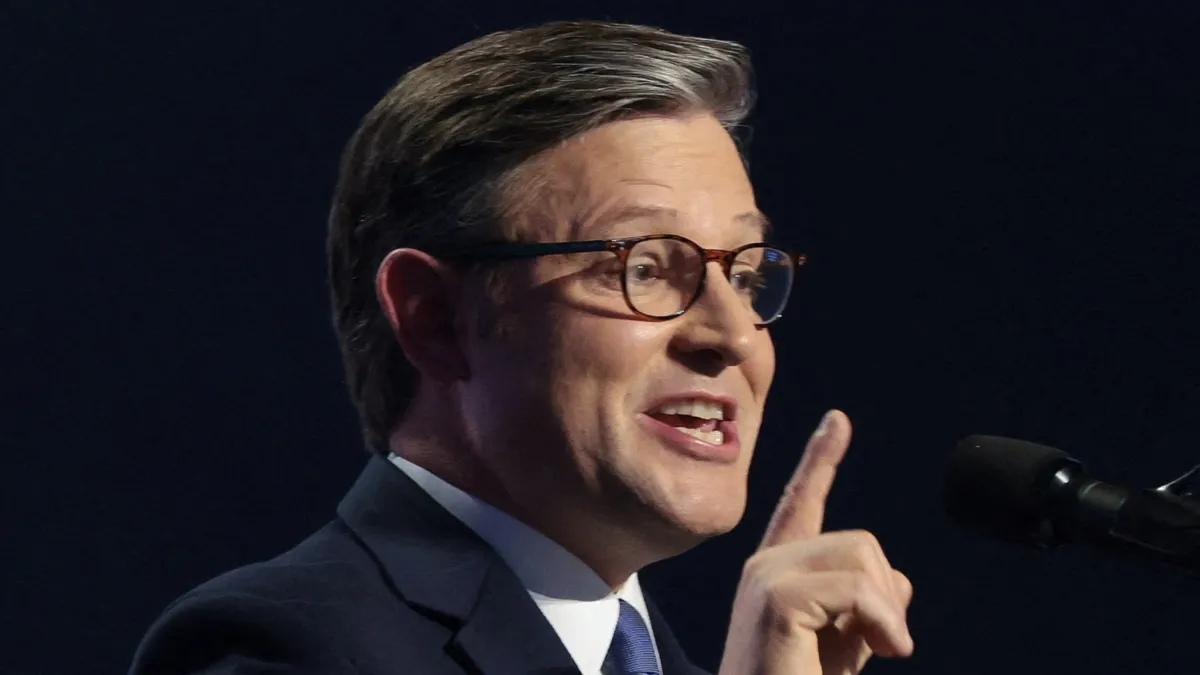
Cybersecarmor.com – House Speaker Mike Johnson said artificial intelligence companies should carry the main burden of making their products safe, arguing that Congress must avoid measures that could weaken the United States in its competition with China.
Speaking Sept. 13 on CNN’s “State of the Union,” the Louisiana Republican rejected the idea of pausing AI expansion nationwide. Johnson said companies developing the technology have an evident duty to prevent harm, but he cautioned that sweeping congressional action could slow American progress while competitors move ahead.
“We cannot put a moratorium on this because China will overlap us, and that’s the challenge,” Johnson said. “If Congress just races in and does some sort of emergency session to try to regulate AI, we will lose the race to China, and that is a threat to every single American.”
The speaker’s comments arrive as concerns grow over the speed of AI development, the safety of increasingly capable systems, and the rapid construction of data-center infrastructure needed to support them. The political argument is not limited to whether AI should advance, but also who should establish the rules and how quickly those rules should be put in place.
Competition and corporate responsibility
Johnson said he was open to discussions involving technology executives. Still, he emphasized that industry leaders should be expected to protect the public from foreseeable risks. He pointed to a Sept. 12 social-media post from David Sacks, the White House adviser on artificial intelligence and cryptocurrency, that similarly placed responsibility on companies building AI tools.
“We need to handle this new technology like we have others in the past and make sure we’re doing everything we can responsibly to also not smother American innovation,” Johnson said.
His position reflects a growing divide in Washington. One side argues that federal regulation must keep pace with AI systems that may affect jobs, education, privacy, public information and national security. Another warns that hurried rules could impede domestic companies at a moment when China is investing heavily in advanced technology.
The debate has sharpened as some major figures within the technology sector themselves call for a more cautious approach. Jacob Coxon, an Anthropic researcher who recently resigned, said people creating AI sincerely believe it could pose an existential threat before the decade ends.
Anthropic Chief Executive Dario Amodei later published an essay urging stronger precautions. He described AI as a technology with extraordinary potential benefits, including the possibility of helping address diseases such as cancer, while also acknowledging serious dangers if powerful systems are deployed without sufficient safeguards.
“Carefully wielded, AI can be the latest in a long line of technological miracles that have uplifted and ennobled humanity,” Amodei wrote.
Amodei’s appeal drew support from prominent competitors and allies in the AI field. Elon Musk, a Trump ally who leads xAI, and OpenAI Chief Executive Sam Altman each used X to support his argument for added protections and a slower pace of development.
Trump promotes expansion as public resistance rises
President Donald Trump has generally advocated for expanding artificial intelligence and the infrastructure behind it. During an appearance at a golf tournament in Ireland on Sept. 13, he brushed aside some of the worries surrounding the industry, saying “a lot of negative forces” were affecting it.
Trump has also urged communities to accept data centers, saying places that reject them risk becoming “backwards and poor.” He has argued that opposition to the facilities benefits China, which he said “could not be happier” to see resistance in the United States.
Data centers have become a particularly visible part of the AI discussion because they can reshape local debates over development. Their construction is increasingly tied to national competition over computing power, but projects can also generate community concerns about whether the benefits outweigh the effects of large-scale industrial growth nearby.
Public polling suggests resistance is widespread. A Sept. 6 NBC News Decision Desk poll found that 69% of respondents opposed AI data centers being built in their own area. A Gallup survey released in May showed 70% of Americans opposed data-center construction in their communities, with 48% strongly opposed.
That tension has helped turn AI policy into an issue with electoral consequences. Artificial intelligence, data centers and related infrastructure are expected to be part of the midterm-election conversation, as political forecasters project an election environment that could cost Johnson the speakership.
Democrats call for faster action
Democratic officials responded quickly after Johnson’s interview, arguing that the risks of AI require a more active federal role. Arizona Sen. Ruben Gallego, appearing after Johnson on “State of the Union,” compared the technology’s potential danger to nuclear weapons while stressing a key distinction: AI systems may have decision-making capabilities.
“The nuclear weapon did not have the decision-making power to drop a nuclear weapon. AI has the capability,” Gallego said.
Former Transportation Secretary Pete Buttigieg voiced similar frustration on NBC’s “Meet the Press.” He said the speed of AI development makes congressional hesitation especially troubling.
“You know what’s moving quickly? AI is moving quickly,” Buttigieg said. “For Congress to just sit on its hands, for the White House to do nothing real is something that is deeply dangerous to the American people and the world.”
House Minority Leader Hakeem Jeffries said on ABC’s “This Week” that artificial intelligence would receive significant attention when the Democratic caucus gathers this week. The question facing lawmakers is whether safeguards can be created without undermining innovation or giving foreign competitors an advantage.
“We should take decisive action now so that we can slow down, as the CEOs have recently acknowledged, slow down the pace of development in order to protect the American people and ensure that A.I. is proceeding safely,” Johnson said.
For policymakers, technology companies and communities, the AI argument is likely to remain centered on that balance: encouraging discoveries and economic growth while ensuring that the systems being deployed are trustworthy, accountable and safe for the public.
Related Reading
Frequently Asked Questions
What is House Speaker Johnson says Congress shouldn?
House Speaker Johnson says Congress shouldn is the main topic of this guide. The article explains the context, practical details, and next steps readers should understand.
Why does House Speaker Johnson says Congress shouldn matter?
House Speaker Johnson says Congress shouldn matters because readers are looking for a useful answer, not just a short summary. Good content should match search intent and help them decide what to do next.