Will you get Trump’s $5,000 dividend check? Here’s what we know.

Daftar Isi
Trump Pitches $5,000 “Dividend” as Midterm Election Nears
Cybersecarmor.com – President Donald Trump is tying a proposed $5,000 payment for every American adult to a Republican victory in the Nov. 3 midterm elections, presenting the idea as a reward made possible by economic growth, private investment and efforts to reduce government waste.
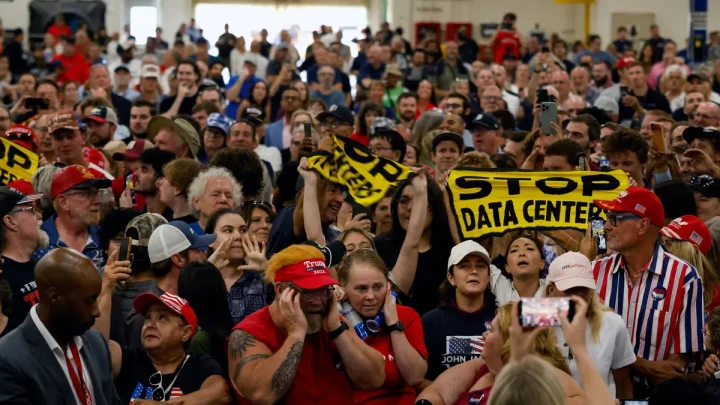
The pledge was made during the GOP’s midterm convention in Dallas on Sept. 9. Trump said Republicans retaining control of both chambers of Congress would unlock what he called a “Trump dividend.” He said recipients would be required to spend the money within the United States.
“If the Republicans win, you win with us, and you get $5,000. It will be called the ‘Trump dividend.’”
For now, the proposal remains a campaign promise rather than an enacted federal program. Trump did not provide a funding mechanism, eligibility limits or a timetable for distributing the payments. The price tag could reach roughly $1.2 trillion, and Congress would need to authorize the spending.
What would need to happen before checks are issued?
A presidential announcement alone would not be enough to create a nationwide payment program of this scale. Lawmakers would have to draft and pass legislation, and the measure would require support in Congress before money could be distributed.
Sen. Bernie Moreno, R-Ohio, said on X that he planned to prepare legislation for the dividend. Whether the proposal can secure enough support is uncertain. Senate Majority Leader John Thune, R-South Dakota, described the prospect as unresolved in remarks to Fox News.
“We will cross that bridge when we come to it.”
The White House argued in a Sept. 10 release that the proposed dividend could be supported by trillions of dollars in new private investment and savings from cutting government waste. Still, there has been no detailed public explanation of how those factors would translate into $5,000 payments for every adult or how the broader cost would be covered.
That missing detail is likely to be central to the political and legislative debate. A universal payment without an income cap would reach a very large number of people, increasing its cost considerably. It also raises questions about federal borrowing, inflation and whether a payment linked to an election result could move through Congress.
Opposition spans both parties
Democratic critics have sharply objected to the idea. Rep. Jamie Raskin, D-Maryland, the ranking Democrat on the House Judiciary Committee, labeled it a political bribe. Rep. Dan Goldman, D-New York, called the pledge corrupt and plainly illegal.
Some Republican figures have also voiced concerns. Florida Gov. Ron DeSantis warned that the plan could add to debt and inflation. Former Rep. Bob Good, R-Virginia, described the checks as a socialist vote-buying scheme.
Sen. Susan Collins, R-Maine, questioned both the expense and the connection between the payment and the election outcome.
“From the few details we have, it seems that the proposed $5,000 dividend would not have an income cap and would be extraordinarily costly.”
Collins said tax and spending choices should be based on the country’s economic needs rather than appear tied to election results.
A Separate $500 Obamacare Refund Is Moving Forward
Trump’s $5,000 proposal is distinct from a smaller health-insurance refund program announced by the White House the following day. That initiative involves $500 checks for qualifying people enrolled in Affordable Care Act coverage through the federal marketplace.
Nearly 1 million people across 30 states may qualify. The payments are expected to be sent in October to individuals who bought coverage through Healthcare.gov and did not receive premium assistance under the Affordable Care Act.
The administration says the refunds are tied to excess user fees collected from insurers through the federal exchange. Those fees, the White House said, were passed on to consumers through higher premiums and exceeded what was necessary to operate the marketplace.
Trump put the amount of the excess fees at $500 million and said the administration was returning money to people who had been overcharged.
“Our Administration is doing the right thing and giving the money back to the people who were wrongly ripped off.”
The $500 refunds have also drawn criticism. Opponents point to Senate Republicans’ December 2025 rejection of a proposal to continue COVID-era Affordable Care Act subsidies, which had helped make insurance more affordable for 22 million Americans.
Brad Woodhouse, president of Protect Our Care, argued that the refund would not offset the larger costs faced by many households.
“Five hundred dollars is a drop in the bucket compared to what Americans are paying because Trump and Republicans gutted health care to bankroll massive tax breaks for billionaires and big corporations.”
Why the distinction matters
The two payment ideas differ greatly in scope and status. The Obamacare refund is a targeted program for a defined group of marketplace enrollees and has an anticipated October distribution date. The proposed Trump dividend would be a far broader payment, but it has no approved legislation, confirmed funding source or established delivery schedule.
Americans weighing the announcements should therefore separate an active refund plan from the $5,000 campaign proposal. Eligibility for the health-care refund depends on where coverage was purchased and whether premium assistance was received. The larger dividend, as described by Trump, would apply to adults generally, but only if Republicans win Congress and lawmakers subsequently approve the program.
Trump has previously promoted other dividend-style payments, including ideas tied to savings from the Department of Government Efficiency and tariff revenue. One payment did reach military personnel in December 2025, when service members received $1,776 “Warrior Dividend” bonuses. That precedent may shape public expectations, but it does not establish that the proposed $5,000 payment will become law.
Until Congress acts, there is no application process, official eligibility guidance or confirmed date for a $5,000 Trump dividend check.
Related Reading
Frequently Asked Questions
What is Will you get Trump s 5 000?
Will you get Trump s 5 000 is the main topic of this guide. The article explains the context, practical details, and next steps readers should understand.
Why does Will you get Trump s 5 000 matter?
Will you get Trump s 5 000 matters because readers are looking for a useful answer, not just a short summary. Good content should match search intent and help them decide what to do next.