
What if AI could move your hand? Students build a wearable device using AI and electric pulses
What if AI could move your hand? Students build a wearable device using AI and electric pulses
What if AI could move your – A group of young engineers has developed a groundbreaking wearable device that bridges the gap between artificial intelligence and human physiology. Dubbed Human Operator, this innovative system leverages AI models, cameras, and muscle stimulation hardware to guide hand movements with remarkable precision. The project, initiated by students at the Massachusetts Institute of Technology (MIT), represents a fusion of cutting-edge technology and biomechanical engineering, offering a glimpse into the future of human augmentation.
The AI-Powered Innovation
Human Operator is designed to function as an interface where AI temporarily assumes control of a user’s hand movements, enabling them to perform tasks they might otherwise find challenging. The device operates through a combination of sensory input and targeted muscle stimulation, creating a seamless link between visual perception and physical action. According to the project website, the team aimed to “give AI a body,” transforming it from a mere computational tool into an active participant in human movement.
“Human Operator is a human augmentation tool that allows AI to briefly take control of your body to help you learn or do things you cannot do,” said the developers on their project site.
The system’s core lies in its ability to interpret both spoken commands and environmental data in real time. By integrating a vision-language model (VLM), the device processes visual information from a head-mounted camera and translates verbal instructions into physical responses. This dual-processing approach ensures that the AI can recognize objects, understand context, and execute precise hand movements with minimal user input.
How It Works
At the heart of Human Operator is the vision-language model, a type of AI trained to analyze both images and language simultaneously. When a user issues a command, such as “wave” or “play a piano note,” the model deciphers the intent and cross-references it with data from the camera feed. This feed captures the surrounding environment, allowing the AI to identify relevant objects and determine the appropriate sequence of muscle activations.
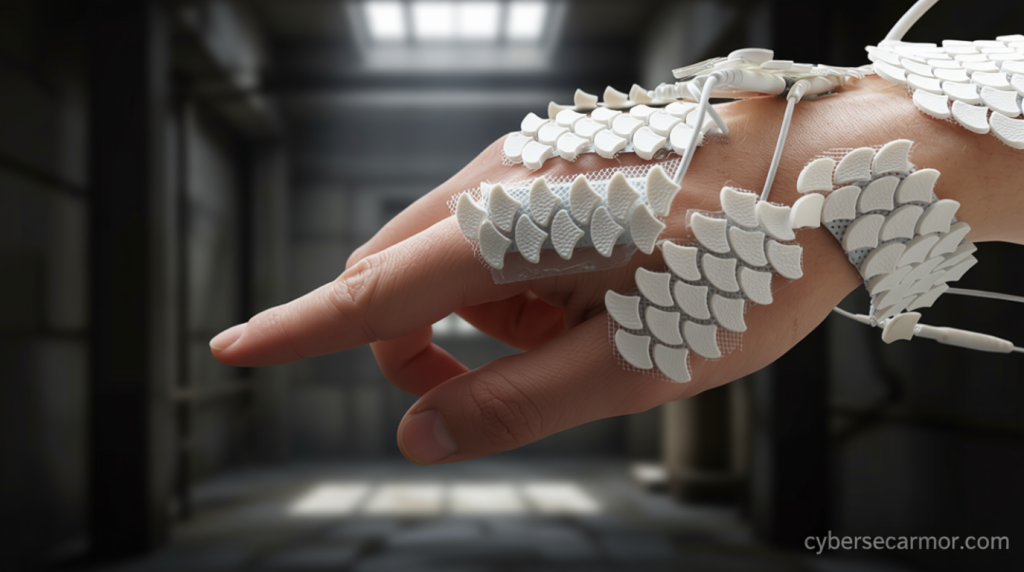
Once the AI processes the input, it sends signals to electrical muscle stimulation (EMS) pads attached to the user’s wrist or forearm. These pads deliver microcurrents that stimulate specific muscles, mimicking the natural motion of the hand. The system’s responsiveness is key—users can observe immediate feedback as the device translates their verbal instructions into physical actions, such as forming an “OK” hand gesture or executing a series of coordinated movements.
EMS technology, though not new, has been widely applied in physiotherapy and assistive devices to aid rehabilitation and muscle strengthening. Human Operator introduces a novel twist by integrating this technology with AI, creating a dynamic system that adapts to the user’s needs in real time. The combination allows for both passive assistance and active learning, where the AI can guide users through unfamiliar tasks by providing tactile cues and correcting movements as they occur.
Potential Applications
The implications of Human Operator extend beyond the confines of a classroom or hackathon. In healthcare, such a device could support physical therapy for patients recovering from injuries or stroke, offering personalized guidance during exercises. In education, it might help students with motor disabilities to engage in hands-on learning, while in professional settings, it could assist workers in performing complex tasks with enhanced precision.
For example, the device’s ability to translate spoken commands into physical actions opens doors for individuals with limited mobility. By simply stating their intention, users can initiate movements that would otherwise require physical effort or dexterity. This could revolutionize how people interact with technology, making it more intuitive and accessible. Additionally, the system’s adaptability suggests potential use in training scenarios, such as teaching musicians or athletes to refine their techniques through AI-assisted feedback.
While the project is still in its prototype phase, the team’s work highlights the growing convergence of AI and human biology. By combining machine learning with biomechanical interfaces, Human Operator demonstrates how artificial intelligence can become an extension of the human body rather than a separate entity. This approach not only enhances user interaction but also raises intriguing questions about the future of human-machine collaboration.
Hackathon Success
Human Operator was created during MIT Hard Mode 2026, a 48-hour hackathon focused on innovation in learning technologies. The challenge required participants to develop solutions that could advance educational tools, and the team’s project stood out for its creative integration of AI and EMS. Winning the Learn Track at the event underscored the potential of their invention to transform how people acquire and apply new skills.
The development process itself was a testament to the team’s ingenuity. By working under time constraints, they managed to assemble a working prototype that demonstrates the feasibility of their concept. The device’s compact design and user-friendly interface suggest that it could evolve into a more refined product in the future, potentially becoming a tool for widespread use in both clinical and everyday settings.
As the team reflects on their achievement, they emphasize the broader impact of Human Operator. “This project is not just about moving a hand—it’s about empowering individuals to overcome physical limitations through technology,” they stated. Their vision aligns with ongoing advancements in AI and wearable devices, which are increasingly being used to enhance human capabilities and improve quality of life.
Looking ahead, the team hopes to refine the device’s accuracy and expand its functionality to include more complex tasks. They also aim to collaborate with experts in neuroscience and rehabilitation to explore its potential in medical applications. With further development, Human Operator could represent a significant step toward a future where AI and human physiology work in harmony, opening new possibilities for learning, movement, and interaction.

