Will Darline Graham turn her family name, Trump’s support into SC win?

Daftar Isi
South Carolina Senate Runoff Pits Trump’s Endorsement Against a Conservative Challenger
Cybersecarmor.com – The Aug. 25 special runoff in South Carolina will determine whether a political newcomer can convert a presidential blessing and a family legacy into a full Senate term. Darline Graham, the 62-year-old incumbent appointed to fill the seat vacated by her late brother, faces Rep. Ralph Norman in a contest that has drawn national attention for reasons extending well beyond the state’s borders.
How a Family Name Became a Ballot Line
Graham entered the Senate chamber on July 13, when Gov. Henry McMaster signed her appointment to complete the unexpired portion of Lindsey Graham’s term. The move came at the direct request of President Donald Trump, who wanted a loyal ally occupying the seat his late friend had held for nearly two decades. South Carolinians had elected Lindsey Graham to the Senate four times, and his death left a void that the state’s Republican establishment needed to fill quickly before the November general election.
Before receiving the appointment, Graham had no elected office behind her. She worked as an optician in disability services and workforce development, served on the South Carolina State Workforce Development Board, and held the title of president-elect at the National Council of State Agencies for the Blind. That background, while respectable in its own right, raised immediate questions about whether she could navigate the foreign-policy and national-security questions that define a modern Senate seat.
A Debate Moment That Reshaped the Race
Those questions crystallized during an Aug. 18 debate, when a moderator pressed Graham on whether Taiwan and the South China Sea constitute vital national-security interests for the United States. Her response stunned observers accustomed to the hawkish foreign-policy posture her brother had championed for years.
“I’m not that informed on national security, so — but I do support the military. I’m not a polished politician up here. National security is not my thing, not my area of expertise, but I do support the military.”
The remark landed with particular force because Lindsey Graham had spent two decades as one of the most vocal foreign-policy hawks in American politics, pressing for robust engagement in the Indo-Pacific and frequent military posturing. For a candidate stepping into his shoes to declare that domain outside her expertise struck many voters and analysts as a disqualifying admission, even if delivered with candor.
What the Numbers Showed on Primary Night
The Aug. 11 special primary produced no majority winner. Graham captured roughly 33 percent of the vote, while Norman finished just under 25 percent. Because neither candidate cleared the 50-percent threshold, the top two advanced to the runoff, leaving behind Rep. Russell Fry, former South Carolina Gov. Mark Sanford, and business owner Mark Lynch. The primary result confirmed that Graham’s name recognition and Trump’s endorsement gave her a starting lead, but it also revealed a fractured Republican electorate unwilling to consolidate behind any single candidate.
Analysts Call It a Coin Flip
Post-primary polling has been sparse, deepening uncertainty about voter sentiment in the final two weeks. Danielle Vinson, a politics and international affairs professor at Furman University, described the contest as genuinely unpredictable.
“I honestly have no real clue what’s going to happen. Can (Graham) win the sentimentality vote and her loyalty to Trump carry her, or will voters want something different? This race is definitely a toss-up for sure.”
Kyle Kondik, managing editor of the nonpartisan Sabato’s Crystal Ball newsletter at the University of Virginia’s Center for Politics, echoed that assessment while noting Graham’s momentum had eroded after the debate.
“I do consider it basically a toss-up. Graham has had a weak finish to the race, thanks to her comments about not knowing much about foreign policy.”
Kirk Randazzo, a political science professor at the University of South Carolina, offered a more granular read, suggesting the debate gaffe and Norman’s rapid exploitation of it had narrowed what had been a comfortable advantage.
“If you had’ve asked me a week ago, I would’ve said that Graham has an edge based on Trump’s endorsement, but given her debate gaffe and Norman capitalizing on it, this is much closer than expected heading into the home stretch. If I had to, I’d give maybe a slight edge in Norman’s favor. But that’s a slight edge. I think anything could happen on Tuesday.”
Trump’s Personal Stake in the Outcome
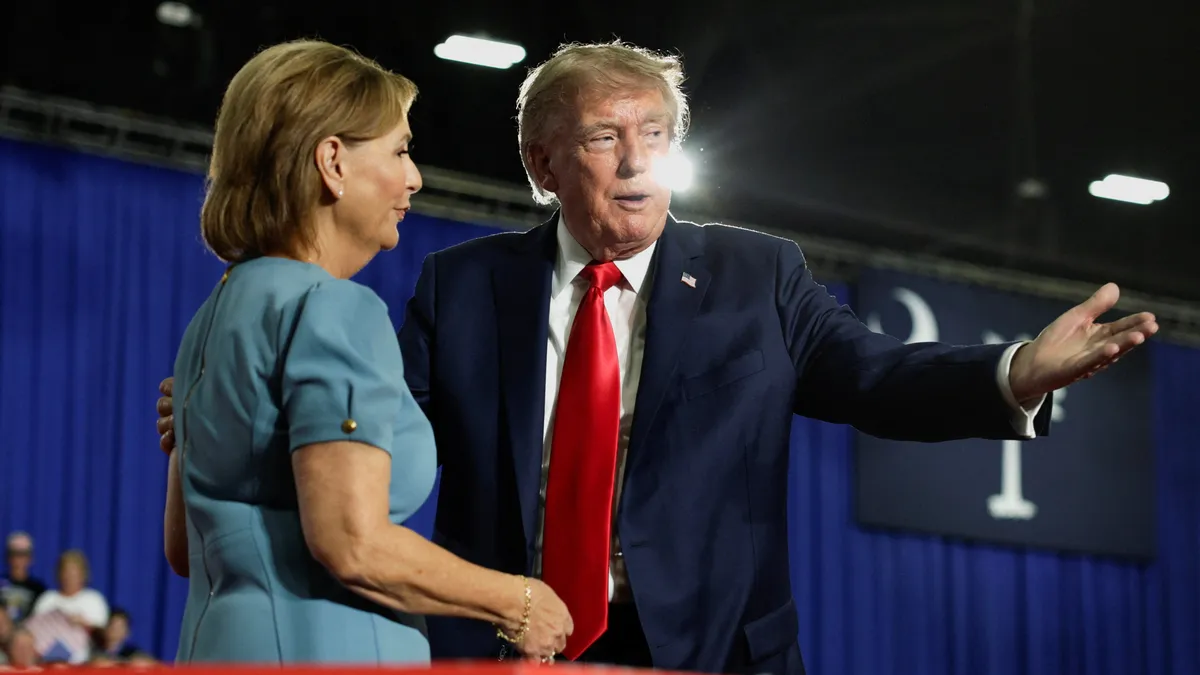
The president has made his preference unmistakable. At a campaign rally in Myrtle Beach on Aug. 21, Trump urged supporters to treat the runoff as though he himself were on the ballot, acknowledging that Republican turnout tends to dip when his name is absent.
“So what I really want you to do is pretend, please, that I’m on the ballot. Just come and vote. It’s so important. So just say that I’m on the ballot one more time. You got to say it, and you got to come out and vote.”
In an Aug. 24 tele-rally, he went further, declaring that Graham “fully supports the Trump agenda” and framing his personal recruitment of her as a deliberate act of political stewardship.
“I asked her to do it. I got her into this whole thing. I have to make sure she gets in because there will be nobody better.”
That language underscores how much the runoff functions as a referendum on presidential influence over down-ballot races. Trump’s endorsement record among Republican primary candidates has been remarkably strong, with victories for Georgia Senate nominee Mike Collins, Texas Senate nominee Ken Paxton, and New York congressional nominee Anthony Constantino. Yet a handful of recent losses have introduced doubt about whether the endorsement alone can overcome a candidate’s substantive vulnerabilities.
What a Winner Means for November and Beyond
Should Graham prevail, the result would validate the theory that a sitting president’s personal intervention can rescue a candidate from an otherwise fatal gaffe and carry her into the general election. It would also cement the Graham family’s grip on South Carolina’s Senate seat, extending a political dynasty that began with Lindsey’s first election in 2000. A Norman victory, by contrast, would signal that South Carolina Republicans still reward ideological consistency and legislative experience over name recognition and presidential patronage, potentially reshaping how future incumbents weigh loyalty to the White House against independent policy credentials.
Either outcome will be watched closely by party strategists in other states facing similar runoff or special-election scenarios, making this small Southern contest a bellwether for the mechanics of presidential influence in the 2026 cycle.
Related Reading
Frequently Asked Questions
What is Will Darline Graham turn her family?
Will Darline Graham turn her family is the main topic of this guide. The article explains the context, practical details, and next steps readers should understand.
Why does Will Darline Graham turn her family matter?
Will Darline Graham turn her family matters because readers are looking for a useful answer, not just a short summary. Good content should match search intent and help them decide what to do next.