When will it snow? Check Farmers’ Almanac first snowfall map

Daftar Isi
Early Mountain Snow Puts Winter on the Radar
Cybersecarmor.com – Autumn has not officially begun, yet the prospect of snow is already drawing attention across parts of the United States. A newly released Farmers’ Almanac map outlines the usual timing of each region’s first measurable snowfall, while forecasts point to a possible early-season burst of snow in some northern mountain areas.
The country has seen little meaningful snow so far this season. Mt. Bachelor, near Bend, Oregon, received a light dusting on Sept. 2, but broader winter-like conditions have yet to arrive. That may begin to change over the weekend in the highest terrain of the northern Rockies and Pacific Northwest.
In Montana, the National Weather Service office in Great Falls has placed the higher elevations along the Rocky Mountain Front under a 40% chance of receiving at least 4 inches of snow this weekend. Forecasters said confidence was increasing for the season’s first significant snow event.
“Confidence is growing that the first impactful snowfall of the 2026-2027 snow season will occur this weekend.”
Higher ridges in the Cascades and Olympic Mountains could also pick up accumulating snow. Such events are a familiar reminder that mountain weather can shift quickly well before lower elevations experience their first sustained cold spell.
A Seasonal Guide, Not a Storm-by-Storm Prediction
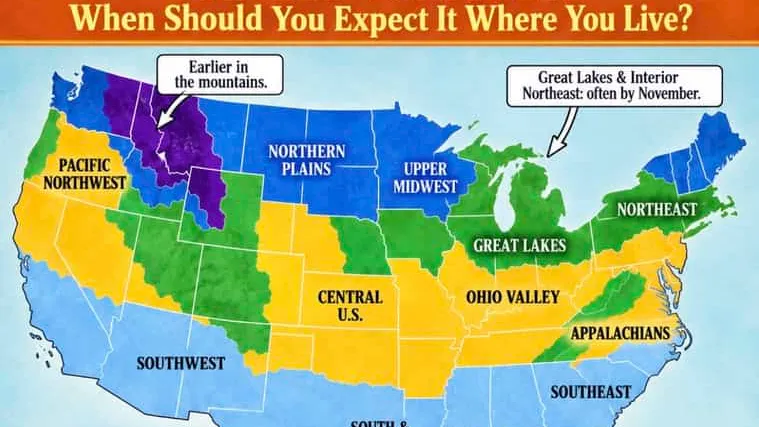
The Farmers’ Almanac describes its map as a climatological reference rather than a forecast for an individual weather system. In practical terms, it illustrates when measurable snow has commonly begun in different parts of the country over time, not a guarantee that snow will fall on a specific date this year.
That distinction matters in early autumn. A brief September snowfall at high altitude does not mean winter weather has settled in permanently. Mild conditions can return, quickly melting fresh accumulation before another round of cold air arrives.
“An August or September mountain snowfall does not necessarily mean winter has arrived for good. Early snow often melts quickly when warmer weather returns.”
For residents and travelers, the map can still offer useful seasonal context. Mountain routes, outdoor recreation plans and early cold-weather preparations may require more attention once snow becomes increasingly common in a region, even if the first flakes are short-lived.
Where Snow Usually Arrives First
October through early November
Parts of Oregon, Washington, Idaho, Montana, Wyoming, Minnesota, North Dakota, South Dakota and Wisconsin generally see their first measurable snow from October into early November. The northern Rockies, northern Plains and Upper Midwest are among the areas where early-season snow becomes much more routine as October progresses.
Historical snowfall patterns tracked by the National Oceanic and Atmospheric Administration closely align with this broad seasonal outlook. Portions of Idaho, Montana, North Dakota, Minnesota and Wyoming often see snow by the middle of October. Smaller sections of California, Oregon and Washington can fall into that early category as well.
By late October, first snowfall is typical across much of Montana, North Dakota and Wyoming, along with parts of Colorado, South Dakota, Utah, Minnesota, Wisconsin, Maine, Vermont and New Hampshire. Elevation remains an important factor: higher terrain can turn snowy well ahead of nearby valleys and cities.
November snow zones
November is the usual opening window for measurable snow across sections of Colorado, Utah, Wyoming, Nevada, New Mexico and Oregon. The pattern also includes parts of Nebraska, Iowa, Illinois, Indiana, Ohio, Michigan and Wisconsin.
Farther east and south, November often brings the first measurable snowfall to parts of North Carolina, Tennessee, Virginia, West Virginia, Pennsylvania, New York, Connecticut, Massachusetts and Rhode Island. The Great Lakes and the inland Northeast frequently enter their snow season during this period, though the timing can vary sharply from one community to another.
Michigan offers a useful example of that variation. Much of the state normally records its first snow in November, but some locations can receive snow in October. September snowfall is uncommon, though it has occurred in the past. Lake influence, local elevation and the track of individual weather systems can all affect when the first accumulation appears.
What “Measurable” Snow Means
A few flakes in the air do not necessarily mark the start of the snow season. The map focuses on measurable snow, commonly defined as at least 0.1 inch of accumulation. That threshold helps separate passing flurries from snow that actually collects on the ground.
In Delaware, the outlook places the first measurable snowfall from late November through December. Wilmington’s mean date for its first accumulation of at least 0.1 inch is Dec. 15, illustrating why the seasonal window can be broader than a single expected day.
States placed in the “rare snow” category can still experience notable winter storms. Georgia, for example, came through a winter that brought multiple storms, including snow in Atlanta. Seasonal averages offer perspective, but they do not rule out unusual events when the right combination of cold air and moisture develops.
Preparing for the Transition
The arrival of the first snow is often more significant than its depth. It can affect mountain travel, road conditions and outdoor plans, especially where drivers and visitors have not yet adjusted to winter hazards. People heading into higher elevations should pay close attention to changing forecasts, road advisories and temperature swings.
For much of the nation, the next several weeks will bring a gradual transition rather than an immediate start to winter. Still, the early mountain outlook is a timely signal: snow season is beginning to take shape, first in the high country and northern states, then across a wider stretch of the country as autumn advances.
Related Reading
Frequently Asked Questions
What is When will it snow Check Farmers?
When will it snow Check Farmers is the main topic of this guide. The article explains the context, practical details, and next steps readers should understand.
Why does When will it snow Check Farmers matter?
When will it snow Check Farmers matters because readers are looking for a useful answer, not just a short summary. Good content should match search intent and help them decide what to do next.