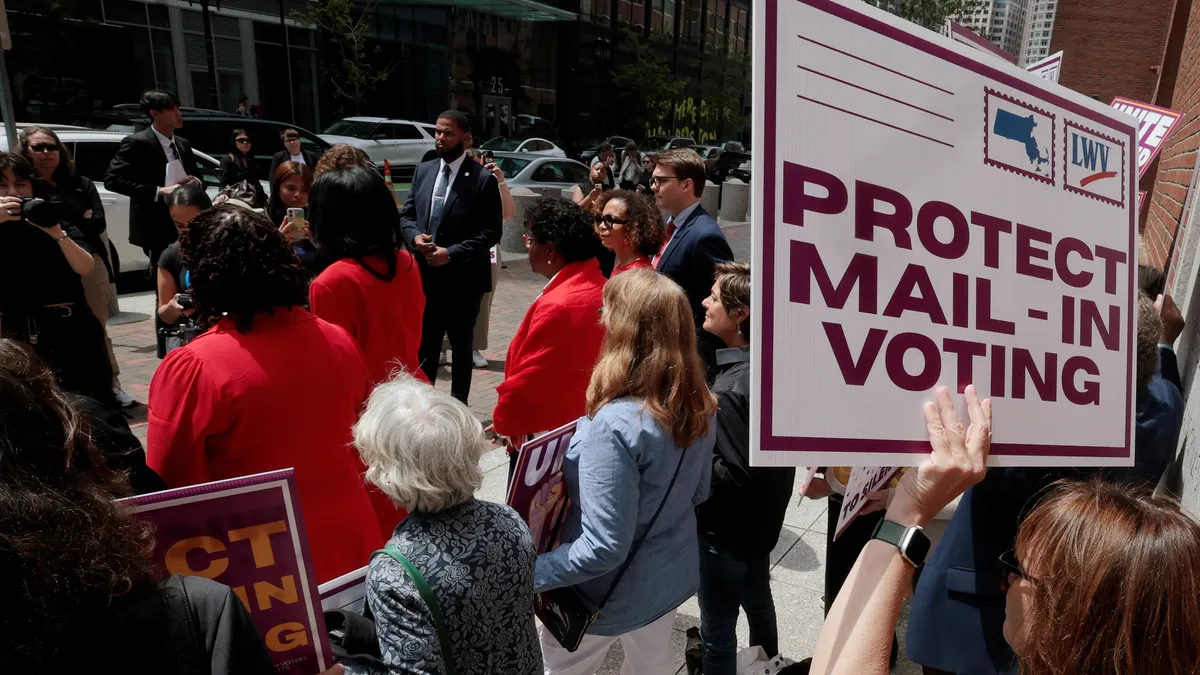
Trump loses key voting fight with Supreme Court. Why that’s a big deal

Daftar Isi
Supreme Court Keeps Mail Voting Rules in Place Before Midterms
Cybersecarmor.com – The Supreme Court has halted President Donald Trump’s effort to impose new limits on mail-in ballots, preserving the election procedures states have relied on for years as the midterm elections approach.
In a 5-2 ruling, the court refused to allow the U.S. Postal Service to review mail ballots after state election authorities receive them. Justice Brett Kavanaugh joined the lower court’s reasoning that introducing major election-rule changes so near an election would be “arbitrary and capricious.”
The outcome is a significant setback for the administration, which has argued that tighter federal involvement is needed to protect election integrity. Trump has repeatedly raised claims of widespread mail-ballot fraud, but those assertions have been debunked.
What the ruling means for voters
For voters, the practical effect is straightforward: states may continue distributing, receiving and processing mail ballots under their existing systems. Election offices will not have to redesign their procedures to accommodate a new Postal Service screening process weeks before voting begins.
The decision is especially consequential in states where voting by mail is a central part of the election system. Utah, California, Colorado, Nevada and Oregon are among the states where most ballots are cast by mail. In some places, ballots had already begun going out to eligible voters when the court acted.
Utah Lt. Gov. Deidre M. Henderson, a Republican and the state’s chief election official, said voters could expect a familiar process.
“Utahns can have confidence that the 2026 election will proceed as normal.”
Oregon elections chief Tobias Read, a Democrat, described the ruling as an important win for voters and legal stability.
“Our secure, fair and accurate vote-by-mail system will go forward as it always does. Presidents don’t decide elections. The people do.”
Mail voting expanded sharply during the COVID-19 pandemic, though its use has fallen from that high point. Nearly 30% of voters nevertheless used a mail ballot in the 2024 elections. Research has found that Democrats are more likely than Republicans to use that voting method, although voters of all political affiliations cast ballots by mail.
A ruling shaped by timing
The court’s decision does not settle every dispute involving federal power and election administration. Its immediate focus was the proposed change to ballot handling and the difficulty of implementing a new nationwide process close to the midterms.
Election administration is largely handled by state and local governments, which establish the rules for sending ballots, verifying voters, tracking returns and counting eligible votes. A late shift in those procedures can create confusion for voters, postal workers and election officials while forcing agencies to retrain staff and revise public instructions.
By leaving current systems intact, the ruling reduces the chance that voters will face different instructions or unexpected administrative barriers during an already active election season. It also means that voters should continue looking to their state or local election office for deadlines, ballot-request requirements, signature rules and return options.
Trump criticizes the decision
Trump responded in a lengthy Truth Social post, calling the outcome a “horrible, highly political, ruling.” He argued that the court had failed to act quickly enough to permit changes before the election.
“It is a big loss for Republicans, and America itself, and makes cheating by the Radical Left ‘Dumocrats,’ on Mail-In Ballots, a much easier thing to do.”
The president’s proposed mail-voting restrictions were part of a broader administration campaign to increase federal scrutiny of how states run elections. That effort has included demands for election records and increased attention to voter-roll maintenance.
Justice Department actions continue
The Department of Justice has sent letters to dozens of election officials seeking assurances that election materials will be retained. It has also warned that some states could face the loss of federal funding if they do not alter voting procedures.
Separately, the department has launched a state-by-state examination of voter rolls. Officials have asked states to explain how they identify and remove people who are felons, deceased, nonresidents or noncitizens when those individuals are ineligible to remain registered.
The department sued Orange County, California, after concluding that the county did not provide sufficient identifying details in response to a records request. It also submitted filings supporting lawsuits from the conservative group Judicial Watch involving claims that Illinois and Oregon have not removed enough names from their voter rolls.
Overall, the Justice Department has filed lawsuits against at least 30 states seeking unredacted voter lists. Court records show the department has lost nearly two dozen of those cases, while the remaining cases are still unresolved.
The Supreme Court’s decision does not end those separate legal and administrative battles. It does, however, ensure that the upcoming midterms will proceed without the Postal Service ballot-screening system sought by Trump, leaving mail-voting operations in the hands of the state and local officials who already administer them.
Related Reading
Frequently Asked Questions
What is Trump loses key voting fight?
Trump loses key voting fight is the main topic of this guide. The article explains the context, practical details, and next steps readers should understand.
Why does Trump loses key voting fight matter?
Trump loses key voting fight matters because readers are looking for a useful answer, not just a short summary. Good content should match search intent and help them decide what to do next.