First NATO, now South Korea. Trump hammers another US ally over Iran

Daftar Isi
Washington Orders Pullback of Joint Drills with Seoul as Trump Presses Pyongyang for Nuclear Talks
Cybersecarmor.com – The White House has instructed the Department of Defense to reduce the scope of combined military exercises conducted alongside South Korea, a move that lands on top of weeks of public friction between Washington and its oldest Pacific ally. The directive, announced by President Donald Trump on August 17 from the Oval Office, frames the decision as a response to what he characterizes as Seoul’s failure to back the United States during the ongoing conflict with Iran.
“We can’t go around and protect all of these countries, especially when they’re not there to help us,” Trump told reporters.
The announcement follows a pattern that has stretched across the transatlantic alliance. Since the United States and Israel opened hostilities with Iran earlier this year, Trump has publicly rebuked the United Kingdom, Italy, and Spain for what he views as inadequate solidarity, and has signaled a broader reexamination of America’s commitments within NATO — an organization he has long faulted for members’ below-target defense budgets. South Korea now occupies the newest slot in that list of chastened partners.
A Parallel Track Toward Pyongyang
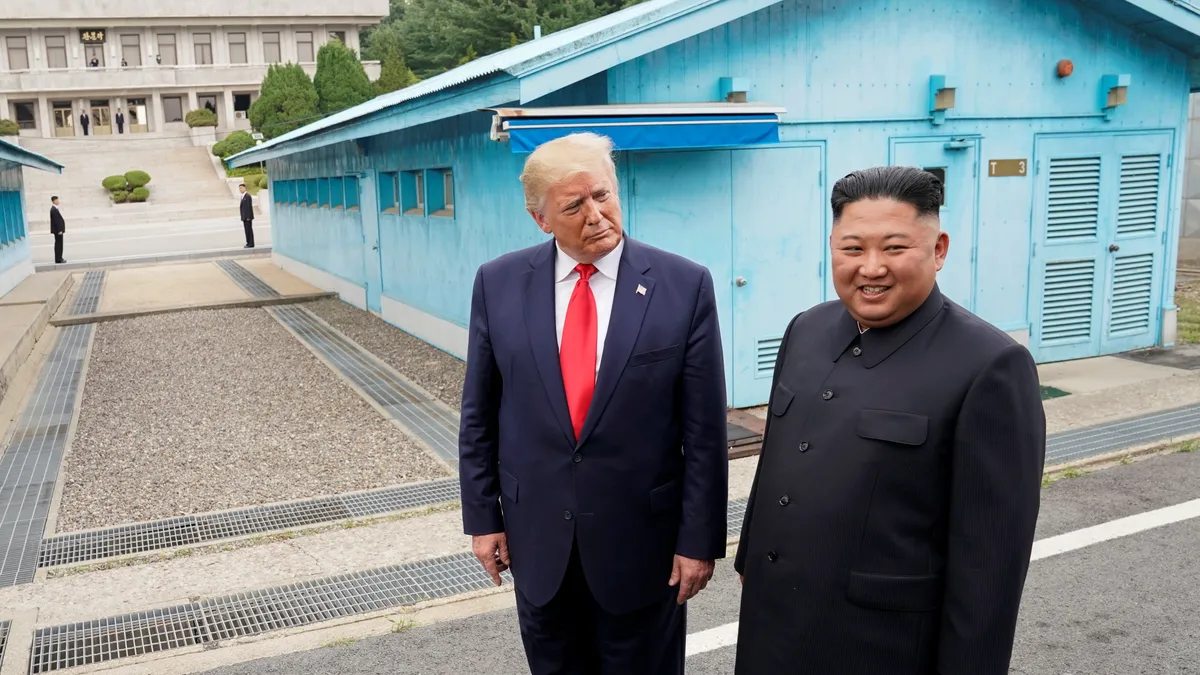
What makes the South Korea move particularly striking to regional analysts is its timing relative to a simultaneous diplomatic overture aimed at North Korea. A day before the exercise-reduction announcement, Trump published a photograph showing himself standing beside Kim Jong Un inside the demilitarized zone — the roughly 160-mile strip of buffer land that has divided the Korean Peninsula since the 1953 armistice ended active fighting without producing a formal peace treaty.
“Despite the unfriendly look on this particular picture, there are many where we’re smiling, Kim Jong Un and I get along GREAT!”
Trump stated on August 17 that Kim had responded to his outreach, though neither the president nor White House officials specified when or through what channel the exchange took place. The president had voiced a wish throughout the prior year to meet Kim either during the Asia-Pacific Economic Cooperation summit held in South Korea or during his spring visit to China, where he was hosted by President Xi Jinping.
Sydney Seiler, a senior adviser at the Center for Strategic and International Studies who specializes in Korean affairs, noted that Trump has long contemplated mechanisms for re-engaging Pyongyang. In her reading, the social-media posts function as a signal of intent to restart denuclearization negotiations with the hermit state.
Seiler pointed to the architecture of the 2018 talks, in which Kim conditioned progress on the United States scaling back the very joint exercises now under review. In exchange, North Korea was expected to suspend nuclear tests and intercontinental ballistic-missile launches.
“Some messages have been sent in. Pyongyang has not replied. But Trump’s had a lot of other things on his plate. He’s not necessarily interested in aggressively chasing after Pyongyang when there’s no evidence that they’ll be receptive,” Seiler said.
Seiler served as the North Korea intelligence officer on the National Intelligence Council during the Biden administration, giving her a front-row view of inter-Korean intelligence dynamics.
Why Now? Experts Scrutinize the Logic
Retired Rear Admiral Mark Montgomery, a senior fellow at the Washington-based Foundation for Defense of Democracies, called the pairing of actions “befuddling and illogical for the president to be reaching out to North Korea with at least partially the intent being to punish South Korea, who is our ally and partner.”
“He’s not going to be able to convince Kim Jong Un to give up his nuclear weapons. There’s no Nobel Prize waiting at the end of this rainbow. So I don’t know what the president’s up to,” Montgomery said.
Montgomery is a coauthor of Axis of Aggressors: Countering the Cooperation of China, Russia, Iran, and North Korea, a volume examining how those four states coordinate strategic behavior against Western interests.
The Cost Argument and the Exercise Question
On August 16, the day before his Oval Office remarks, Trump wrote that the United States was “dialing down” the combined drills, adding that the decision came too late to cancel the current cycle entirely.
“These exercises are not only costly, with much of these costs paid for by the United States of America (as usual!)”
The cost complaint echoes a recurring theme in Trump’s foreign-policy rhetoric: that allied nations free-ride on American security guarantees while contributing disproportionately little to their own defense. South Korea, a country of roughly 52 million people with one of the world’s largest standing armies, has repeatedly been pressed by successive U.S. administrations to shoulder a greater share of the burden for the U.S. Forces Korea garrison of about 28,500 troops stationed on the peninsula.
A Peninsula Still Technically at War
Underlying all of this maneuvering is a fact that often escapes public attention: South Korea and North Korea have never signed a peace treaty. The 1953 armistice halted shooting but left the two states in a perpetual state of armed truce. South Korea’s constitution asserts sovereignty over the entire peninsula, while North Korea’s recently amended constitution formally designates its southern neighbor a “hostile state.”
Over the weekend preceding the exercise announcement, South Korean President Lee Jae Myung publicly called for negotiations aimed at formally ending the war. The appeal landed in a diplomatic environment already strained by Washington’s shifting posture.
Earlier, at last October’s APEC CEO Summit, South Korea’s then-Prime Minister Kim Min-seok told Trump, “I believe that we’ve been planting good seeds for a better future” — a diplomatic formulation that now reads with added irony given the administration’s subsequent posture toward Seoul.
For regional planners in Tokyo, Beijing, and Seoul, the combination of reduced exercises and renewed overtures to Pyongyang raises immediate operational questions: How will the South Korean military adjust its readiness posture? What signal does a scaled-back U.S. presence send to North Korea’s conventional force planners? And can a president who simultaneously disciplines an ally and court its adversary sustain either relationship without collapsing the credibility of both?
Related Reading
Frequently Asked Questions
What is First NATO now South Korea Trump?
First NATO now South Korea Trump is the main topic of this guide. The article explains the context, practical details, and next steps readers should understand.
Why does First NATO now South Korea Trump matter?
First NATO now South Korea Trump matters because readers are looking for a useful answer, not just a short summary. Good content should match search intent and help them decide what to do next.