Does your state dish reign supreme? America250 lets you decide

Daftar Isi
America250 Opens the Vote on Each State’s Defining Dish
Cybersecarmor.com – From the charred edges of a Texas brisket to the sweet-tart filling of an Oregon marionberry pie, regional food has always carried the weight of identity. Now, for the first time, Americans get to formally declare which plate earns that symbolic status. The Official State Dish Registry, launched as part of America250’s semiquincentennial programming, invites the public to cast votes that will cement a permanent culinary record for all fifty states — a designation comparable in permanence to state birds, mottos, and nicknames already enshrined in official records.
The voting window closes on November 1, with winners slated for announcement later that fall. Until then, the leaderboard shifts daily as millions weigh in on what truly represents their home state’s kitchen heritage.
How the Candidate List Was Built
The registry did not arrive fully formed. Its initial slate of dishes was assembled by cross-referencing regional cookbooks, archives held by state historical societies, foods previously recognized by state legislatures, and dishes already widely understood as unofficial state icons. After that baseline was set, the public was invited to nominate additional candidates, widening the pool beyond what any single editorial board might have selected.
The result is a contest that spans every culinary tradition in the country — from the dense, layered construction of a California burrito to the thin-crust geometry of a New York-style pizza slice, from the smoky bark of a Texas brisket to the famously photographed Taylor Ham of New Jersey.
The Race Is Tight
As of August 23, Oregon’s marionberry pie sits atop the overall leaderboard, narrowly ahead of the California burrito, the New York-style pizza slice, Texas brisket, and the Taylor Ham. But the margins are razor-thin in several states. In Nevada, prime rib holds just a five-vote cushion over shrimp cocktail. Hawaii’s plate lunch edges out poke bowl by four votes. Missouri is locked in a two-city standoff: Kansas City burnt ends is pulling ahead of St. Louis toasted ravioli by a four-vote gap, a contest that could swing with a single weekend of voting.
The Curator’s Philosophy
America250 tapped Joe Ariel, cofounder and CEO of Goldbelly, to serve as the project’s official food curator. Ariel frames his role not as a critic ranking flavors but as a documentarian tracing how Americans actually eat, what they share, and why particular dishes carry emotional weight in specific communities.
“You might have a West Virginia pepperoni roll, and there is so much meaning behind that dish for people from there. You might not think it’s the most delicious thing ever, but you don’t need to. What’s more interesting is trying to appreciate and understand why that came to be and what the meaning of it is to the people that are from there.”
He extends that logic to the broader project:
“My broader hope of the whole project, when all is said and done, is that it becomes a living archive. Really the national food registry for American regional food.”
Gumbo, Not Melting Pot
In discussing how American cuisine actually functions, Ariel rejects the tired “melting pot” metaphor in favor of something more textured. He likens the national food landscape to a bowl of gumbo — a dish in which every ingredient remains visually and flavorfully distinct even as it contributes to a unified whole.
“In a great bowl of gumbo, you clearly and decisively can tell the different components of it. It’s all merged into one, but everything maintains its uniqueness.”
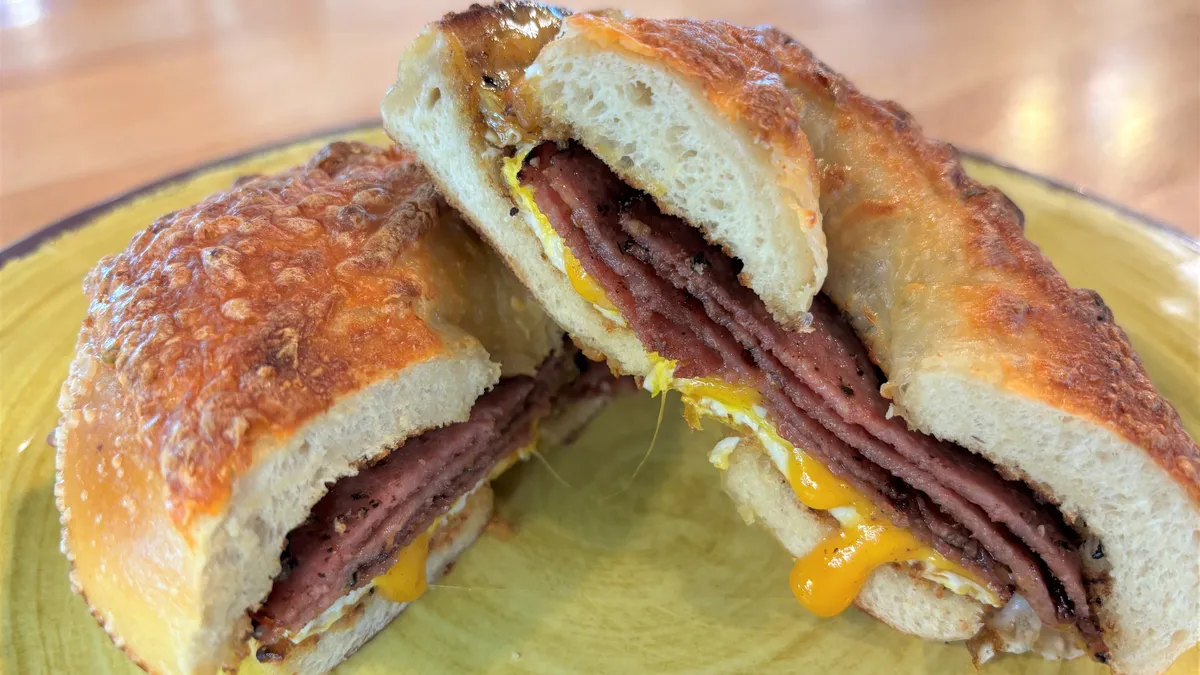
The bagel sandwich serves as his go-to illustration: a Jewish bakery product married to a deli meat tradition, often finished with a European-style condiment, yet instantly recognizable as its own American creation. The origins are legible; the result is something new.
“There’s so much connective tissue to a country of immigrants who have brought certain things, but also have taken certain things, shared certain things and merged them together to create these beautiful foods.”
From Viral Moment to National Staple
Ariel is candid about how quickly a dish can leap from obscurity to ubiquity — and how many never make that jump. Buffalo wings, he notes, were born in a family-run Italian restaurant when a mother’s son and his friends, tipsy one evening, tossed chicken wings into a pan with butter and Tabasco sauce. What started as a drunken experiment became a viral sensation and eventually a fixture on menus from coast to coast.
“That literally was invented by Italian immigrants, in the mom’s restaurant; her son and friends came up with it drunk one night. They took the wings, mixed it with butter, Tabasco, fried it up, created this thing that, at the time, became a viral sensation. Now it’s on every American food menu across the country.”
Not every internet-born creation survives that gauntlet. The cronut, Ariel observes, generated a brief frenzy but never calcified into a lasting icon. Nashville hot chicken, by contrast, sits what he calls “mid-loop” — past the novelty phase, not yet fully settled into the permanent canon, but clearly on a trajectory toward staying power.
Why the Registry Matters Beyond the Plate
State symbols — birds, flowers, rocks, mottos — have long served as low-stakes civic rituals, giving residents a shared point of pride and a small entry point into local history. A state dish adds a sensory, edible dimension to that tradition. For communities whose identity is woven through food culture, from Appalachian smokehouses to Pacific Island plate-lunch counters, formal recognition carries a weight that a state bird simply cannot match.
Ariel closes his interview with a note that frames the entire exercise as an act of cultural literacy rather than competition:
“I just think that’s a much more beautiful way to open your eyes, and your mouth, to the world around you.”
With voting open through November 1, the question facing every American is less about which dish tastes best and more about which one tells the truest story of home.
Related Reading
Frequently Asked Questions
What is Does your state dish reign supreme?
Does your state dish reign supreme is the main topic of this guide. The article explains the context, practical details, and next steps readers should understand.
Why does Does your state dish reign supreme matter?
Does your state dish reign supreme matters because readers are looking for a useful answer, not just a short summary. Good content should match search intent and help them decide what to do next.