Former NYPD pilot reveals unseen aerial photos of 9/11

Daftar Isi
Former NYPD Pilot’s 9/11 Images Offer a Rare View From Above
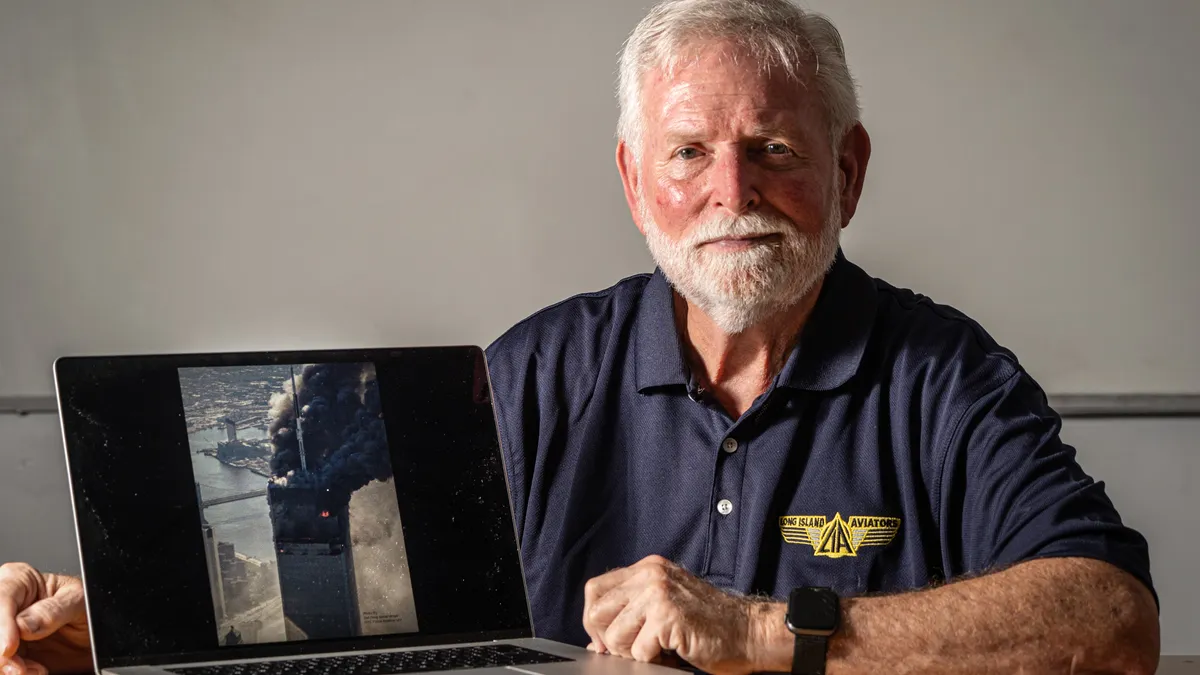
Cybersecarmor.com – Nearly a quarter-century after the attacks of Sept. 11, 2001, a collection of photographs taken from an NYPD helicopter is bringing fresh perspective to one of the most documented days in American history. The images were made by Greg Semendinger, then a New York City police detective and aviation-unit pilot, as the Twin Towers burned and ultimately fell.
Semendinger, now 77, retired from the NYPD Aviation Unit in 2002. He recently revisited the photographs at the Long Island airport where he works, moving through the images on his laptop while recounting the flight that placed him over Lower Manhattan during the attacks.
He had not been assigned as an official department photographer. Still, Semendinger routinely carried a camera to record rescue work performed by his squad, and one was aboard the helicopter on the morning of 9/11. That habit left him with an extraordinary visual record of events unfolding far below.
A clear morning turns into catastrophe
The first attack occurred at 8:46 a.m. on Sept. 11, 2001, when American Airlines Flight 11, a Boeing 767 carrying 92 people, struck the north tower of the World Trade Center. Five terrorists had hijacked the aircraft and flown it into the building between the 93rd and 99th floors.
Early reports suggested that a small private plane might have been involved. Semendinger, who was preparing police helicopters for daily operations at Floyd Bennett Field in Brooklyn, immediately doubted that explanation after looking toward Manhattan.
“I look at the towers and I see the amount of smoke coming from it,” Semendinger recalled. “And I said, ‘That does not look like a small plane.’”
The weather made the destruction especially visible. The late-summer sky was clear and blue, with no clouds obscuring the almost 1,400-foot towers. Semendinger and his partner, Jim Ciccone, took off over Brooklyn and arrived about eight minutes after the first impact.
As their helicopter approached the north tower, they saw the huge opening created by the jetliner and dark smoke flowing from the upper floors. They flew around the building in an L-shaped route, looking for anyone who might appear on the roof. A larger helicopter could potentially have attempted a rescue, although a rooftop landing was considered too dangerous. No one emerged.
The second strike confirms the attack
At 9:03 a.m., the south tower was struck by a second hijacked aircraft. Semendinger could not see the plane’s final approach because surrounding buildings blocked his view, and the helicopter’s engine and radio traffic masked the impact sound. But the explosion made clear that the first collision had not been an accident.
“Well, now we know it’s a terrorist attack,” Semendinger said. “And now we know that there are other planes that are a possibility of being in the area.”
His photographs capture the aftermath from a vantage point rarely available to people on the ground: burning towers, vast columns of smoke, and papers forced into the air by the violence of the second impact.
“This was taken right after the second plane hit,” he said while examining one image. “We saw the initial explosion, the explosion went away. But the papers that were blown out of the building was unbelievable. The compression from the second plane hitting was just tremendous.”
With both towers burning, Semendinger and Ciccone were directed away from Lower Manhattan to collect a commanding officer in the Bronx. They brought him to Floyd Bennett Field, then headed back toward the World Trade Center as the crisis deepened.
Witnessing the collapse from the air
The south tower collapsed at 9:59 a.m. while the officers were crossing Brooklyn’s Prospect Park. Semendinger recorded that first collapse from a distance, using a Canon digital camera. During the next stretch of the flight, he continued documenting the disaster as smoke and debris spread across Lower Manhattan.
Among the images are aerial views of the towers in flames and the moment the second tower disappears into an immense cascade of debris. A thick gray cloud rises and expands over the city, dramatically changing the skyline and covering streets below. The pictures underscore the scale of the event in a way that ground-level images cannot fully convey.
The photographs also reflect the uncertainty faced by emergency personnel that morning. The NYPD aviation crew was attempting to assess possible rescues while confronting an attack that was still unfolding. The danger did not end with the impacts; officials had to consider the possibility of additional aircraft and threats while coordinating rapidly changing emergency operations.
Some of Semendinger’s photographs have surfaced over the years. Others were used without his permission in books, while some appeared in news coverage in 2010. Several were displayed with his consent at the 9/11 museum at Ground Zero. Many more, however, remained outside public view until he shared his collection for anniversary coverage.
A personal archive with historical weight
For Semendinger, the pictures are not simply archival material. Each frame recalls a morning when routine aviation work became a mission in the middle of an unprecedented attack. His account adds another human layer to the historical record: a police pilot looking across a cloudless New York sky, recognizing almost immediately that the smoke rising from the north tower could not have come from a small aircraft.
The images preserve both the destruction and the urgency of the response. They show the Twin Towers during their final minutes, but they also document the perspective of first responders who were trying to determine what could still be done. Twenty-five years later, Semendinger’s aerial photographs remain a stark reminder of the speed with which the day changed New York City and the nation.
Related Reading
Frequently Asked Questions
What is Former NYPD pilot reveals unseen aerial?
Former NYPD pilot reveals unseen aerial is the main topic of this guide. The article explains the context, practical details, and next steps readers should understand.
Why does Former NYPD pilot reveals unseen aerial matter?
Former NYPD pilot reveals unseen aerial matters because readers are looking for a useful answer, not just a short summary. Good content should match search intent and help them decide what to do next.