Here are the 10 wealthiest suburbs in America

Daftar Isi
America’s Richest Suburbs: Where Household Income Tops Half a Million
Cybersecarmor.com – Across the United States, a handful of residential communities quietly command household incomes that dwarf the national average by multiples. A fresh analysis of suburban wealth, published on June 1 by personal-finance platform MoneyLion, places Scarsdale, New York, at the very top of the list, followed closely by West University Place in Houston, Texas. Together, these two enclaves represent the uppermost tier of American suburban affluence as measured by mean household income in the 2024 American Community Survey.
The survey’s findings reveal a striking geographic concentration. Eight of the ten most affluent suburbs fall within just three states — California, New York, and Texas — while the broader metropolitan anchors include New York City, Houston, Dallas, and San Francisco. In other words, the nation’s suburban wealth is not evenly distributed; it clusters in a small number of coastal and Gulf-corridor metro areas where high-earning industries, legacy wealth, and limited land supply converge.
How the Ranking Was Built
MoneyLion evaluated the 50 most affluent suburbs in the country using mean household income figures drawn from the 2024 American Community Survey. To qualify, a community had to contain at least 5,000 households and be classified as a suburb of a larger metropolitan center. This threshold excludes genuinely wealthy but very small communities — Kenilworth near Chicago and Chevy Chase near Washington, D.C., for instance, both fall below the 5,000-household cutoff and therefore do not appear in the rankings.
The choice of mean rather than median income carries significant methodological weight. Mean figures are pulled upward by ultra-high earners, so a suburb with a small number of multimillion-dollar households can rank far above one whose wealth is more broadly shared. By median income, a different picture emerges: a 2025 U.S. News analysis identified Sammamish, Washington, a Seattle-area suburb, as the wealthiest U.S. city, with a median household income of $238,750 — a figure far below the mean incomes reported for Scarsdale or West University Place.
The Top of the List
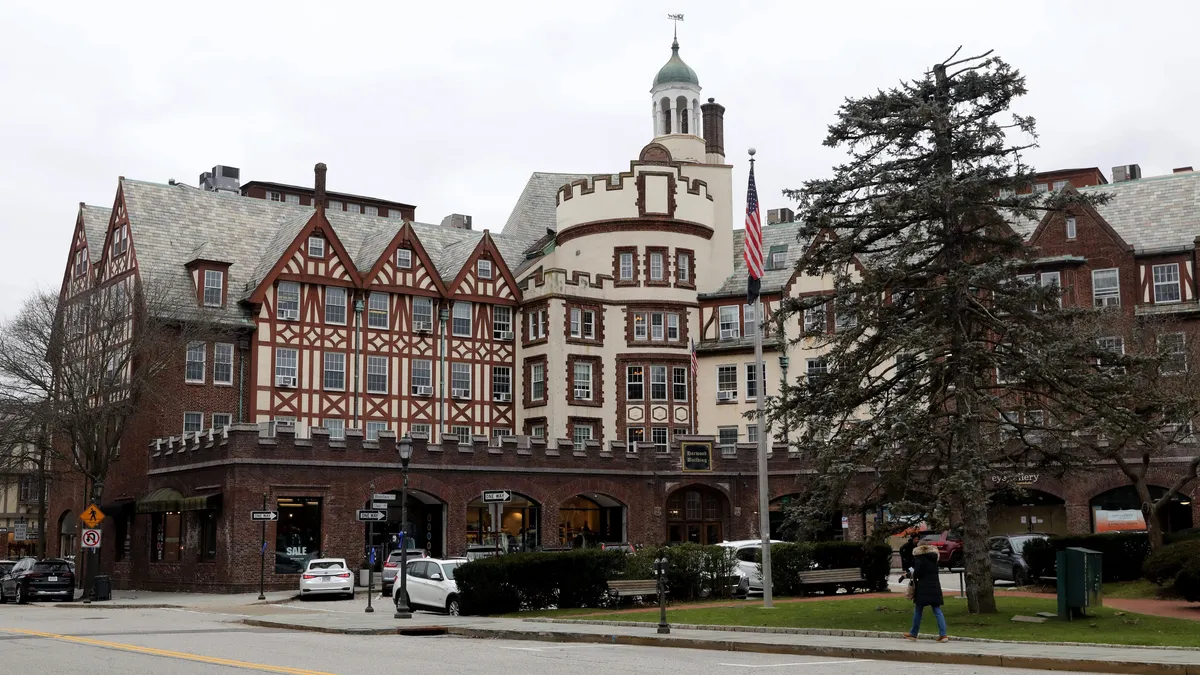
Scarsdale, a compact village tucked into Westchester County’s tree-lined landscape north of New York City, posted a mean household income of $612,591 in 2024, securing its position as the wealthiest suburb in the country. West University Place, a lesser-known Houston enclave, followed at $439,594. Rye, another Westchester community, slipped to third place with $428,806 — a drop from its second-place finish in the prior year’s ranking. Los Altos, California, a Silicon Valley suburb wedged between Stanford University and the Santa Cruz Mountains, rounded out the top four, where the average single-family home commands roughly $4.8 million.
What These Communities Share
Despite their geographic dispersion, the suburbs at the top of the list exhibit recurring physical and institutional traits. Many sit along coastlines, bays, rivers, or lakes. Several function as college towns or host major university campuses. A common spatial pattern places them at a comfortable distance from the nearest urban core — far enough to preserve a sense of separation, yet close enough to sustain a practical daily commute.
Rudri Patel, a certified financial expert at MoneyLion, explained the structural forces behind these communities’ wealth concentration in a June interview:
“You’re looking at better schools. You’re looking at a limited housing supply.”
That scarcity of buildable land, combined with demand from high-earning professionals, drives home prices to extraordinary levels. In Los Altos, the average listing price of $4.8 million reflects not just income but a land market where new construction is constrained by topography, zoning, and environmental protections.
The Affluence–Risk Corridor
Patel also flagged a less-discussed consequence of concentrated suburban wealth: heightened exposure to white-collar financial crime. Communities where large sums of money change hands regularly become targets for identity theft, wire fraud, and sophisticated scam operations.
“Where you see affluence, you also see risk of identity theft and wire fraud and the potential for scams.”
For residents of these high-income enclaves, that observation carries practical weight. Financial-planning conversations in such communities increasingly include identity-protection strategies, wire-transfer verification protocols, and estate-structuring advice alongside the more traditional portfolio-management topics.
Reading the Numbers Carefully
Anyone comparing their own community against these rankings should keep the methodological choices in mind. Mean-income rankings reward outliers; a single hedge-fund manager or tech executive can lift a suburb’s average well above what the typical household actually earns. Median-based rankings, by contrast, describe the experience of the middle household and tend to produce different leaders. Both lenses are valid; they simply answer different questions about where wealth lives and how broadly it is shared.
The broader takeaway from the 2024 data is that American suburban affluence remains intensely localized. A small number of communities — clustered around a handful of major metros — capture a disproportionate share of household income, while the vast majority of suburbs nationwide operate at a fraction of those figures. Understanding where that concentration sits, and why it persists, is essential context for anyone making decisions about where to live, work, or invest in the American suburban landscape.
Related Reading
Frequently Asked Questions
What is Here are the 10 wealthiest suburbs?
Here are the 10 wealthiest suburbs is the main topic of this guide. The article explains the context, practical details, and next steps readers should understand.
Why does Here are the 10 wealthiest suburbs matter?
Here are the 10 wealthiest suburbs matters because readers are looking for a useful answer, not just a short summary. Good content should match search intent and help them decide what to do next.