Maps capture the travel strain on USS Abraham Lincoln aircraft carrier

Daftar Isi
Two Thousand Miles from Home: How a Single Strike Reshaped Life Aboard the USS Abraham Lincoln
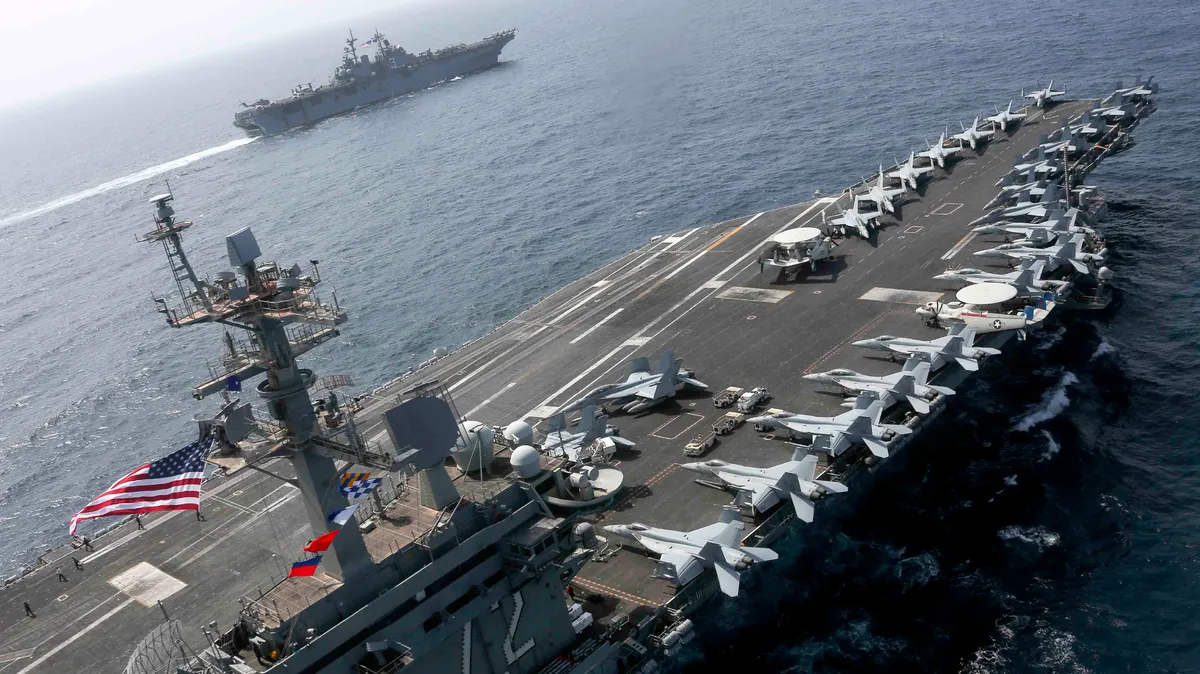
Cybersecarmor.com – The aircraft carrier USS Abraham Lincoln (CVN-72) has spent more than 260 consecutive days at sea without docking at a single port, a stretch that has drawn scrutiny over crew welfare, logistics strain, and the broader implications of a disrupted supply network in the Persian Gulf. The carrier, which has been away from port since December, currently operates as a floating airbase supporting aerial combat missions over the Arabian Sea under Operation Epic Fury, the American military campaign against Iran.
The root of the problem traces back to a single night. On February 28, at the outset of the war, Iranian forces struck Naval Support Activity Bahrain, a critical Navy logistics installation situated on the island of Bahrain in the Persian Gulf. The attack heavily damaged much of the facility, severing the primary resupply link for U.S. combat ships operating in the region.
A Logistics Gap Measured in Thousands of Miles
With Bahrain rendered inoperable, the Navy redirected its replenishment pipeline to Naval Support Facility Diego Garcia, a U.S.-operated installation on the British-controlled atoll of Diego Garcia, located south of the Maldives. The geographic consequence is stark: Diego Garcia sits roughly 2,100 miles from American naval forces deployed in the Gulf of Oman, whereas the former Bahrain base had been approximately 870 miles from the central Gulf. That additional distance has stretched every link in the supply chain between the logistics hub and the ships themselves.
The disruption also eliminated what the Navy designates a “liberty port” — a harbor where a vessel’s crew may disembark for personal time ashore. In practice, liberty-port visits allow sailors to rest, contact family members, pursue recreation, and receive resupply and repairs. Without one, the crew of the Abraham Lincoln has been confined to the ship for nearly nine months, a duration that exceeds most peacetime deployments and approaches the longest continuous sea periods recorded since World War II.
Crew Welfare Under Pressure
Family members of sailors assigned to the Abraham Lincoln have voiced growing alarm over what they describe as a deterioration in crew mental health. Food-related difficulties aboard the ship surfaced in April, adding a tangible dimension to the broader welfare concerns. Shortages of non-essential items and the loss of personal mail were subsequently confirmed by the Navy in an official statement.
The Navy acknowledged the logistical strain while framing its response in terms of operational triage:
“Leadership prioritized mission-critical supplies: first food, then hygiene items, then mail.”
The service added that crew members now have access to clean water and “healthy meal options,” signaling that the most acute deprivation has been addressed even as the underlying distance problem persists.
Political Fallout and Institutional Pushback
The situation has entered the congressional arena. Democratic Senators Jon Ossoff and Mark Kelly have publicly criticized the Trump administration’s handling of the crisis and called for a formal investigation into living conditions aboard the Abraham Lincoln. Republican members of Congress, by contrast, have largely maintained silence — neither endorsing the administration’s position nor joining the Democrats’ critique.
The Navy, U.S. Central Command, and War Secretary Pete Hegseth have collectively pushed back against what they characterize as exaggerated accounts of personnel hardship. In their framing, reports about conditions on the ship have been
“completely misrepresented.”
The tension between those two narratives — families and lawmakers describing a crew in distress versus the command structure insisting the situation is under control — underscores how contested the interpretation of wartime logistics failures can become when they intersect with domestic politics.
Historical Context and the Question of Duration
Extended periods without shore leave are not unprecedented in Navy history. During World War II, many vessels operated for months without a port call. In the modern era, the closest parallel is the USS Dwight D. Eisenhower, which logged 206 days without a liberty-port visit during the pandemic disruptions of 2020. The Abraham Lincoln’s current streak of over 260 days surpasses that benchmark, placing it in rarefied territory for a peacetime-era carrier deployment.
The distinction matters because liberty-port visits are not merely a perk; they serve as the primary mechanism through which sailors decompress, maintain family bonds, and receive medical or dental care unavailable aboard ship. When that mechanism is removed for nearly a year, the cumulative psychological and physical toll becomes a matter of institutional concern, not just individual complaint.
Relief on the Horizon
The Abraham Lincoln is scheduled to be relieved by the USS George Washington (CVN-73), which will assume the carrier’s operational duties in the region. Once relieved, the Lincoln is expected to sail to its homeport of San Diego, California, where the crew will finally step ashore after an unbroken sea period that has made the ship a focal point of debate over wartime logistics, crew welfare, and the limits of projecting naval power from a base 2,100 miles away.
The episode raises a structural question for the Navy: how dependent is carrier-based power projection on a single, geographically vulnerable logistics node? The answer, as the Abraham Lincoln’s crew will know intimately, is that the dependency is total — and that a single strike can convert a routine resupply cycle into a nine-month ordeal at sea.
Related Reading
Frequently Asked Questions
What is Maps capture the travel strain on USS?
Maps capture the travel strain on USS is the main topic of this guide. The article explains the context, practical details, and next steps readers should understand.
Why does Maps capture the travel strain on USS matter?
Maps capture the travel strain on USS matters because readers are looking for a useful answer, not just a short summary. Good content should match search intent and help them decide what to do next.