Judge blocks Kennedy Center’s plan to add Trump’s name back on building

Daftar Isi
Federal Judge Stops Proposed Trump Inscription at Kennedy Center
Cybersecarmor.com – A federal judge has barred the John F. Kennedy Center for the Performing Arts from placing President Donald Trump’s name beneath the building’s exterior sign, finding that the proposed tribute conflicts with both federal law and an earlier court order.
U.S. District Judge Christopher Cooper issued the ruling Tuesday, Sept. 15, preventing the center from installing wording that would state the building was “renovated and restored by Donald J. Trump.” The decision extends a dispute over efforts by Trump-aligned Kennedy Center officials to associate the president’s name with the Washington arts institution.
“Simply put, Defendants cannot install memorials for President Trump or anyone or anything else at the Kennedy Center without Congress’s blessing,” Cooper wrote in his 22-page order. “The board resolution bucks a federal court order and a statute Congress enacted.”
Board Removes Inscription Vote From Agenda
The Kennedy Center’s board of trustees had been expected to select language for an inscription during its Tuesday meeting. Federal government lawyers told the court late Monday, however, that the item had been removed from the September agenda.
A draft resolution prepared for board consideration contained 10 possible phrases intended to acknowledge Trump’s financial support for the center. Each would have appeared below the facility’s main exterior sign.
The proposal followed the board’s August vote to pursue an honorary inscription. Its draft language suggested that Trump would not oversee what it called a fiscal rescue from possible bankruptcy unless the center added recognition bearing his name.
At a court hearing Tuesday, Cooper questioned the legal premise behind that assertion. He pressed Justice Department attorneys on whether an entity structured as a trust, such as the Kennedy Center, could file for bankruptcy. The attorneys said they did not have an answer.
“Before throwing around these concepts, I would suggest knowing the answer to these questions,” Cooper said.
Dispute Follows Earlier Order on Kennedy Center Name
The latest order builds on Cooper’s ruling in May, when he directed the Kennedy Center to remove Trump’s name from its title, branding and signage. That earlier decision found that the board’s March action to rename the facility for Trump violated the 1964 federal law establishing the center as a memorial to President John F. Kennedy.
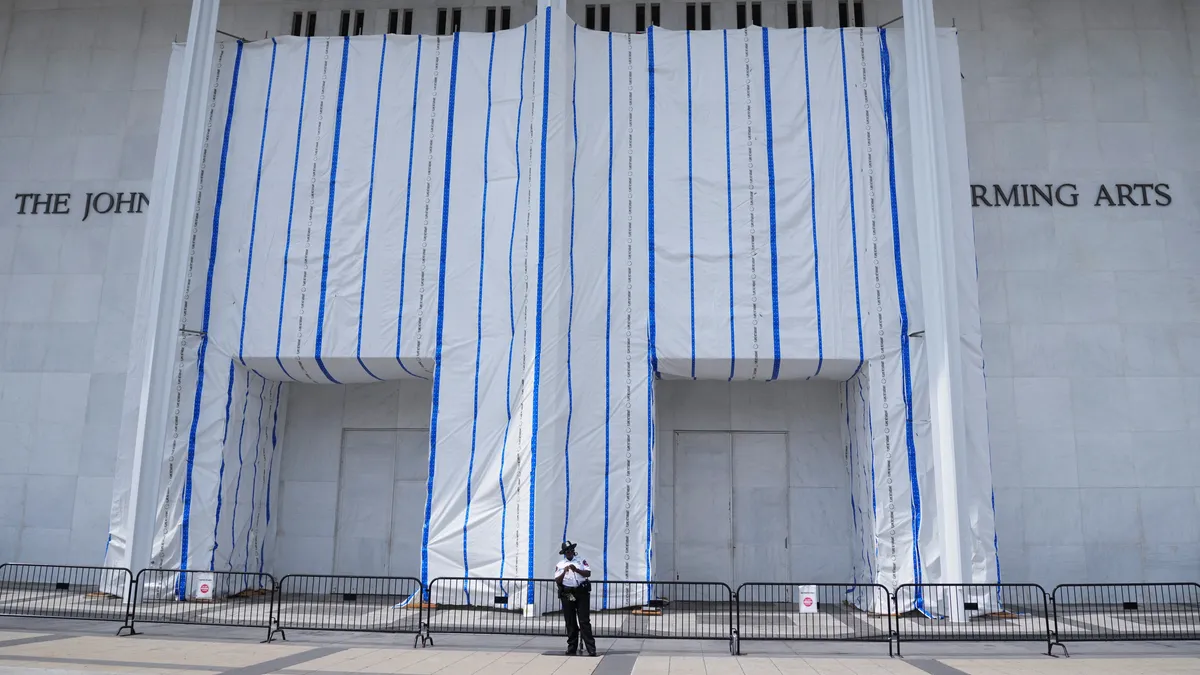
The Kennedy Center complied with the direction to take Trump’s name off the exterior sign on June 13, though the removal occurred hours after a court-imposed deadline. A large tarp was then left over the facade, obscuring the sign from public view. The covering remains in place.
Cooper’s May ruling also halted a March board vote that would have closed the center for two years for renovation work. He concluded that trustees lacked sufficient information when they approved the closure plan.
The case has therefore become about more than signage. It concerns how far the Kennedy Center’s board can go in changing the identity, public presentation and operations of an institution whose name and purpose are defined by federal law.
Renovation Plans Remain Before the Court
Although the inscription proposal has been set aside, the board still planned to vote Tuesday on shutting down most of the Kennedy Center immediately for a two-year renovation period. Whether such a closure can proceed remains subject to Cooper’s review.
The federal government has asked the judge to vacate his May order related to the proposed shutdown. Justice Department lawyers have argued that Cooper did not prohibit renovations themselves, but objected to the speed and lack of supporting information surrounding the board’s March vote.
Trump and Kennedy Center officials have cited findings by an outside consulting group that identified leaks and other building concerns as justification for a temporary closure. Cooper made clear during Tuesday’s hearing that his previous ruling does not prevent ordinary maintenance while the venue remains open.
That distinction is significant for the center’s operations. Routine upkeep can continue without waiting for a final decision on a broad shutdown, while a plan to close much of the institution for years requires further judicial consideration.
Congressional Authority Central to the Ruling
The Kennedy Center occupies a distinctive place among American cultural institutions. Created by Congress in 1964, it was established to honor Kennedy and serves as a national memorial alongside its role as a major venue for performances and arts programming.
Cooper’s decision emphasizes that this congressional foundation limits the board’s authority over commemorative changes. In the judge’s view, an inscription honoring Trump would function as a memorial and could not be added merely through a board resolution.
The ruling leaves the Kennedy Center without the proposed exterior reference to Trump while allowing the separate debate over maintenance and renovation to continue. The court’s next decisions will help determine whether the center can substantially curtail operations for construction and under what terms that work may move forward.
For now, the legal boundary is clear: the board cannot use an inscription on the Kennedy Center facade to honor Trump without authorization from Congress.
Related Reading
Frequently Asked Questions
What is Judge blocks Kennedy Center s plan?
Judge blocks Kennedy Center s plan is the main topic of this guide. The article explains the context, practical details, and next steps readers should understand.
Why does Judge blocks Kennedy Center s plan matter?
Judge blocks Kennedy Center s plan matters because readers are looking for a useful answer, not just a short summary. Good content should match search intent and help them decide what to do next.