Why one Senate Republican says ‘classic Mitch’ has returned

Daftar Isi
McConnell’s Return Eases Immediate Questions for Senate Republicans
Cybersecarmor.com – Senate Republicans are welcoming Mitch McConnell back at the Capitol after a difficult summer in which the longtime Kentucky senator’s absence complicated both the chamber’s daily rhythm and the party’s vote calculations.
McConnell, 84, returned after a June fall and a subsequent case of pneumonia kept him away from Washington for much of the summer. His absence came at a consequential point for Republicans, whose narrow margins can make the availability of every senator important when major legislation reaches the floor.
Now back at work, McConnell has been greeted publicly with encouragement from colleagues who say his focus remains fixed on the Senate’s institutional rules and on foreign policy priorities that have long defined his approach to governing.
“Classic Mitch” in a Senate Conversation
Sen. Thom Tillis of North Carolina, who has served alongside McConnell for more than a decade, described a recent conversation with the former Republican leader as immediately familiar. Tillis said he briefly asked about McConnell’s health before the discussion turned quickly to Senate procedure and international affairs.
“I spent 20 seconds asking him how he’s doing, and he goes right into preserving the filibuster, and who we have to look ahead to do it as we leave, and Ukraine,” Tillis said.
Tillis, who is also set to leave the Senate next year, said the exchange felt like “classic Mitch.” The comment reflected the issues that have remained central to McConnell even as he prepares to conclude a Senate career spanning more than four decades in January.
McConnell is not seeking another term. His departure will close one of the longest tenures in Senate history and mark the end of a period in which he became a defining Republican strategist in Congress, including through his years as party leader.
Back on the Floor After a Long Absence
On the evening of Sept. 14, McConnell made his return to the Senate chamber in a wheelchair. His hands showed visible bruising, but he struck a light tone with reporters, acknowledging that he had avoided their questions while away from Washington.
He said it was time to resume work and complete the remaining business before Congress. The Senate is scheduled to remain in session for two more weeks before a recess lasting more than a month, extending beyond the November midterm elections.
For Republicans, McConnell’s return has practical significance as well as symbolic value. In a closely divided Senate, illness or absence can alter the prospects for bills, nominations, and procedural votes. His return gives Republicans another experienced vote at a time when legislative scheduling remains demanding.
Focus on the Filibuster and Ukraine
McConnell’s conversation with Tillis highlighted two subjects likely to remain prominent in the final months of his Senate service: the filibuster and continued American support for Ukraine in its war against Russia.
He has consistently argued for retaining the filibuster, the Senate practice that generally requires 60 votes to advance legislation. Supporters view that threshold as a tool that encourages bipartisan negotiation, while critics say it can prevent legislation backed by a simple majority from moving forward.
President Donald Trump has pushed for ending the filibuster, placing McConnell’s position at odds with a key demand from the White House. McConnell has maintained that the rule serves as an important protection for the Senate’s distinctive role and can restrain abrupt policy shifts when political control changes.
Ukraine has also been a longstanding priority for McConnell. He has advocated continued U.S. military and diplomatic backing for Kyiv as it confronts Russia’s invasion. His stance has made him one of the most prominent Republican voices in favor of sustained assistance, even as the party has debated the scope and duration of American involvement overseas.
Questions Over a Committee Vote
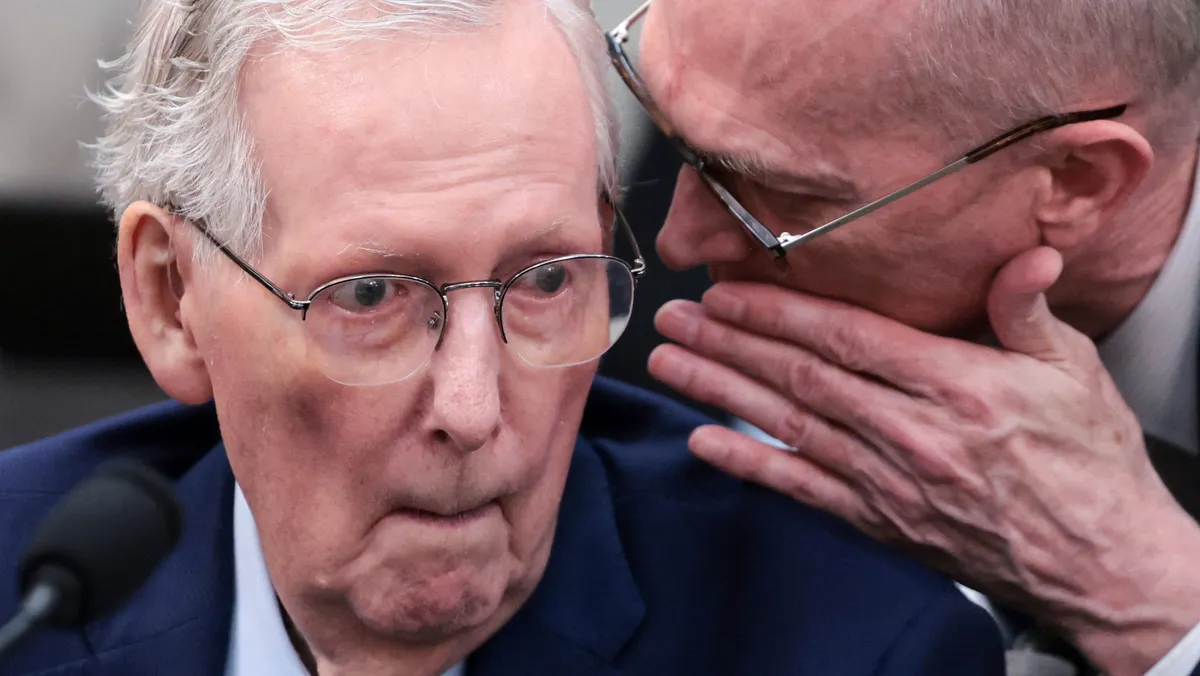
McConnell’s return also drew intense attention online after a Senate Agriculture Committee meeting on the farm bill. Some viewers questioned whether he had cast the wrong vote after Sen. John Hoeven of North Dakota leaned toward him and spoke following McConnell’s “yes” vote.
Hoeven said there was no correction involved. He explained that he had been uncertain himself whether the panel was taking a procedural vote or voting on final committee approval of the measure.
“He voted, and he voted correctly,” Hoeven said. “He was there. He was present. He got it right.”
The episode underscored how closely McConnell’s appearances are being watched after his health-related absence. Republican colleagues, however, have emphasized that they are pleased to see him resume Senate duties.
Sen. Rand Paul, McConnell’s fellow Kentucky senator, said he had not yet encountered him since his return but welcomed the improvement.
“I haven’t had a chance to run into him,” Paul said. “But I’m glad he’s back and glad he’s doing better.”
With his retirement approaching, McConnell’s return offers him an opportunity to take part in the Senate’s remaining work while continuing to press the issues he considers central to the institution’s future. For his colleagues, the immediate message is that a familiar presence has returned to the chamber—one still focused on the rules, alliances, and political battles that have shaped his career.
Related Reading
Frequently Asked Questions
What is Why one Senate Republican says classic?
Why one Senate Republican says classic is the main topic of this guide. The article explains the context, practical details, and next steps readers should understand.
Why does Why one Senate Republican says classic matter?
Why one Senate Republican says classic matters because readers are looking for a useful answer, not just a short summary. Good content should match search intent and help them decide what to do next.