Trump signs order to rename Lake Ontario as Lake America

Daftar Isi
Executive Order Renames Lake Ontario to Lake America as U.S.-Canada Trade Clash Intensifies
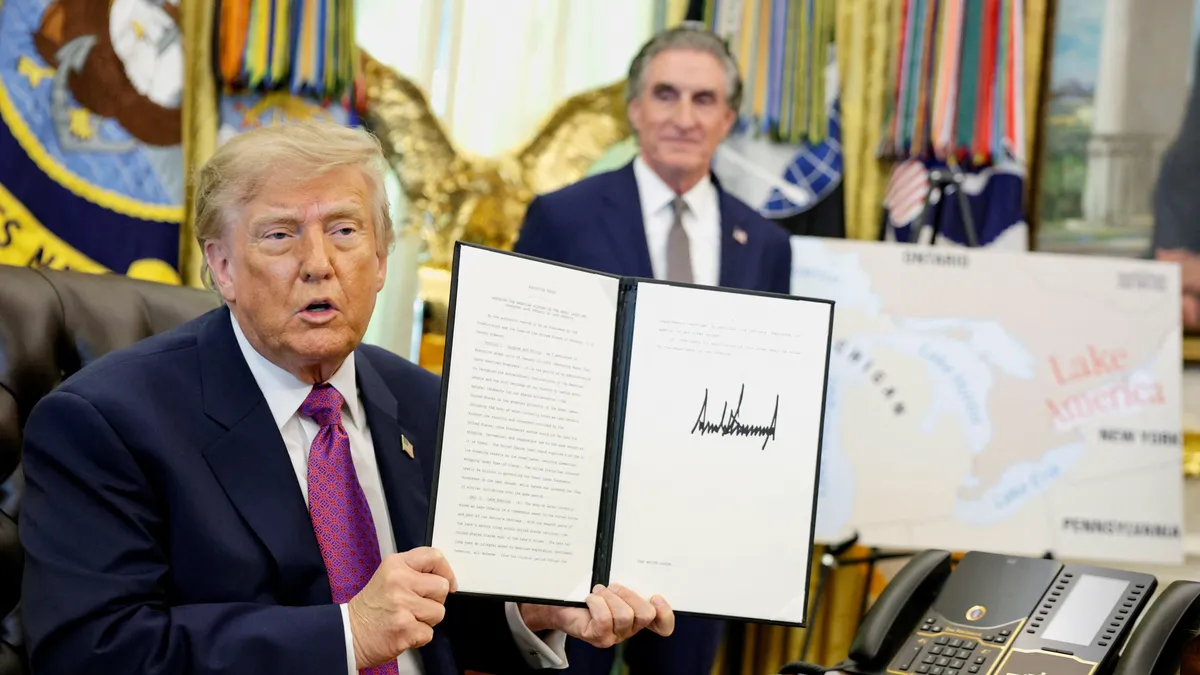
Cybersecarmor.com – In a move that blends domestic symbolism with escalating cross-border friction, President Donald Trump signed an executive order on August 27 directing federal agencies to replace the name “Lake Ontario” with “Lake America.” The action, carried out in the Oval Office, came days after trade negotiations between Washington and Ottawa collapsed and both sides imposed sweeping new tariffs on each other’s goods. The renaming follows a similar rebranding Trump executed last year when he declared the Gulf of Mexico the “Gulf of America.”
The Signing and the President’s Rationale
As Trump took the pen, a posterboard displaying a map of the Great Lakes alongside the slogan “Making the Great Lakes Greater” stood on an easel beside the desk. White House staff secretary Ben Moss read aloud that the order ensures the “lake once known as Lake Ontario will from this day forward be known as Lake America.” Moss noted that although the lake borders Toronto — Canada’s largest city — the majority of its water volume and its deepest points fall within American territory.
“This will reflect that this is an American lake,” Moss said as he handed the president the order to sign.
Trump framed the gesture as part of a broader pattern of geographic rebranding. Comparing the lake rename to his earlier Gulf of Mexico action, he mused aloud about extending the practice further:
“If you think about it, we have a gulf and we have a lake, now all we need is an ocean. So maybe we’ll have to change the name of the Atlantic and/or the Pacific.”
Historical Roots of the Name
The designation “Ontario” traces back to the 17th century. It derives from the Iroquois word “Ontarí’io,” which translates roughly as “lake of shining waters,” according to the Center for Great Lakes Literacy. European explorers began inscribing the name on their charts as early as the 1660s, making it one of the oldest geographic labels in the region. The lake itself is the fourth-largest of the five Great Lakes, straddling the border between Ontario province and New York state, and serves as a critical waterway linking the St. Lawrence Seaway to the interior of North America.
The Trade War Backdrop
The renaming did not arrive in a vacuum. Last week, after bilateral trade talks broke down, Trump imposed 50 percent tariffs on a broad swath of Canadian imports. Prime Minister Mark Carney responded by levying tariffs between 15 and 50 percent on American exports. Trump has additionally threatened to double existing 25 percent duties on Canadian automobiles and auto parts to 50 percent, a step that would hit one of the most integrated manufacturing corridors in North America.
“The Canadian officials have treated us very badly. They’re nasty people,” Trump said, accusing Ottawa of imposing enormous tariffs on products from American farmers.
For readers unfamiliar with the stakes: the Great Lakes region supports roughly 40 million people and underpins industries ranging from freshwater shipping to hydroelectric generation. A sustained tariff war between the two largest economies on the continent could ripple through supply chains that have been tightly woven together since the 1994 North American Free Trade Agreement.
Burechanical Mechanics of a Federal Rename
Under the order, Interior Secretary Doug Burgum and the U.S. Board on Geographic Names are directed to update the Geographic Names Information System (GNIS) — the federal database that catalogs every officially recognized place name in the United States — to reflect the new designation. All agency maps, contracts, and official documents referencing the lake must be revised accordingly. The board, composed of representatives from multiple federal departments, ordinarily subjects name changes to a formal review process. That procedure was notably compressed during last year’s Gulf of Mexico rebrand, and the same expedited pathway appears to be in play here.
Ottawa’s Response and the Question of International Recognition
Carney addressed the renaming in a public statement shortly after the order was signed, insisting that Canadians will continue to call the water body Lake Ontario regardless of Washington’s decree.
“The name is more than 400 years old, predating both the Confederation of Canada and the Declaration of Independence of the United States of America,” Carney said. “We know that America is changing. Their trading relationships, their foreign policies, their national monuments, their hydronyms. Canadians also know that naming reality means calling it Lake Ontario – then, now and always.”
The broader international community is unlikely to adopt the new name. Despite last year’s Gulf of Mexico rebrand, Mexico and other nations continue to use the traditional designation in diplomatic correspondence, cartographic products, and media coverage. International hydrographic naming conventions, overseen by bodies such as the International Hydrographic Organization, generally require mutual agreement between riparian states before a shared water feature receives a new official name. Lake Ontario, as a transboundary waterway governed in part by the 1909 Boundary Waters Treaty and the International Joint Commission, sits squarely in that category.
Whether the rename will persist beyond the current administration, or whether it will be reversed by a future president, remains an open question. What is certain is that the episode has injected a new layer of cultural and diplomatic friction into an already volatile trade dispute, turning a geographic label into a flashpoint between two neighbors who share the longest international border on Earth.
Related Reading
Frequently Asked Questions
What is Trump signs order to rename Lake?
Trump signs order to rename Lake is the main topic of this guide. The article explains the context, practical details, and next steps readers should understand.
Why does Trump signs order to rename Lake matter?
Trump signs order to rename Lake matters because readers are looking for a useful answer, not just a short summary. Good content should match search intent and help them decide what to do next.