Huge heat dome is building over US. Here’s your forecast

Huge Heat Dome Builds Over U.S. – Updated Forecast for Summer’s Intense Weather
Cybersecarmor.com – A significant wave of extreme heat is set to sweep across more than half of the United States, arriving just in time for the second week of summer. This development marks the start of a widespread heat event that could challenge temperature records in several regions. The National Weather Service has already issued warnings, highlighting the potential for dangerous conditions as the heat intensifies.
Heat Wave Intensifies Ahead of Fourth of July Holiday
A prolonged heat wave is forming over the central regions of the country in the lead-up to the Fourth of July holiday, expanding from the Great Plains to the Midwest and even extending into the eastern states. According to AccuWeather meteorologist Alex Sosnowski, the system is expected to create a multiday stretch of oppressive heat, with temperatures climbing to historically high levels.
“A multiday heat wave is brewing across the middle of the nation ahead of the Fourth of July weekend, expanding from the Plains to the Midwest and even nosing into the East,” said Alex Sosnowski in an online forecast.
The upcoming heat event could bring the most extensive 90-degree weather so far this year to central and eastern regions, as reported by AccuWeather. NOAA’s Weather Prediction Center confirmed that the weekend will be dominated by above-average temperatures, driven by a strong upper-level ridge of high pressure—a phenomenon commonly referred to as a heat dome.
Temperatures are projected to reach the 90s in the Great Lakes and Minnesota, while much of Texas could experience 100-degree heat. In areas such as the mid-South and central Gulf Coast, heat indices may approach 110 degrees due to the combination of extreme heat and high dew points. These conditions will create a stifling environment, with humidity levels adding to the discomfort.
Overnight lows will also remain unusually warm, potentially setting new records for high minimum temperatures. This persistent warmth means that the heat will not only affect daytime temperatures but will also extend into nighttime hours, increasing the risk of heat-related illnesses for vulnerable populations.
Understanding the Heat Dome Phenomenon
Heat domes, or high-pressure ridges, are large atmospheric bulges that trap warm air beneath them, creating a stagnant, oven-like environment. These systems can span hundreds of miles and cause temperatures to rise 30 degrees above normal. According to Weather.com, the term describes “oppressive” high-pressure systems that push warm air toward the Earth’s surface and prevent it from escaping.
“The dome traps high-pressure air in one place, like the lid on a pot,” the website said. “These large zones of hot air result in a combination of blistering temperatures, devastating wildfires, and drought conditions.”
William Gallus, a meteorology professor at Iowa State University, explained that a heat dome occurs when a persistent high-pressure system blocks cooler air from moving in, leaving the region under its influence to endure prolonged heat. “The heat dome can stretch over several states and linger for days to weeks, leaving the people, crops, and animals below to suffer through stagnant, hot air,” Gallus stated in an article for The Conversation.
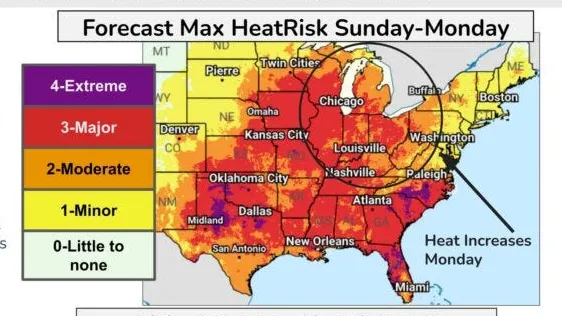
Such systems are not uncommon in summer but can have severe consequences when they intensify. They contribute to dangerous heat waves, which are often linked to increased mortality rates and agricultural stress. The current heat dome is expected to be particularly impactful, with its core centered over the Ohio Valley, Mississippi Valley, and Tennessee Valley in the coming days.
Heat Dome’s Regional Impact and Future Shifts
As the heat dome stabilizes, its center is anticipated to remain over the Ohio Valley, the middle Mississippi Valley, and the Tennessee Valley. AccuWeather’s Chad Merrill noted that the heat will occasionally spread outward, affecting areas such as the Great Lakes, Plains, and even the Gulf Coast. This movement could create a ripple effect, with sweltering conditions extending further than initially predicted.
“It will turn very hot and humid in the East by early next week (June 29-30),” said Chad Merrill. “Multiple days with highs well into the 90s are likely along the Interstate 95 corridor in the mid-Atlantic.”
While the central heat dome is expected to ease during the second week of July, temperatures will still remain a few degrees above historical averages in the Plains and Midwest. “The core of the heat should then shift into the West toward the middle of July,” Merrill added, indicating that the region will continue to feel the effects of this weather pattern for weeks.
During the heart of the heat dome, little to no thunderstorm activity is anticipated. However, the edges of the system may bring rounds of thunderstorms, particularly in the Plains, Upper Midwest, and Northeast. These storms could provide some relief but are likely to be severe, with damaging winds and heavy rainfall.
Climate scientists emphasize that heat domes are not isolated events but part of broader atmospheric patterns. Their formation is influenced by factors such as ocean currents, jet stream behavior, and global climate trends. As the summer progresses, the interplay between these systems will determine how long the heatwave persists and its overall impact on the U.S. climate.
Doyle Rice, a national correspondent for USA TODAY with expertise in weather and climate, has been tracking the development of this heat event. His analysis underscores the importance of preparedness, especially in regions where heat indices are expected to reach critical levels. As the heat dome strengthens, residents are advised to stay hydrated, limit outdoor exposure, and monitor weather updates closely.
With the heatwave set to intensify over the next few days, the U.S. will face a challenging summer. The combination of extreme temperatures and humidity will test the resilience of both natural ecosystems and human infrastructure. AccuWeather and NOAA are closely monitoring the situation, providing real-time updates to help communities adapt to the conditions.
As the heat dome lingers, its effects will be felt across multiple states, from the Midwest to the Southeast. The prolonged exposure to high temperatures may lead to increased energy demands, water shortages, and heightened risk of wildfires. This event serves as a reminder of the power of atmospheric systems and their ability to reshape weather patterns across vast regions.
In summary, the upcoming heat dome will bring record-breaking temperatures and oppressive humidity to much of the central and eastern United States. While the core of the system may eventually move westward, the region will remain under its influence for an extended period. Precautions are essential as the U.S. braces for one of the most intense summer heatwaves in recent history.