
General strike in Belgium against government reforms draws tens of thousands to the capital
General Strike in Belgium Against Government Reforms Draws Tens of Thousands to the Capital
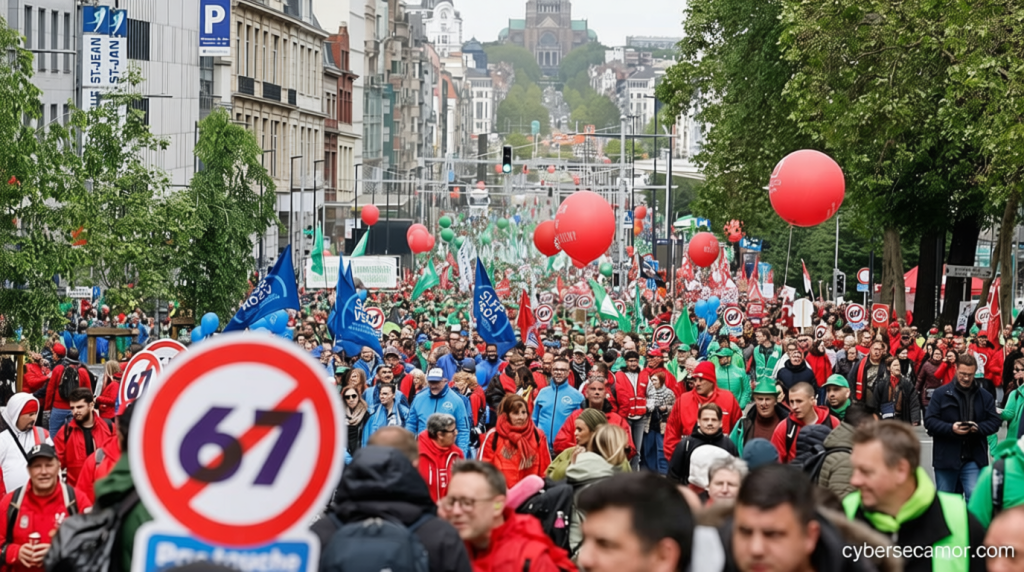
General strike in Belgium against government – On Tuesday, May 12, 2026, the streets of Brussels became a battleground for public dissent as between 40,000 and 70,000 participants took part in a nationwide strike. Organized by Belgium’s three primary labor unions, the protest was a direct response to the federal government’s recent policy changes, which union representatives have labeled as “anti-social.” The event marked the latest in a series of coordinated demonstrations targeting the ruling coalition, led by Prime Minister Bart De Wever, a prominent Flemish nationalist figure.
At the heart of the strike were three core concerns: pension restructuring, the erosion of purchasing power, and the suspension of automatic wage indexation. Workers’ representatives argued that the pension reforms disproportionately affected middle-aged and older employees, reducing their retirement benefits without adequate compensation. Meanwhile, the automatic indexation of wages—a long-standing mechanism tied to inflation—was criticized as a direct assault on workers’ financial stability. These grievances, combined with rising energy costs, fueled the public’s frustration and led to a significant turnout in Brussels.
Energy prices had surged dramatically in recent months, driven by the ongoing conflict in the Middle East. This economic strain, coupled with the government’s proposed reforms, has intensified the pressure on households and businesses alike. The strike, which unfolded across the country, saw public transport services scaled back to manage the disruption, with Charleroi Airport temporarily halting all flights for the day. This logistical challenge underscored the widespread impact of the protest, as commuters and travelers alike faced delays and cancellations.
The demonstration was not an isolated incident but part of a sustained campaign by labor unions against the De Wever-led government. Spanning over a year and a half, the initiative has aimed to challenge the coalition’s policies, particularly those perceived as undermining workers’ rights and social welfare. Unions have emphasized that the reforms represent a shift toward austerity, with public services and employee benefits taking the brunt of the cuts. This has sparked a growing movement among workers, who view the changes as a threat to their livelihoods and the broader social contract.
Brussels, the political heart of Belgium, served as the focal point for the strike. The city’s central square, Place de la Bourse, became a hub for protesters, with banners and placards demanding fair treatment. Among the most vocal participants were representatives from the three major unions, who called for immediate action to halt the reforms and negotiate better terms for workers. The crowd, composed of both union members and sympathetic citizens, expressed solidarity through chants and speeches, highlighting the national scale of the issue.
“The pension reform is a direct attack on the dignity of workers,” stated a spokesperson for the Confederation of Belgian Trade Unions. “By cutting benefits and reducing support, the government is creating a system that favors the wealthy while punishing the hardworking.”
Historically, Belgium has experienced periodic labor strikes, but the magnitude of this one surpassed previous efforts. The last demonstration, held on March 12, had attracted an estimated 80,000 to 100,000 participants, setting a precedent for public engagement. This time, the turnout was even larger, reflecting a deepening discontent among the populace. The strike’s timing also coincided with a critical period for the government, as it faced mounting pressure to address inflation and unemployment.
While the immediate cause of the strike was the pension and wage reforms, the underlying tensions revealed broader economic and political challenges. The government’s decision to introduce austerity measures was met with criticism for its failure to consult stakeholders adequately. Union leaders argued that the reforms, though framed as necessary for fiscal responsibility, overlooked the needs of ordinary citizens. This sentiment was echoed by many demonstrators, who cited rising living costs and stagnant wages as key factors in their decision to join the strike.
Public transport, a vital component of daily life in Belgium, was significantly impacted by the strike. Trains and buses operated at reduced frequencies, with many routes suspended entirely. This disruption not only inconvenienced commuters but also highlighted the extent to which the government’s policies affect everyday operations. Charleroi Airport’s decision to cancel all flights underscored the economic ripple effects of the protest, as businesses and travelers were left scrambling to adjust their schedules.
As the strike unfolded, it became a symbol of collective resistance against what many see as an increasingly rigid political agenda. The involvement of the three main unions—each with a distinct but overlapping set of interests—demonstrated a united front against the reforms. Their coordinated efforts had been instrumental in organizing the event, with logistical planning and grassroots mobilization playing a critical role in ensuring a large turnout.
Analysts noted that the strike’s success hinged on the ability of unions to galvanize public support. By linking the reforms to broader economic issues, such as energy prices and purchasing power, the unions framed the protest as a fight for national survival rather than a localized labor dispute. This strategic approach helped to broaden the movement’s appeal, drawing not only workers but also families and businesses that felt the impact of the policy changes.
Despite the scale of the demonstration, the government remained resolute in its stance. Officials defended the reforms as necessary steps to address the country’s financial challenges, emphasizing that they would help reduce the budget deficit and ensure long-term economic stability. However, critics warned that the measures risked deepening social inequality and eroding public trust in the ruling coalition.
As the strike concluded, its impact on the political landscape was expected to be significant. The pressure on the government to reconsider its policies was likely to grow, with union leaders poised to escalate their demands. The event also served as a reminder of the power of collective action in Belgium, where labor movements have historically played a key role in shaping national policy. With the public’s support and the unions’ organizational strength, the strike may mark a turning point in the ongoing debate over economic reform and social equity.

