Why Christopher Nolan’s ‘The Odyssey’ still has a women problem

Reassessing Gender Dynamics in Christopher Nolan’s Epic Adaptation
A Familiar Narrative with Promising Cast
Cybersecarmor.com – One man’s journey away from his homeland serves as the foundation for numerous Christopher Nolan productions. His latest endeavor, currently screening in cinemas, assembles an impressive roster of celebrated actresses. Zendaya, Anne Hathaway, Charlize Theron, and Lupita Nyong’o all feature prominently in this ambitious production.
Despite this stellar ensemble, the film encounters the same gender-related criticism that has followed Nolan throughout his career. The Bechdel test requires two female characters to engage in dialogue concerning matters beyond men. While Penelope, portrayed by Hathaway, does issue commands to her servant Melantho, played by Mia Goth, this interaction fails to satisfy the criteria. Throughout the entire three-hour runtime, no other female-to-female conversation occurs.
This outcome comes as no shock to viewers familiar with Nolan’s work. Over nearly three decades and thirteen feature films, the director has consistently avoided placing women at the center of his narratives. Nevertheless, the initial trailer and the remarkable cast list suggested a potential shift in his approach. Many anticipated a more balanced representation of female characters.
Women as Supporting Forces
The film does offer moments where female characters illuminate the suffering women endure because of men and their conflicts. Penelope and Circe, played by Samantha Morton, provide poignant commentary on this theme. However, the viewing experience left many hoping for greater realization of these actresses’ potential.
Nolan’s well-documented weakness involves underdeveloped female characters. Viewers recall “Oppenheimer,” where Emily Blunt portrayed a scientist whose profession was easily overlooked. His recurring “dead wife” narrative device has also drawn criticism for becoming predictable.
The title itself signals a male-centered story. Yet “The Odyssey” encompasses more than just Odysseus’s journey. Numerous women assist and obstruct his path home. Athena provides active guidance. Calypso imprisons him. Penelope demonstrates loyalty while governing Ithaca, cleverly delaying her suitors’ demands.
Standout Female Characters and Their Limitations
Several scenes highlight how women experience victimization under patriarchal systems. Nyong’o’s Helen protests her role as the war’s catalyst, despite being celebrated as the face that launched a thousand ships. Her sister Clytemnestra, also portrayed by Nyong’o, murders King Agamemnon, played by Benny Safdie, following his sacrifice of their daughter to gain divine favor.
Circe transformed Odysseus’s crew into pigs to reveal their true nature, motivated by fear of their treatment of her. In a notable departure from Homer’s original text, Odysseus’s passionate speech—not sexual relations—persuades her to reverse the transformation.
Penelope expresses concern that men will control her destiny, whether through her son or her numerous suitors. She responds sharply when Telemachus, played by Tom Holland, suggests she remarry to enable his kingship: “I’ve been sitting on that empty throne for 20 years,” she declares.
Agency and Representation
Hathaway shared with Entertainment Weekly that a friend who viewed the film believed “the women get blamed for everything in ‘The Odyssey'” while still appreciating Nolan’s interpretation. Calypso, played by Theron, chooses to release Odysseus out of genuine care rather than divine compulsion. This differs from Homer’s version, where Zeus compels her compliance. Their peaceful, lotus-filled existence contrasts with the original’s portrayal of Calypso holding Odysseus captive for sexual purposes. While Nolan doesn’t fully develop this character, he grants her more nuance and independence than his previous female roles.
Nevertheless, the film aligns with Nolan’s pattern of positioning women to advance male narratives. Nyong’o, despite portraying dual roles and enduring significant criticism regarding her casting, receives limited screen presence.
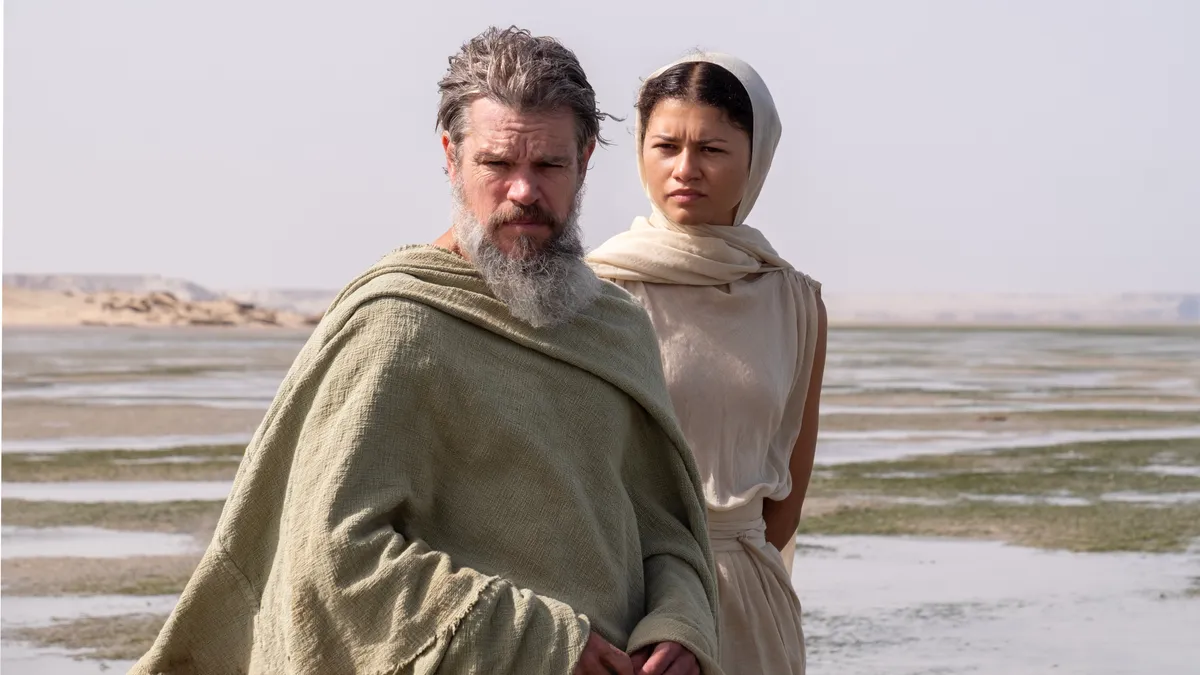
Zendaya’s ethereal Athena represents the sole divine figure visible in Nolan’s adaptation. The goddess and Odysseus share a mentor-mentee dynamic. Though she expresses displeasure at Troy’s destruction and provides guidance, Zendaya’s Athena primarily nods and offers comfort to Matt Damon’s Odysseus. This passive portrayal contrasts sharply with the goddess’s active role in Homer’s epic, where she petitioned Zeus directly for Odysseus’s return. Beyond the appeal of seeing Zendaya and Holland together, one might have wished for Athena to encourage Telemachus to confront the suitors, as she did in the original text. Nolan’s version prefers emphasizing male resilience over divine intervention.
It proves noteworthy that Nolan, frequently criticized for his female characterizations, specifically referenced Emily Wilson’s “Odyssey” translation before the film’s premiere. Wilson’s edition holds the distinction of being the first English translation authored by a woman, often described as “feminist” in its approach.