
Chinese carmakers double EU market share as EVs drive sales growth
EU Automotive Market Sees Sustained Expansion Amid Shift Toward Electric Vehicles
Chinese carmakers double EU market share – The European Union’s new car market continued its upward trajectory in the initial four months of 2026, with a total of 3.8 million vehicles registered—a 4.2% increase compared to the same period in 2025. This data, released by the European Automobile Manufacturers’ Association (ACEA) on Wednesday, highlights a broader transformation in the industry, driven by a surge in demand for electric and hybrid vehicles. The shift is evident as these powertrain types now dominate the market, with Chinese automakers playing an increasingly pivotal role in reshaping the competitive landscape.
“This trend underscores the growing influence of electric vehicles in the EU market,” noted ACEA in its report.
Rising Dominance of EVs and Hybrid Models
Electric and hybrid vehicles have become the primary drivers of sales growth, with battery-electric cars capturing 19.7% of the EU market in the first four months of 2026. This marks a notable jump from 15.3% in the same period the previous year, reflecting a rapid adoption of clean energy technologies. The momentum is particularly strong in the bloc’s top four markets: Italy, Spain, Germany, and France. Italy recorded the most significant gain, with a 25.5% rise in EV registrations, while Spain and Germany saw growth of 19.7% and 6.6%, respectively. France, though slower to adopt, still managed a 2.3% increase.
April alone witnessed a 37.7% surge in battery-electric vehicle sales, pushing their market share to 20.6% for the month. This growth was accompanied by a 12% rise in hybrid-electric vehicles, which retained their position as the most popular single powertrain type, accounting for approximately 36.9% of April’s sales. Plug-in hybrids also saw a notable 16.4% increase, capturing 9.8% of the market. In contrast, traditional fuel-based vehicles faced declining demand, with petrol cars dropping 16.3% to fewer than 218,500 units and diesel vehicles falling 17.1% to around 74,000 units. Together, these two segments represented less than 30% of the EU’s total sales in April, a sharp contrast to their earlier dominance.
Performance Variability Among Established Automakers
While the overall market expanded, the performance of major European brands showed mixed results. Volkswagen Group, the EU’s largest automaker, maintained its lead with a 26.7% market share, selling just over one million units—a 2.9% year-on-year increase. However, within the group, individual brands diverged. Skoda saw a 15.5% rise in registrations, and Audi reported an 8.6% growth. The core Volkswagen brand, however, experienced a 3.2% decline, struggling to keep pace with evolving consumer preferences.
Stellantis emerged as the second-largest player, securing a 17.1% share of the market with over 648,000 units sold. This growth was fueled by a remarkable 32% recovery at Fiat and a 22% increase in registrations for Opel and Vauxhall. Renault Group, on the other hand, lagged behind, recording a 7.4% decline to around 384,250 units. Dacia’s sharp drop of more than 15% further highlighted challenges for some segments of the company. Meanwhile, BMW Group and Mercedes-Benz posted modest gains of 3.9% and 3.8%, respectively, while Toyota and Hyundai Group both experienced declines of 2.5% to 3.1%.
Chinese Automakers Outpace Growth in EU Market
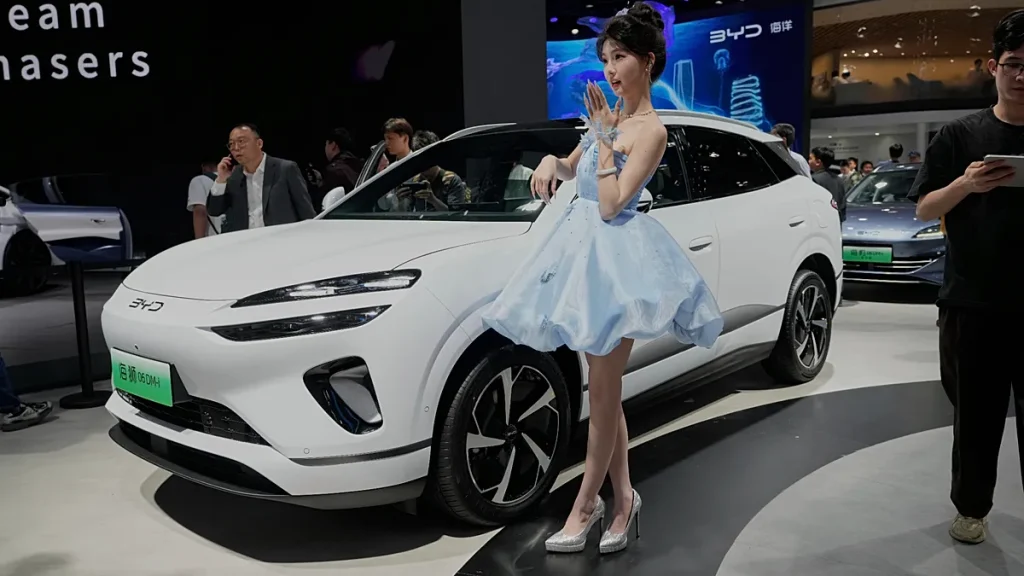
The most striking development in April’s data was the rapid expansion of Chinese carmakers in the EU. According to ACEA, BYD’s registrations in the region more than doubled year-on-year, surging 152.9% to exceed 71,850 units. This performance outpaced many established European brands, signaling a new era of global competition. Chery Automobile also demonstrated strong growth, with its Omoda, Jaecoo, and Jetour brands collectively rising by 267.1% to over 48,350 units. Leapmotor, leveraging its joint venture with Stellantis, saw an even more dramatic increase, growing 558.8% to surpass 28,700 units.
SAIC Motor, the largest Chinese automaker by volume in the EU, added 10.4% to its registrations, reaching more than 77,000 units. This growth underscores the strategic importance of the EU market for Chinese brands, which now hold a combined 6% share of registrations from January to April 2026—double their 3.2% share a year prior. Across the broader European market, including the UK and EFTA countries, Chinese brands accounted for a combined 7.3% share, up from 3.7% in 2025.
Strategic Moves and Market Impact
The surge of Chinese manufacturers is attributed to a combination of aggressive market strategies and favorable conditions in the EU. Government incentives, such as subsidies and tax breaks, have accelerated the transition to electric vehicles, creating opportunities for Chinese companies to capitalize on lower production costs and innovative designs. Additionally, the EU’s commitment to reducing carbon emissions has made electric mobility more attractive to consumers, further boosting demand for EVs.
Chinese brands have also benefited from the EU’s growing appetite for affordable, high-quality alternatives to traditional European models. Their presence has intensified competition, pushing domestic automakers to innovate and improve efficiency. This dynamic has not only expanded the market but also diversified consumer choices, leading to a more competitive pricing environment. As a result, the EU automotive industry is experiencing a paradigm shift, with Chinese players gaining traction in both the consumer and commercial sectors.
Broader Implications for the European Automotive Sector
The increasing influence of Chinese carmakers has prompted European automakers to reassess their strategies. With the EU market share of Chinese brands doubling in just a few months, the industry faces a new challenge in maintaining its foothold. Analysts suggest that the rise of Chinese EVs is a reflection of the continent’s shifting priorities, as environmental sustainability becomes a central factor in purchasing decisions.
Despite this growth, European brands are not without their strengths. Volkswagen’s leadership in the market remains a key indicator of its enduring relevance, while Stellantis and Renault continue to navigate the transition with varying degrees of success. The data also highlights the resilience of luxury segments, where BMW and Mercedes-Benz managed to maintain their positions. However, the decline of petrol and diesel vehicles suggests that the industry’s future will be increasingly defined by electric powertrains and hybrid technologies.
As the EU continues to prioritize green mobility, the role of Chinese automakers is expected to grow. Their ability to scale production rapidly and offer competitive pricing has positioned them as a formidable force in the region. For European manufacturers, this presents both a challenge and an opportunity to refine their offerings and align with the market’s evolving demands. The data from the first four months of 2026 serves as a clear indicator that the automotive industry is entering a new phase, with electric vehicles and Chinese brands at the forefront of this transformation.

