In Louisiana, a new voting rights fight takes shape as midterms loom

Daftar Isi
Louisiana Organizers Prepare for a New Battle Over Black Voting Power
Cybersecarmor.com – In Baton Rouge, activists are building a fresh voter-engagement effort after a Supreme Court ruling and a rapid redraw of Louisiana’s congressional map reshaped the political landscape ahead of the midterm elections.
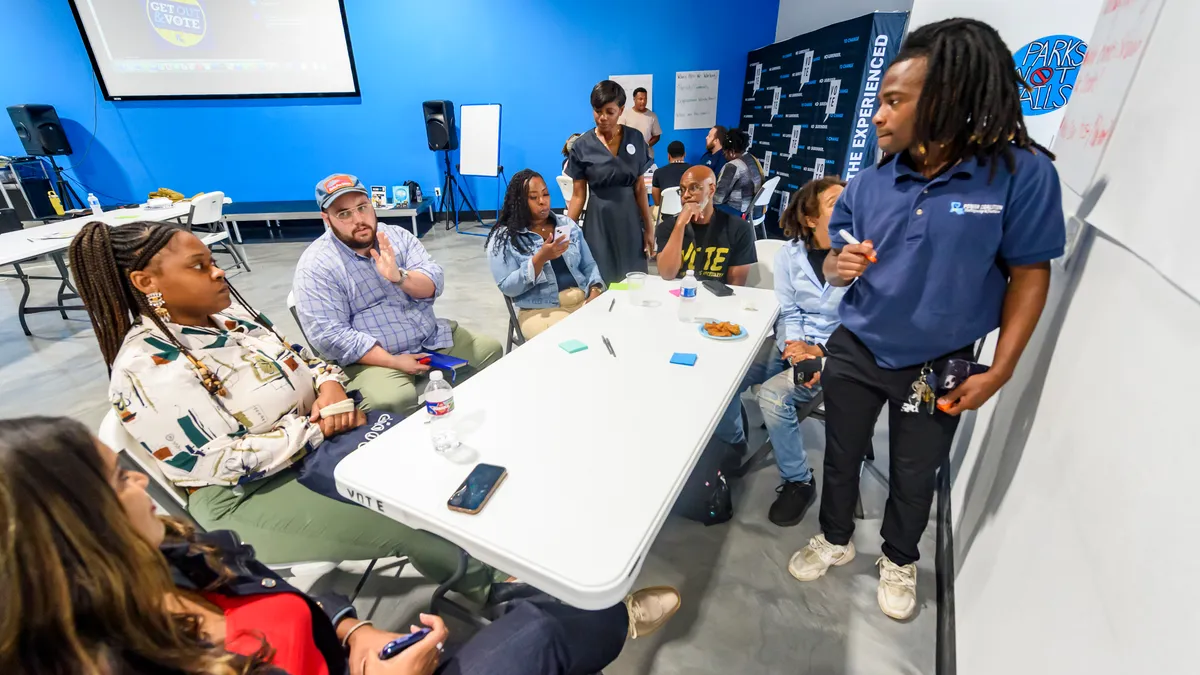
Laketa M. Smith calls the initiative “Reignite Louisiana.” It began quietly in an office conference room, where Black college students, nonprofit leaders, civic advocates and older community members were asked to put away their phones and focus on a candid discussion about their state’s future.
No photographs. No social-media posts. Smith wanted participants to speak freely and develop practical ideas. On a whiteboard, the group outlined possible goals: an economic agenda that could motivate residents to vote, clearer explanations of why participation matters, and accessible election materials for people who are deaf or blind.
The meeting followed the Supreme Court’s April 29 decision in Louisiana v. Callais, which invalidated the state’s voting map and weakened Section 2 of the Voting Rights Act. The ruling arrived at a consequential moment for Louisiana, where lawmakers soon acted to eliminate one of two majority-Black congressional districts.
The new map leaves Baton Rouge and Shreveport, two large cities with majority-Black populations, with reduced prospects for electing Black representatives to the U.S. House. For Smith and others involved in the organizing effort, the change is both a legal setback and a challenge to years of work aimed at expanding political representation.
A Regional Concern
Louisiana is not the only Southern state confronting concerns over maps and Black political influence. Alabama, Florida and Tennessee also moved quickly to adopt new district lines that critics say diminish Black voting strength. The developments have heightened anxiety among organizers who see hard-won civil-rights gains under renewed pressure.
After the Voting Rights Act was enacted in 1965, Black representation in Congress increased substantially. That history informs the urgency felt by organizers preparing for the first election cycle after the Louisiana v. Callais ruling.
“Our state needs us. Our legacy – our family – needs us,” Smith said.
Smith views the current moment as a continuation of a much longer struggle rather than a separate political dispute. Her family’s connection to the Civil Rights Movement gives that belief a deeply personal dimension.
“The movement has never been over. This is just round two. The blood of my ancestors says, ‘I have to do this work,’” she said.
Supporters of the Supreme Court decision have described their position as a defense of a “colorblind” constitutional approach, arguing that race-conscious treatment itself can be discriminatory. Louisiana Gov. Jeff Landry’s office, the Republican National Committee and state Republican leaders did not respond to requests for comment.
Woody Jenkins, a former state representative and chairman of the Republican Party of East Baton Rouge Parish, emphasized the importance of participation across political affiliations.
“Low voter turnout is one of our biggest problems in America today and especially in Louisiana. We applaud all efforts to inform and turn out voters Nov. 3, whether they be Republicans, Democrats, or no party voters. Voting is our right and obligation as Americans,” Jenkins said.
A Family History of Resistance
For Smith, organizing is rooted in family memory. Her great-uncle, Jerome “Big Duck” Smith, and great-aunt, Doratha “Dodie” Smith, were Freedom Riders. In 1961, they tried to integrate a Greyhound bus-station waiting room in McComb, Mississippi. They were pursued and beaten by a white mob, which shouted, “Kill ’em!”
Smith’s late mother, Fannie L. Johnson, was also an original plaintiff in a continuing class-action case against New Orleans involving the construction of a neighborhood on landfill. Those family experiences shaped Smith’s sense that community advocacy requires persistence across generations.
Her own nonprofit, A Bella LaFemme Society, grew from her professional experience in emergency management. The organization focuses on mental health, advocacy and disaster relief, connecting immediate community needs with broader civic participation.
“The work has to continue,” Smith said. “We’re all intertwined… We cannot sit this one out.”
Baton Rouge as a Political and Historical Setting
Baton Rouge carries visible reminders of the state’s history of racial conflict and division. Louisiana seceded from the United States in 1861, and the state Capitol includes statues of two Confederate generals who later served as governor. Smith considers the Capitol her favorite place in the city, even as its surroundings reflect unresolved questions about whose history and political power are recognized.
About 10 minutes southeast of Smith’s office lies St. George, a largely white and more affluent area that separated from Baton Rouge after a lengthy legal battle. The split has added another layer to local debates about municipal boundaries, resources and representation.
During a drive through Baton Rouge, Smith moved from strip malls and residential neighborhoods toward the city’s poorer, heavily Black northern area, where her mother was raised. At one intersection, she stopped to greet Second District Councilman Anthony Kenney Jr., whom she had helped elect when he was 27.
That encounter illustrated the kind of local, relationship-based organizing Smith hopes to expand. Her approach is not limited to a single election or court ruling. It relies on conversations, civic education and a belief that residents who understand how public decisions affect their lives are more likely to participate.
As Louisiana approaches Nov. 3, organizers face the task of turning concern over district changes into sustained engagement. “Reignite Louisiana” is intended to do more than increase turnout: it is an effort to connect voting rights, economic opportunity, accessibility and community history in a state where each remains central to the debate over political power.
Related Reading
Frequently Asked Questions
What is In Louisiana a new voting rights?
In Louisiana a new voting rights is the main topic of this guide. The article explains the context, practical details, and next steps readers should understand.
Why does In Louisiana a new voting rights matter?
In Louisiana a new voting rights matters because readers are looking for a useful answer, not just a short summary. Good content should match search intent and help them decide what to do next.