Supreme Court once again blocks Trump-backed House map in Missouri

Daftar Isi
Supreme Court Halts Use of Missouri’s Disputed Congressional Map for November
Cybersecarmor.com – The Supreme Court has again prevented Missouri from using a Republican-drawn congressional map in the November midterm elections, bringing an end to weeks of uncertainty over which district boundaries will govern the vote.
In an unsigned order issued Sept. 25, the justices suspended a lower-court decision that had directed Missouri to use the map sought by President Donald Trump and backed by state Republicans. The order contained no recorded dissents.
“Given this Court’s two prior orders in this litigation, our conclusion that this was error should come as no surprise,” the court wrote.
The immediate practical effect is that Missouri will not be required to replace its current election map after absentee ballots have already been distributed. The justices warned that implementing the contested map at this stage would create “electoral chaos.”
A fight with national consequences
The dispute carries importance beyond Missouri because control of Congress will be decided in the midterms. The Republican Party holds only a narrow House majority, making even a single competitive seat significant in the larger battle for control of the chamber.
The challenged Missouri map was designed to reshape a district held by Democrats in Kansas City. State lawmakers approved the plan last year, dividing that Democratic-held area in a way that gave Republicans an advantage in seven of Missouri’s eight congressional districts.
Trump’s effort to encourage Republican-led states to revise maps outside the usual redistricting timetable helped fuel the broader legal conflict. Redistricting normally follows the census, but the Missouri fight centered on whether the state could put a newly drawn congressional plan into effect without first receiving voter approval.
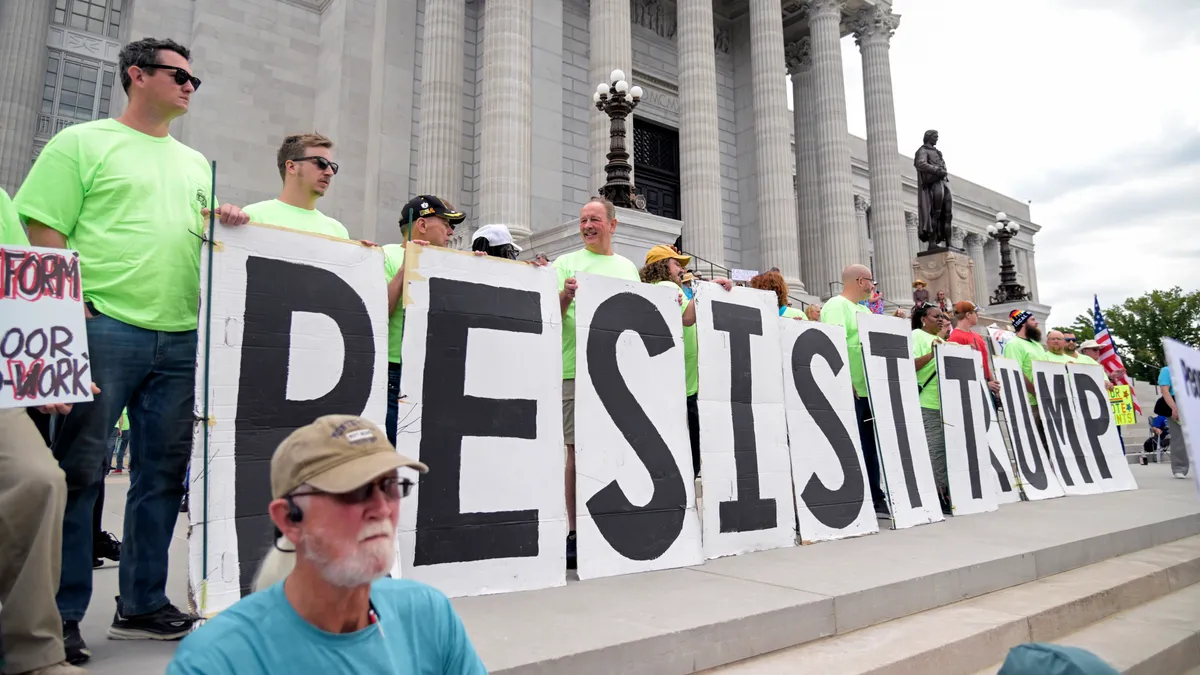
People Not Politicians, the organization formed to challenge the new boundaries, gathered enough signatures to place the changes before voters through a ballot measure. The group argued that Missourians should be allowed to decide the map’s future themselves.
Abha Khanna, an attorney representing opponents of the plan, said the Supreme Court’s latest intervention protects both already-cast ballots and voters’ ability to determine the map’s fate.
“However, we must not forget how far Republicans were willing to go to deny Missourians the right to vote under fair and lawful congressional maps, even if it meant disregarding court orders and throwing an election into chaos at the eleventh hour,” Khanna said.
State constitutional question led to a series of rulings
Missouri Secretary of State Denny Hoskins, a Republican, maintained that the state constitution does not permit ballot measures involving congressional redistricting. He issued that determination on Aug. 4, the day of Missouri’s primary election. The timing meant opponents could not obtain a court challenge to the ruling before the primary took place.
Early in September, the Missouri Supreme Court concluded that state law required voter approval before the new congressional map could be used. That ruling set off a rapid sequence of emergency appeals and conflicting judicial orders.
Justice Brett Kavanaugh, who handles emergency matters from Missouri, initially declined a request by state officials and the Republican Party for Supreme Court intervention. Hours later, though, a federal judge ruled in a separate Republican-backed lawsuit that the disputed map should be used.
The Supreme Court paused that federal ruling on Sept. 10. On Sept. 21, the St. Louis-based 8th U.S. Circuit Court of Appeals issued another order that revived the map for the general election, again placing Missouri election officials and voters in limbo.
The appeals court reasoned that the disputed boundaries should remain in place because they had already been used for the primary. Its judges said changing districts between the primary and general election could mean that some voters had greater influence than others over who would represent them in Congress.
“Some Missouri voters will have more say than others on who represents them in Congress,” the appeals court wrote, describing what it viewed as a constitutional concern.
The 8th Circuit noted that about one in four Missouri voters were assigned to different districts from the ones in which they cast primary ballots. Those voters did not participate in choosing party nominees for their current congressional district. The court emphasized that, in heavily partisan districts, the primary winner is often strongly favored in the general election.
It also concluded that restoring the Republican-backed map so close to Election Day could be accomplished without major expense, hardship, or voter confusion.
Election administration at the center of the case
People Not Politicians sharply disagreed with that assessment. The group said the appeals court’s action had generated uncertainty for election officials and voters alike, creating confusion about how the election should be conducted and about the legal rules that would govern the results.
The organization also argued that the Constitution does not guarantee a voter the ability to cast primary and general-election ballots within the same congressional district. In its view, preserving a legally valid election process and respecting Missouri’s voter-approval requirement outweighed the concern over changed district lines.
Missouri officials told the Supreme Court that no available outcome would permit a completely orderly election at this late date. Attorney General Catherine Hanaway argued on behalf of Hoskins that retaining the GOP-drawn map would better serve the public interest because voters needed stability after repeated changes.
“More than anything, Missouri voters need stability,” Hanaway wrote. “The Secretary respectfully believes that denying a stay − and declining to change Missouri’s congressional map for a fifth time − is the best way to promote stability.”
The Supreme Court ultimately reached the opposite conclusion on Sept. 25. By suspending the lower-court ruling, the justices left the disputed Republican map out of use for November and avoided another abrupt change after absentee voting had begun.
For Missouri voters, the decision settles the immediate question of which boundaries will apply in the general election. The longer conflict over congressional redistricting, voter approval, and the limits of late-stage election changes remains a defining issue in a contest where district lines could influence the balance of power in Washington.
Related Reading
Frequently Asked Questions
What is Supreme Court once again blocks Trump?
Supreme Court once again blocks Trump is the main topic of this guide. The article explains the context, practical details, and next steps readers should understand.
Why does Supreme Court once again blocks Trump matter?
Supreme Court once again blocks Trump matters because readers are looking for a useful answer, not just a short summary. Good content should match search intent and help them decide what to do next.