Kennedy Center closure and Trump’s overhaul, explained

Daftar Isi
Kennedy Center Faces Uncertain Future After Sudden Closure and Renovation Dispute
Cybersecarmor.com – The John F. Kennedy Center for the Performing Arts has become the focus of an escalating dispute over safety, renovation plans and the possibility of far more dramatic changes to one of Washington’s best-known cultural venues.
The center’s board voted Sept. 15 to close the main building, citing a need to address its condition. The decision came as President Donald Trump, who appointed himself chair of the institution early in his second term, has pressed for an extensive reconstruction project. Most members of the current board were selected by Trump.
Questions about the scale and timing of the plan have intensified since the closure. The administration has characterized the work as a major renovation that could require two years, while government attorneys later described the immediate shutdown as a seven-day measure to deal with safety concerns tied to deteriorating conditions.
What has closed — and what remains open
The board’s Sept. 15 action applies to the Kennedy Center’s primary building. The REACH, a newer and substantially smaller wing used for performances and community programming, remains open.
Trump said in a Truth Social post that the board had voted to shut the building because of safety concerns and to begin reconstruction preparations.
“to close the Building for Safety reasons, and so that it can begin the process of Reconstruction.”
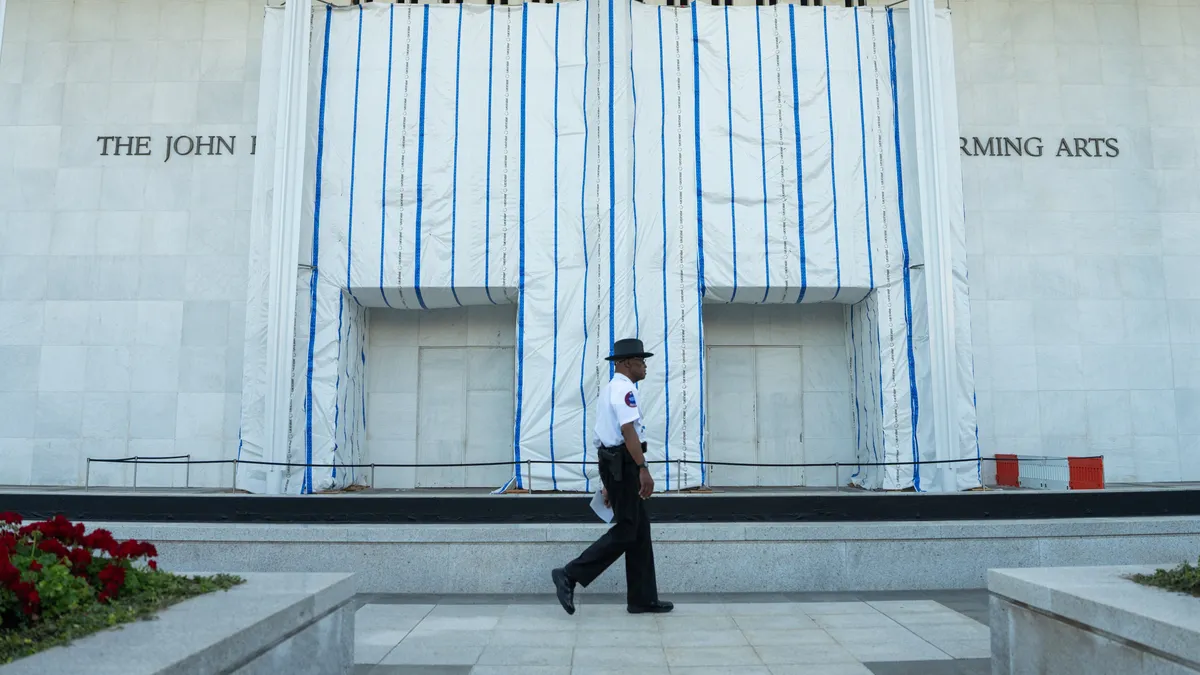
The closure has visible effects around the complex. Fencing was installed soon after the vote, and workers have been seen using forklifts and moving equipment in and around the property. The front entrance remains covered with scaffolding and a tarp, obscuring signage that includes the location where Trump’s name had been added and later ordered removed this year.
For audiences and arts organizations, the distinction between the main building and the REACH matters. The Kennedy Center is a major home for concerts, theater, dance and other events, and it also hosts prominent national programs including the Kennedy Center Honors and the Mark Twain Prize for American Humor. A long closure of the central facility could affect the venue’s role as a gathering place for performers, visitors and annual celebrations.
Why the duration of the closure matters
The central conflict is not simply whether repairs are needed, but whether the institution can remain closed long enough to complete the overhaul Trump has described.
Administration officials have said the building requires major renovations that could take two years. Yet a Sept. 17 filing by government lawyers presented a narrower explanation for the immediate closure, saying employees needed time to confront “acute risks to public safety resulting from continued structural deterioration at the Center.” The filing stated that the present closure would last seven days.
Any effort to turn the temporary shutdown into a prolonged closure would face a legal hurdle. U.S. District Judge Christopher Cooper earlier blocked a proposed two-year closure for renovation work. The government would need to ask the court to lift that order before an extended shutdown could proceed.
That means the next phase of the dispute may depend on how the administration defines the work, how long it seeks to close the building, and whether the court concludes that the proposal complies with existing restrictions.
Demolition concerns draw new scrutiny
Concern about the future of the Kennedy Center intensified after photographs taken Sept. 16 showed Trump aboard Air Force One reading a posterboard bearing the words “Kennedy Center DEMOLISHED” in large red letters. The images were taken through a window after the president arrived at Joint Base Andrews. The board appeared to include an image of the building.
Trump has said the center could need to be demolished if it does not receive substantial renovation work. That possibility has placed the closure under even closer examination, particularly because the Kennedy Center is a recognizable part of the capital’s cultural landscape and has long served as a national performing-arts institution.
On Sept. 17, Cooper ordered the Kennedy Center to give 30 days’ notice before starting demolition or other significant work affecting the main building. The notice requirement gives the court time to review the legality of a potential demolition effort or a major physical alteration before it begins.
The order does not settle the broader fight over renovations, but it creates a defined period in which proposed work can be challenged and examined. In practical terms, a demolition plan would not be able to move forward immediately without attracting judicial scrutiny.
Legal challenge questions the stated rationale
Rep. Joyce Beatty, D-Ohio, is the plaintiff in the federal case contesting attempts to close the Kennedy Center. After the temporary shutdown was announced, her legal team argued that the administration’s stated safety explanation should not be accepted at face value.
“Defendants’ rationale that they are only temporarily closing the Kennedy Center is a plain pretext to justify shutting down the Center permanently,”
Beatty’s challenge places the institution’s future before the federal court at a moment when competing descriptions of the closure are circulating. One account frames the shutdown as a limited response to immediate building-safety issues. Another anticipates a lengthy reconstruction process. The demolition-related imagery has added a third concern: whether the building itself could ultimately be replaced rather than renovated.
Trump has also connected renovation plans to his push to place his name on the center. He has said he will not pursue the project unless he can add his name back to the institution, though a federal court blocked that move. Efforts by the board to rename the center after Trump have generated public opposition and legal setbacks.
What comes next
The immediate question is whether the seven-day closure ends as described or becomes the first step toward a broader construction plan. Longer-term action would require further legal proceedings, and any demolition or major alteration to the main building must comply with Cooper’s 30-day notice order.
Until those questions are resolved, the Kennedy Center’s main building remains closed, its entrance covered and its future unsettled. The dispute now reaches beyond routine building maintenance: it concerns who controls one of the country’s most prominent arts institutions, how its physical home will be changed, and whether its traditional public role can continue during a period of political and legal conflict.
Related Reading
Frequently Asked Questions
What is Kennedy Center closure and Trump s overhaul?
Kennedy Center closure and Trump s overhaul is the main topic of this guide. The article explains the context, practical details, and next steps readers should understand.
Why does Kennedy Center closure and Trump s overhaul matter?
Kennedy Center closure and Trump s overhaul matters because readers are looking for a useful answer, not just a short summary. Good content should match search intent and help them decide what to do next.