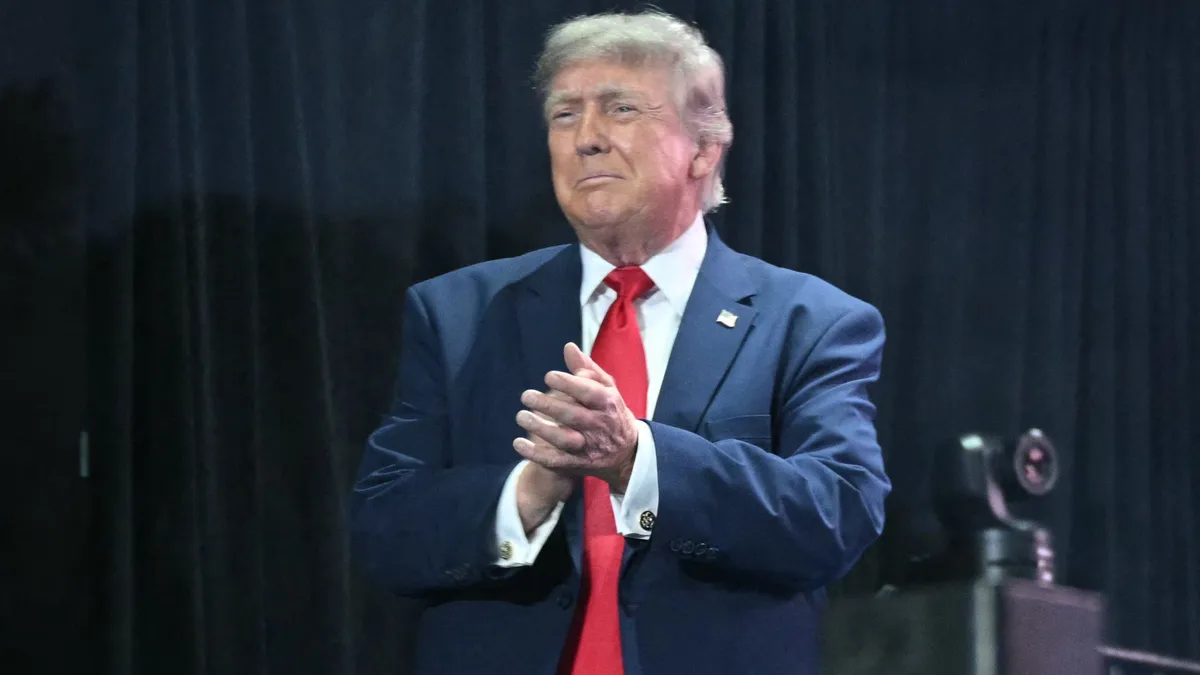
Republicans descend on Dallas in search of jolt at midterm convention


Daftar Isi
Republicans Gather in Dallas Seeking a Midterm Reset
Cybersecarmor.com – Republican leaders are bringing candidates, administration officials and their party’s most devoted supporters to Dallas on Sept. 9 for a two-day midterm convention aimed at reversing a campaign environment that has increasingly favored Democrats.
The event, held less than two months before the Nov. 3 election, is the party’s first convention focused specifically on a midterm cycle. Organizers are looking to President Donald Trump to energize MAGA voters, sharpen the party’s message and blunt fears of a Democratic surge in congressional contests across the country.
Party officials have labeled the gathering “Trumpapalozza,” placing Trump at the center of a program designed to promote his agenda, attack Democrats as “communists” and focus attention on races that could determine control of both chambers of Congress.
Senate map puts pressure on Republicans
Republicans currently hold a 53-47 advantage in the Senate, but Democrats need a net gain of four seats while defending their own seats in Georgia, Michigan and New Hampshire to capture the majority. What once appeared to be a favorable Senate map for Republicans has become far less certain as Democratic candidates have moved ahead in several competitive states.
Recent polling averages show Democrats leading in eight of the nine most closely watched Senate races. Their candidates hold advantages in North Carolina by 8 percentage points, Georgia by 7.5 points, Ohio by 2.6 points, Texas by 2.4 points, Maine and Michigan by 2.3 points each, New Hampshire by 2 points and Alaska by 2 points. Republicans maintain a narrow 1.8-point edge in Iowa.
Those margins have forced the GOP to defend territory that had previously been treated as reliably Republican. Close contests in Ohio, Alaska and Iowa have added to the party’s financial and strategic burden. Trump has said he expects to campaign in Alaska, a state that has historically voted Republican, during the final stretch of the election.
Election markets and forecasters have reflected the shift. Polymarket gave Democrats an 87% chance of taking the House and a 53% chance of winning the Senate as of Sept. 8. One year earlier, the market placed the Democratic chance of gaining Senate control at 28%.
Decision Desk HQ also put the Senate outcome at an even 50-50 on Sept. 8, after much of the previous year had treated Republicans as clear favorites to retain the chamber.
A narrow House majority is also at risk
The House is nearly evenly divided, with Republicans holding a 218-215 edge. Democrats need only three additional seats to take control, leaving little room for Republican losses in closely contested districts.
That arithmetic makes turnout especially important. Republican leaders hope that a high-profile convention and repeated appearances by Trump can turn general enthusiasm among his supporters into votes in House and Senate races that may otherwise receive less national attention.
The strategy carries risks as well. Trump remains influential with the party’s core voters, yet Democrats are working to link Republican candidates to public dissatisfaction with his handling of the economy and the war in Iran. The convention will give Republicans a major platform to define their argument, but it will also keep Trump closely associated with candidates trying to persuade independent and undecided voters.
“Republicans are in the process of having a bad year because people are unhappy about the economy and the war and some of the other things that the administration has done,” Republican strategist Charlie Black said. “So you got to give them some good news.”
Turnout gap becomes a central concern
Signs of stronger Democratic engagement have added urgency to the Dallas meeting. An Economist/YouGov poll released last month found that 91% of registered Democrats said they definitely planned to vote, compared with 79% of registered Republicans.
In that survey, voters preferred a generic Democratic congressional candidate over a Republican candidate by 46% to 40%. The Democratic advantage rose to 11 points among respondents who said they were certain to vote, suggesting that turnout could be as decisive as persuasion in November.
For Republicans, the convention represents an effort to close that enthusiasm gap before early voting and the campaign’s final weeks intensify. The party will seek to give voters a national reason to focus on local contests, while candidates will try to connect the broader message to the concerns of their own states and districts.
Trump takes the stage twice
Trump is scheduled to speak in prime time on both nights at the American Airlines Center. His appearances will compete for attention with the opening games of the NFL regular season, creating an additional challenge for a convention intended to dominate the political conversation.
Trump administration officials are also expected to address attendees, alongside Republican candidates running in the midterms. Not every candidate in a competitive race plans to appear. Some have chosen to skip the gathering, a sign that individual campaigns are making different calculations about how closely to associate themselves with the national party event.
“This is really just an attempt to provide a rallying point and a media focus for the Republican Party as it enters the home stretch for the the midterms, which are shaping up to be very difficult for the party,” said Calvin Jillson, a political science professor at Southern Methodist University. “And Democrats do seem to be energized.”
Dallas will not settle the midterm results, but it may reveal whether Republicans can create a more compelling closing message for voters who have not yet committed to participating. With control of the House potentially decided by only a handful of seats and the Senate map tightening, the party is entering its final campaign phase with little margin for error.
Related Reading
Frequently Asked Questions
What is Republicans descend on Dallas in search?
Republicans descend on Dallas in search is the main topic of this guide. The article explains the context, practical details, and next steps readers should understand.
Why does Republicans descend on Dallas in search matter?
Republicans descend on Dallas in search matters because readers are looking for a useful answer, not just a short summary. Good content should match search intent and help them decide what to do next.