US Open menu 2026: Food prices, Honey Deuce, caviar nuggets and more

Daftar Isi
The US Open’s Culinary Spectacle: What to Eat and Drink at the 2026 Billie Jean King Tennis Center
Cybersecarmor.com – Each late-August week, New York’s USTA campus transforms into something far more than a tennis venue. While the world’s top-ranked players battle for the final Grand Slam title on hard courts, a parallel spectacle unfolds along the concourses and food villages: a sprawling, high-concept culinary operation that draws as much attention as the matches themselves. The US Open’s food program has become an annual event unto its own, drawing loyal fans who plan their tournament attendance around specific dishes and cocktails as much as around particular matchups.
The scale of the operation is staggering. Walk any corridor inside the Billie Jean King Tennis Center and you will encounter vendor after vendor, each pushing a distinct flavor identity. The USTA has leaned into this reality openly. Last week, COO Daniel Zausner framed the culinary program not as a footnote to the sport but as its co-lead attraction.
“We all know that beyond the action on the courts, our fans’ number one attraction is the culinary experience, and this year is no exception,” Zausner said.
That framing is not marketing hyperbole. The tournament’s food and beverage revenue has grown into a major economic engine for the event, and the prices reflect that ambition. Admission and menu costs at the US Open have long drawn public scrutiny, yet attendance figures suggest the audience accepts the premium willingly. The question for fans this year is less whether to spend and more where to spend.
CQDQ: Caviar, Chicken, and a $100 Nugget
The venue’s most talked-about vendor returns with its viral signature item: the Golden Nuggets, a batch of chicken pieces crowned with Petrossian caviar and a dollop of crème fraîche. The price tag reads $100, and last year’s social-media frenzy around the dish has only intensified demand. For those who want savory without the caviar markup, CQDQ also fields a “Gangnam Style” chicken sandwich built on a buttered brioche bun, layered with coleslaw, Kewpie mayonnaise, and a soy-garlic sauce that gives the sandwich a distinctly Asian-adjacent profile.
After a plate of rich chicken, the natural next stop is Steph’s cookie, a dense, sugar-heavy confection combining brown butter, chocolate, and toffee in a single oversized bite. It is engineered to end a meal, not begin one.
KIMBOP: Korean Street Food Meets Grand Slam
A few steps from the main food village, a new entrant debuts this year: KIMBOP, a concept from restaurateur Simon Kim rooted in his mother’s home recipe for gimbap, the Korean rice-and-seaweed roll that many diners compare to sushi. Kim, whose creative instincts trace back to childhood memories in South Korea, designed the menu to feel personal yet globally accessible.
“I think the most important thing is I put myself in customer’s shoes. The US Open is once a year, it’s something that you wait for the entire year. Every year, I want to bring something new,” Kim told USA TODAY Sports. “I want to bring something personal that can be turned into something global.”
The KIMBOP lineup pairs fresh gimbap rolls with a Prime Beef Bulgogi and a vegetable-forward option called The Original. A Jambon Beurre sandwich and a Steph’s cookie round out the savory-sweet spread. On the beverage side, Kim introduces a non-alcoholic program headlined by “Finesse,” an energy drink, and “Dropshot,” a blend of matcha, pineapple, and ginger fortified with L-theanine and ginseng. The naming convention—tennis terminology applied to functional drinks—fits the venue’s playful tone.
The Honey Deuce: A $23 Institution
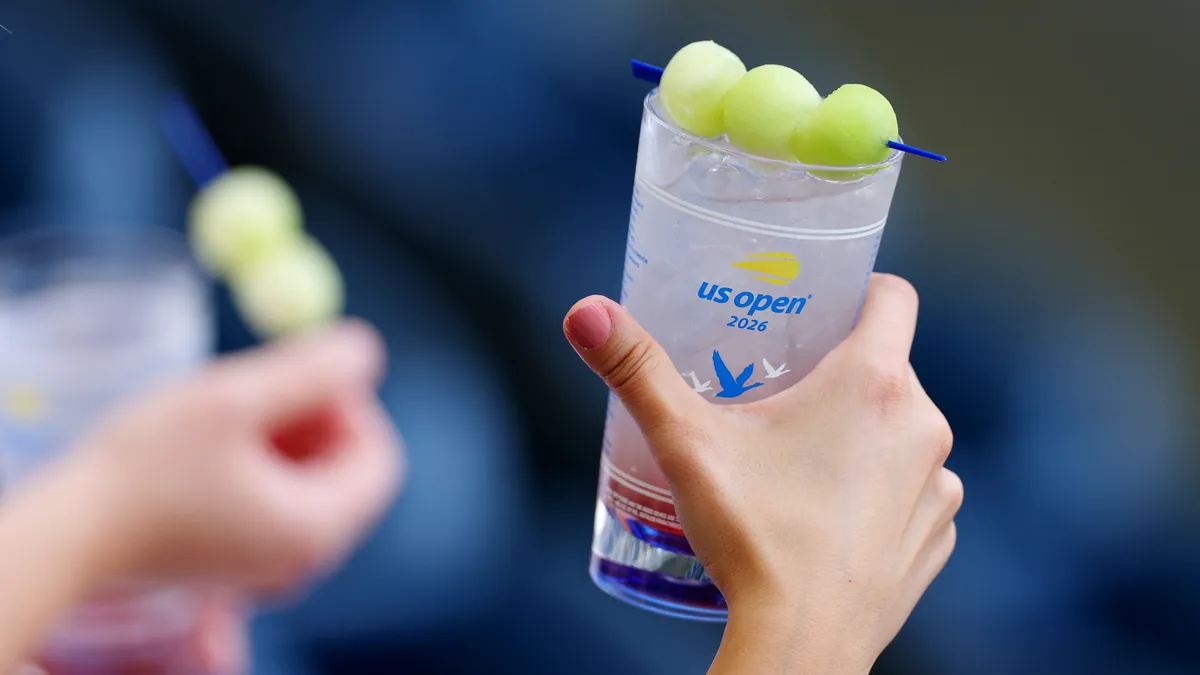
No discussion of US Open drinks is complete without the Honey Deuce, the tournament’s perennial best-seller. The cocktail muddles Grey Goose vodka, lemonade, and raspberry liqueur, then crowns the glass with three spheres of honeydew melon sculpted to mimic tennis balls. It returns this year at its established $23 price point.
The numbers behind the drink are remarkable. During last year’s tournament, vendors poured out nearly 740,000 Honey Deuces across the two-week event. That volume kept the concourses buzzing and, as the original coverage noted, kept law enforcement on heightened watch throughout the grounds.
Tequila, Champagne, and the Upper Echelons
For patrons seeking something sharper, the Dobel Tequila Club debuts the Organic Cucumber Slice, built on Dobel Tahona Tequila Blanco, cucumber juice, Supasawa, simple syrup, and elderflower liqueur. The drink leans herbal and crisp, a deliberate counterpoint to the sweeter cocktails elsewhere on the grounds.
At the top of the price ladder sits the Moët Serve: Ice Imperial Brut poured into a reimagined tennis-ball canister and garnished with three fresh lime slices. The presentation is theatrical, the cost commensurate, and the effect is less about flavor than about the photograph you will post afterward.
Heavier Fare: Ramen, Steak, and the $38 French Dip
Not every US Open meal is a cocktail or a cookie. Several vendors cater to diners who want a substantial plate.
pastaRAMEN, which also operates a location in Montclair, New Jersey, has expanded its tournament menu beyond the instant-noodle origins implied by its name. New entries include a teriyaki-inspired chicken katsu ramen, a piccata-flavored chicken katsu ramen, and a shrimp scampi ramen, each served with crispy rice. The house recommendation pairs the chicken teriyaki or shrimp scampi bowl with nori honey curly fries as a side.
Pat LaFrieda Meat Co. brings its signature steak sandwich au jus to the grounds: Black Angus beef, caramelized onions, and Monterey Jack cheese pressed into a toasted roll. Napkin quantity should be planned accordingly.
Salt Hank’s offers a single headline item that commands its own paragraph: the French Dip Sandwich at $38. The build stacks dry-aged prime rib, provolone, caramelized onions, and horseradish aioli inside a baguette. It is, by any reasonable measure, a meal unto itself.
Finally, Champions by Benjamin Steakhouse operates a full-service premium steakhouse experience within the complex. Its Porterhouse cut draws the most reservations, and the venue strongly advises guests to book ahead. Walk-in availability, if it exists at all, is uncertain, and the queue for an unreserved table can rival the wait for a court-side seat.
Planning Your Tournament Plate
The 2026 US Open food landscape rewards advance planning. High-demand items—the Golden Nuggets, the French Dip, the Champions Porterhouse—will sell out or face long waits on peak-match days. Non-alcoholic options like the Dropshot and Finesse give designated drivers a reason to linger. And the Honey Deuce, for all its ubiquity, remains the single easiest way to feel like you are participating in the tournament’s most communal ritual: raising a glass of raspberry-laced vodka while a rally unfolds two hundred yards away.
The courts will produce champions. The food villages will produce their own kind of legend. Both deserve your attention this September.
Related Reading
Frequently Asked Questions
What is US Open menu 2026?
US Open menu 2026 is the main topic of this guide. The article explains the context, practical details, and next steps readers should understand.
Why does US Open menu 2026 matter?
US Open menu 2026 matters because readers are looking for a useful answer, not just a short summary. Good content should match search intent and help them decide what to do next.