Fed chair impressed by US economy, still hopes to tame inflation

Daftar Isi
Warsh Tells Markets to Stop Looking Over His Shoulder as Inflation Remains the Fed’s Central Obsession
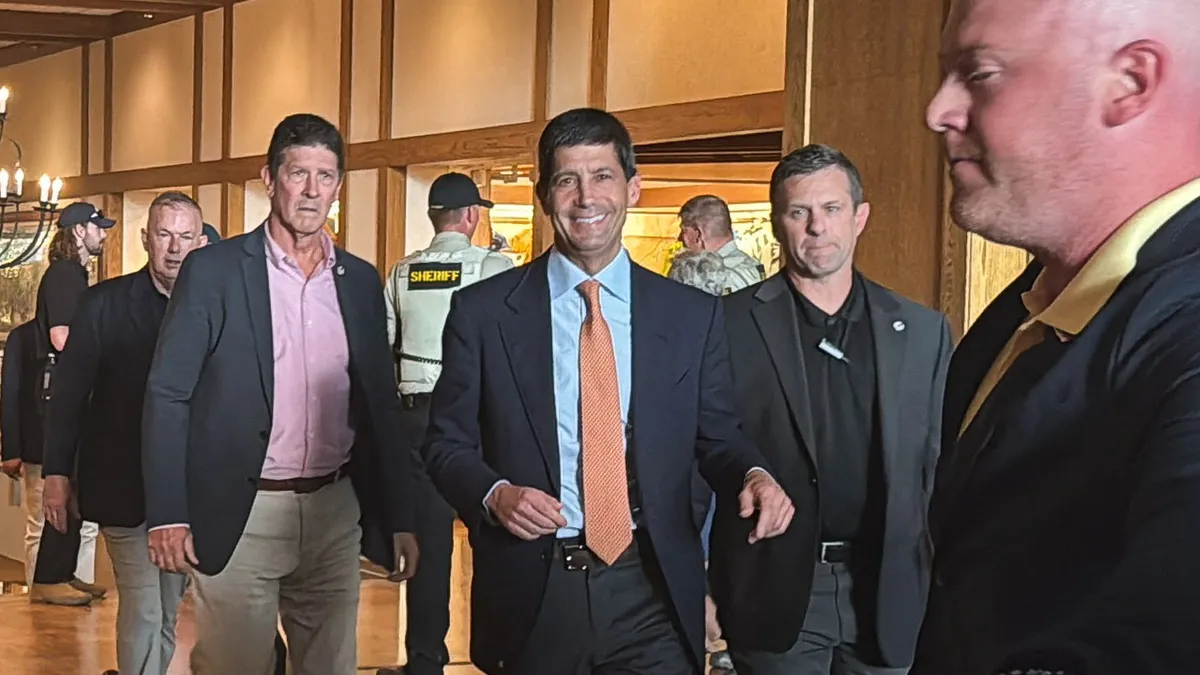
Cybersecarmor.com – Standing before the annual symposium crowd in Jackson Hole, Wyoming, Federal Reserve Chair Kevin Warsh delivered a message that cut sharply against the prevailing appetite for predictability: the economy’s most urgent problem is still prices, and the central bank will not telegraph its next move. Speaking on August 28, Warsh framed the current conjuncture as one in which inflation continues to run above target and the committee’s singular priority is pulling it back down.
The remarks came weeks after Warsh assumed the chairmanship in May, a transition during which he had been notably reticent about the trajectory of short-term borrowing costs. At Jackson Hole he confirmed that the federal funds rate — the benchmark that ripples through every mortgage, credit card, and corporate loan in the country — remains the Fed’s principal instrument for achieving both price stability and maximum employment. What he did not confirm, however, was any hint about where that rate will land next.
Rejecting the Forward-Guidance Playbook
Rather than offer a roadmap, Warsh mounted an explicit argument against the practice of forward guidance, the strategy in which the Fed signals its intended path of rate moves to anchor market expectations. He warned that a two-way dependency between the central bank and financial markets creates a dangerous feedback loop.
“If markets rely materially on the Fed’s guidance and the Fed relies on market prices, we’re more likely to be blinded to new developments,” Warsh said. “If the Fed gets inflation wrong and judges the economy wrong, who gets the worst of it? Not the financial high-fliers. Hardworking Americans are the ones left to deal with inflation that is too high or jobs that suddenly appear less secure.”
The framing was pointed. By naming ordinary households as the ultimate bearers of policy error, Warsh positioned the Fed’s opacity not as a mystery for its own sake but as a protective measure for people whose paychecks, rent, and grocery bills are most exposed to sustained price increases.
A Mixed-But-Positive Read on the Real Economy
On the growth side, Warsh struck a notably upbeat tone. He described the overall U.S. economy as having “strengthened,” called the labor market “quite stable,” and characterized consumer spending as “healthy.” A particular source of momentum he highlighted was the surge in business capital expenditures tied to artificial-intelligence infrastructure — data centers, chip fabrication, and the energy systems that power them.
He was careful, though, to flag a soft spot: recent graduates entering the workforce. Acknowledging that pockets of weakness persist, he nonetheless concluded that the aggregate picture was consistent with full employment.
“There are always areas of concern in the labor market. For example, among recent graduates,” Warsh said. “In general, though, people who want to work, by and large, are holding or finding jobs. They may well be concerned about future labor disruptions, but as of now, I believe the labor markets are broadly consistent with full employment.”
AI as a “Hinge Point” and the Questions the Fed Hasn’t Answered
Warsh’s remarks landed in the same week that Goldman Sachs Research published an estimate placing total U.S. investment in AI infrastructure at just under $600 billion for calendar year 2026. He seized on that figure to declare that the economy had arrived at “a hinge point in history,” with ever-expanding pools of capital flowing into AI-related buildout.
He then posed a series of open questions that, by his own admission, the Fed does not yet have answers to: whether AI will produce a significant and sustained lift in economy-wide productivity, and if so, on what timeline; whether token usage will complement or compete with human labor; and which sectors — AI labs, chipmakers, energy producers, cloud providers — will capture the largest share of the value created.
“Will the application of AI cause a significant, sustained rise in productivity across the economy? And if so, when?” Warsh asked. “Will token usage be complimentary or competitive to labor?”
Those questions, he noted, are being examined by one of five task forces he established at the Fed upon taking office, one of which is dedicated to productivity and jobs. The task force’s composition drew criticism during his July Senate confirmation testimony. Sen. Tina Smith, D-Minnesota, argued that Warsh had selected members “who are likely to get richer” because of the technology. Warsh responded that the group would “hear from folks that will be affected.”
“My early check-ins with the leaders of that task force, and the four others, have been encouraging,” Warsh said Aug. 28. “To be clear, though, their recommendations will come later and have no bearing on decisions we make in the current policy conjuncture.”
Market Reaction and the Rate-Setting Backdrop
The trading response to the speech appeared to align with what the Fed prefers: short-term rates ticked higher while long-term yields edged marginally lower. Larry Holzenthaler, a senior portfolio manager at Catalyst Funds, characterized the move as the market “reacting exactly the way the Fed wants,” and told investors to assume the committee will raise rates if conditions demand it.
The Federal Open Market Committee, which Warsh chairs, voted in July to hold the target range at 3.5% to 3.75%, extending the pause that has defined the year so far. A higher range translates into steeper interest charges on credit cards, auto loans, and personal borrowing, while savers see richer yields on high-yield accounts and certificates of deposit. A lower range reverses those effects.
The pause now sits against a backdrop of renewed trade friction with Canada and an ongoing military conflict in Iran — two developments that carry a clear risk of pushing import prices and energy costs higher, complicating the disinflation path Warsh described as the committee’s top priority. Whether the next FOMC meeting brings a hold, a hike, or a signal of patience remains, by Warsh’s own design, something the markets will have to figure out on their own.
Related Reading
Frequently Asked Questions
What is Fed chair impressed by US economy?
Fed chair impressed by US economy is the main topic of this guide. The article explains the context, practical details, and next steps readers should understand.
Why does Fed chair impressed by US economy matter?
Fed chair impressed by US economy matters because readers are looking for a useful answer, not just a short summary. Good content should match search intent and help them decide what to do next.