Chemical tank was deemed unsafe months before deadly Washington blast

Daftar Isi
Months of Warning Ignored Before Washington Paper Mill Tank Rupture Killed 11
Cybersecarmor.com – A federal safety investigation has revealed that a massive chemical storage tank at a Pacific Northwest paper mill was formally flagged as dangerously degraded roughly ten months before it ruptured and killed eleven workers. The finding, detailed in a report published on August 28 by the U.S. Chemical Safety and Hazard Investigation Board, points to a prolonged period during which a known structural weakness sat unaddressed inside an active industrial facility in Longview, Washington.
The incident occurred on May 26 at the Nippon Dynawave Packaging Company mill, situated approximately 45 miles north of Portland, Oregon, along the Cowlitz River corridor. What began as a routine morning shift at the facility ended in one of the deadliest industrial disasters in recent Washington state history.
The Inspection That Found a Failing Shell
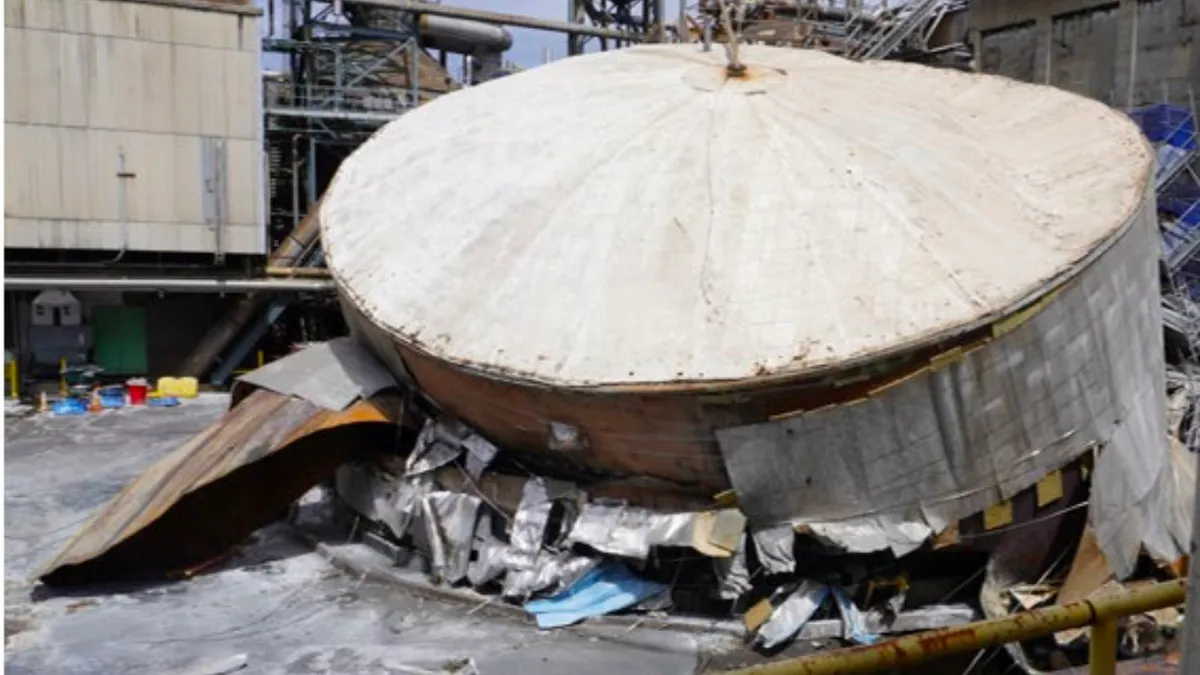
According to the board’s updated findings, an exterior inspection of the tank—designated “G Tank” in company records—was carried out in July 2025. That examination uncovered that substantial sections of the vessel’s carbon-steel shell had eroded below the calculated minimum safe thickness. Investigators concluded the tank was
“not fit for continued service and could fail.”
The report further states that, absent repair, there existed a
“high likelihood/consequence of failure.”
Despite those explicit warnings, the tank continued operating through the following months until it catastrophically ruptured. The gap between the inspection’s conclusions and the eventual explosion represents the central question now driving the ongoing federal inquiry.
What Happened at 7:09 a.m.
At 7:09 a.m. Pacific Time on May 26, the 1.2-million-gallon atmospheric storage tank gave way. At that moment, 17 employees occupied the ground level of the mill, seven maintenance workers and one foreman were inside the mechanical maintenance shop, eight additional maintenance personnel were in the electrical maintenance shop, and a single operator stood in the mill courtyard.
The rupture discharged roughly 900,000 gallons of what investigators described as
“extremely hot highly caustic white liquor.”
The released fluid generated what the board characterized as
“a massive wave of white liquor”
that rapidly inundated the courtyard and surged toward adjacent structures. The kinetic force of the moving liquid crushed parked vehicles, tore away a roll-up door on one of the surrounding buildings, and breached a wall. The caustic solution then penetrated the lower floors of those buildings through door seals—precisely where morning shift meetings were underway.
Human Toll
Eleven employees were killed. Three others sustained serious injuries, and five more suffered minor wounds. A firefighter responding to the scene was also hurt. Scott Goldstein, chief of Cowlitz 2 Fire & Rescue, described the spectrum of injuries as ranging from
“critical, severe to minor.”
Several workers and the injured firefighter were transported to local hospitals for treatment of chemical burns and trauma.
Company Response and Ongoing Inquiry
Nippon Dynawave Packaging Company spokesperson Sam Jefferies stated that the firm supports the board’s efforts to build
“a complete factual record that can help prevent future tragedies.”
In an emailed statement, Jefferies added that the company’s
“focus remains on supporting affected families and employees and taking the necessary steps toward fully reopening the Longview facility.”
He noted the company
“will carefully consider the update and all information developed as the investigation proceeds”
and would continue coordinating with the board and relevant regulatory authorities. Jefferies closed by saying,
“We believe the responsible course is to allow the full investigative process to proceed and establish a complete and accurate record before conclusions are reached.”
The federal agency emphasized that the August 28 document represents only an interim update. It remains actively working to determine the official root cause of the explosion, including why a tank already identified as structurally compromised was permitted to remain in operational service for an additional ten months.
Broader Implications for Industrial Tank Safety
The Longview disaster underscores a recurring vulnerability in aging industrial infrastructure: the interval between a formal inspection finding and the corrective action that follows. Atmospheric storage tanks holding caustic or otherwise hazardous process chemicals are common fixtures in pulp-and-paper operations, where white liquor—sodium hydroxide and sodium sulfide solutions used in the kraft pulping process—circulates at elevated temperatures and pressures. When such vessels lose wall thickness through corrosion, the margin between normal operating stress and structural failure narrows quickly.
The fact that the inspection explicitly quantified the thinning against a calculated minimum safe thickness, and that the language used in the report leaves little ambiguity about the tank’s condition, will likely draw scrutiny toward internal decision-making at the mill. Questions about who received the inspection results, what risk assessments followed, and why no shutdown or interim repair was ordered before May 26 are expected to feature prominently as the investigation moves toward its final determination.
For the eleven families affected and for the broader workforce in Washington’s paper and packaging sector, the report’s central finding—that the danger was identified, documented, and then left unaddressed—carries implications well beyond a single facility. It raises the question of how effectively existing inspection regimes translate written warnings into enforced operational changes, and whether additional regulatory teeth are needed to close the gap between a finding on paper and a tank taken out of service.
Related Reading
Frequently Asked Questions
What is Chemical tank was deemed unsafe months?
Chemical tank was deemed unsafe months is the main topic of this guide. The article explains the context, practical details, and next steps readers should understand.
Why does Chemical tank was deemed unsafe months matter?
Chemical tank was deemed unsafe months matters because readers are looking for a useful answer, not just a short summary. Good content should match search intent and help them decide what to do next.