Trump says he will meet this year with North Korea’s Kim Jong Un

Daftar Isi
Trump Confirms Plans for Second-Term Summit with Kim Jong Un, Signals Push to End North Korea’s Nuclear Program
Cybersecarmor.com – WASHINGTON, Aug. 19 — President Donald Trump confirmed on Tuesday that he intends to sit down face-to-face with North Korean leader Kim Jong Un before the calendar year ends, marking what would be the first bilateral summit of his second administration. The announcement carried a broader diplomatic signal: Trump is preparing to re-engage the stalled effort to persuade Pyongyang to dismantle its nuclear arsenal, a goal that consumed much of his first term without producing a final agreement.
A Personal Relationship as Diplomatic Leverage
Trump framed the upcoming encounter in terms of personal rapport rather than formal protocol. Asked by reporters whether he expected to meet Kim within the year, the president responded:
“Yeah, I will be.”
He went further, characterizing the bond between the two leaders as a strategic asset:
“The fact that I get along with him — that’s a good thing, not a bad thing.”
Trump then turned critical of the current state of affairs, noting that Kim now commands a substantial nuclear stockpile:
“He has 57 very powerful nuclear weapons. Should have never allowed it to happen. If I was president, I wouldn’t have allowed it to happen. But he’s got them.”
The president’s remarks underscore a recurring theme in his foreign-policy rhetoric: that personal chemistry between heads of state can substitute for traditional multilateral frameworks. Critics of the approach have long argued that informal summits conducted without preconditions risk rewarding proliferation rather than deterring it, while supporters contend that direct access to Kim shortens communication lines between two states that share one of the world’s most heavily fortified borders.
Scaling Back Joint Drills with Seoul
In tandem with the diplomatic overture, the Pentagon and South Korea’s defense ministry announced on Aug. 18 a significant reduction in annual joint military exercises. The combined training schedule will shrink from eleven days to five, with additional cuts to certain field-training components. The adjustment was made at Trump’s explicit direction.
This concession carries historical weight. North Korea has consistently demanded reductions in large-scale U.S.-South Korean drills as a precondition for meaningful nuclear talks, arguing that the exercises function as rehearsals for invasion. By trimming the schedule before any summit takes place, Trump is offering a tangible gesture of de-escalation — one that Pyongyang has sought for years.
The move also lands amid ongoing friction between Washington and Seoul over defense-cost sharing. Trump has repeatedly pressed South Korea to contribute more toward the expense of U.S. forces stationed on the peninsula, a pressure point that complicates the broader trilateral security architecture in Northeast Asia.
The First-Term Precedent
The planned encounter would be the fourth sitting between Trump and Kim. During his first term, the two leaders met three times — in Singapore in 2018, on the Korean demilitarized zone in 2019, and again in Hanoi later that year. Each summit was conducted without preconditions, a choice that drew sharp criticism from congressional hawks and allied governments who argued that Pyongyang should have demonstrated concrete denuclearization steps before earning a presidential audience.
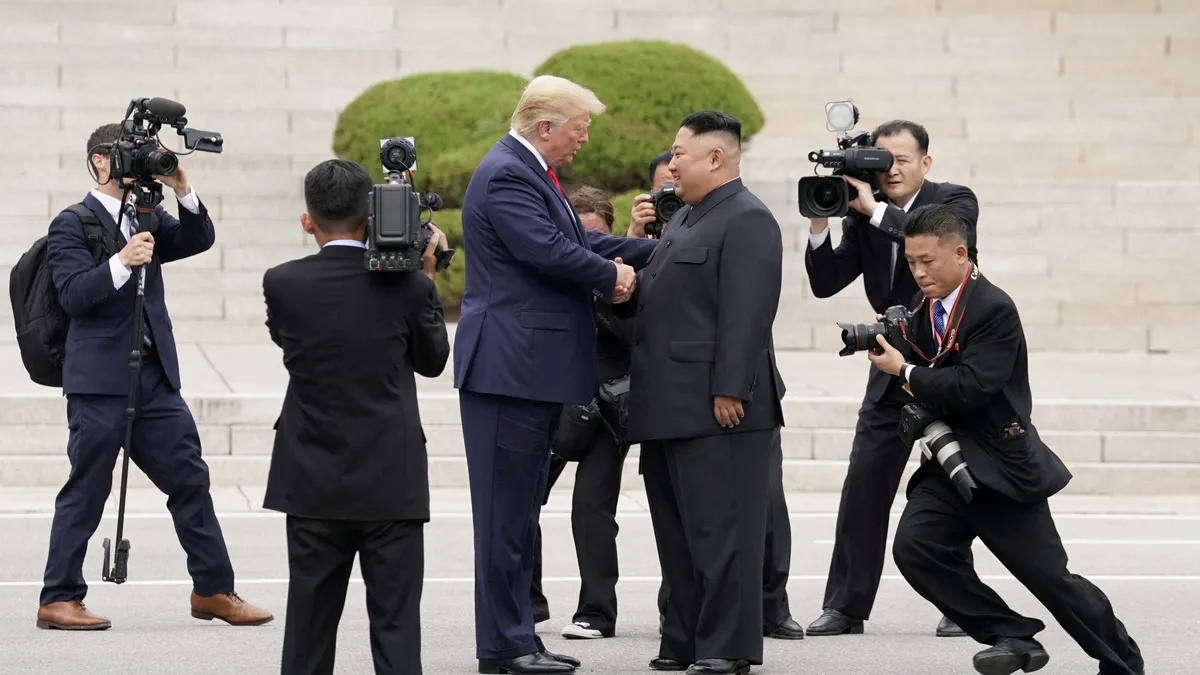
The 2019 DMZ meeting remains the most visually striking of the three. Trump walked briefly across the military demarcation line into North Korean territory, a symbolic gesture that dominated global headlines for days. Yet despite the spectacle, none of the three summits produced a binding agreement for Kim to surrender his nuclear arsenal in exchange for sanctions relief. Talks ultimately collapsed, and Pyongyang resumed regular test firings.
The Size of the Problem
Estimating North Korea’s exact nuclear inventory has long been difficult because the regime keeps its weapons program closely guarded. In June, the Stockholm International Peace Research Institute assessed that Pyongyang has “possibly assembled around 60 warheads” and “possesses enough fissile material to produce at least 30 more.” Other analysts have offered lower figures over the years, but the consensus is that North Korea now fields a credible, if modest, nuclear deterrent — a reality that reshapes any negotiation table.
Trump says he will meet this is the main topic of this guide. The article explains the context, practical details, and next steps readers should understand. Trump says he will meet this matters because readers are looking for a useful answer, not just a short summary. Good content should match search intent and help them decide what to do next.Related Reading
Frequently Asked Questions
What is Trump says he will meet this?
Why does Trump says he will meet this matter?