
Trump launches fresh tirade against Merz after troop withdrawal threat
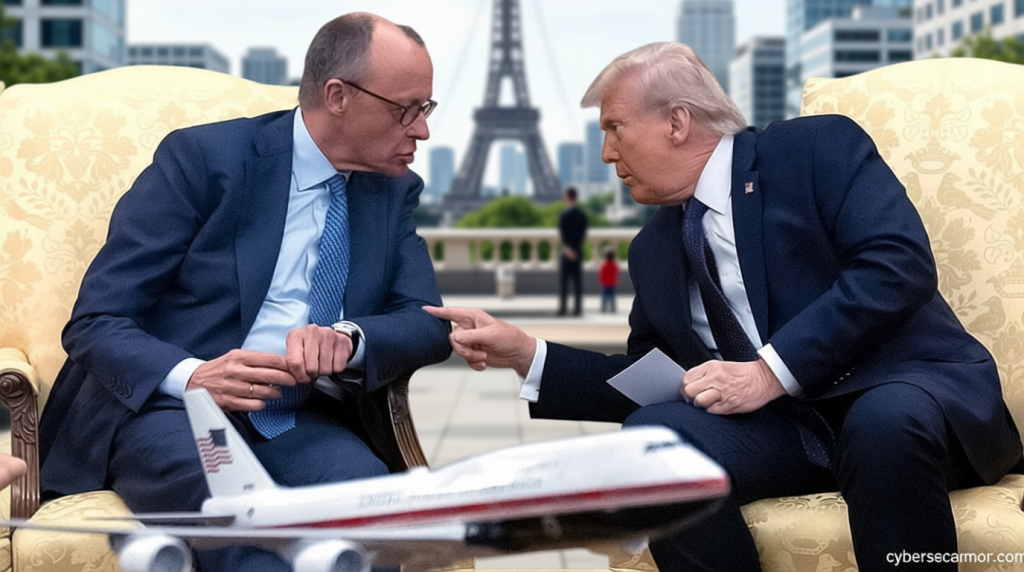
Trump’s Sharp Remarks Toward Merz Highlight US-Europe Tensions
Trump launches fresh tirade against Merz – US President Donald Trump has intensified his verbal attacks on German Chancellor Friedrich Merz, a leader of one of America’s key allies, by accusing him of prioritizing the Iran conflict over critical issues in Europe. In a recent post on his Truth Social platform, Trump called out Merz for allegedly diverting attention from the war in Russia/Ukraine, where he claimed the chancellor has “totally ineffective” performance. “The Chancellor of Germany should focus more on ending the war with Russia/Ukraine and revitalizing his nation’s infrastructure, particularly in addressing immigration and energy challenges,” Trump wrote. “He should allocate less time to interfering with those who are actively eliminating the Iran Nuclear threat, thus ensuring global, including German, safety.”
Criticism Over Iran War Strategy
Merz’s recent statements about the Iran war have sparked a backlash from Trump, who framed the chancellor’s comments as evidence of a lack of strategic focus. Earlier this week, Merz criticized the US for being “humiliated” by Iranian leadership, arguing that Tehran had outmaneuvered American negotiators. “An entire nation is being humiliated by the Iranian leadership, especially by these so-called Revolutionary Guards,” Merz stated during a speech to students in Marsberg. “The Iranians are clearly stronger than anticipated, and the Americans lack a compelling strategy in these negotiations,” he added. These remarks, according to Trump, justify his push to reduce the number of US troops stationed in Germany, a move he has emphasized as a critical step in reevaluating America’s commitments to the region.
“The United States is examining options to cut back on its military presence in Germany, with a decision likely to be announced soon,” Trump wrote in a separate post. The threat to withdraw troops follows a pattern of similar declarations, which have raised concerns about the stability of the transatlantic alliance. NATO experts warn that repeated announcements of troop reductions could irreparably weaken the partnership, as European leaders grow increasingly wary of US unpredictability.
Merz’s response to Trump’s threats has been measured, emphasizing the durability of the US-Europe alliance. During a visit to military personnel in Munster, he did not directly address the troop drawdown but instead highlighted the enduring nature of the transatlantic partnership. “On every global matter, we maintain strong, trusting ties with our allies, particularly Washington,” Merz said. “This collaboration is rooted in shared interests and mutual respect, with responsibilities evenly distributed.” His words underscore a commitment to the alliance, even as tensions simmer over differing priorities.
Broader Implications of US Policy Shifts
Trump’s rhetoric extends beyond Merz, targeting a range of NATO allies for perceived complacency. Recently, he revoked sanctions on Russian oil, a move that has drawn sharp criticism from Western partners. This decision, combined with his threats to annex Greenland—a semi-autonomous territory of Denmark—has fueled speculation about his shifting foreign policy goals. “Leaders are now less concerned about criticizing this [policy],” said Fabrice Pothier, a former NATO Policy Director, when addressing the consequences of Trump’s actions. “The US has put itself in a foolish position with far-reaching global impacts.”
Pothier also pointed to a leaked email from the Pentagon, which hinted at potential sanctions against Spain and the UK for their leaders’ public critiques of the war in Ukraine. “This leak suggests the US is ready to penalize allies who question its approach,” he noted. The email underscores a growing rift between Washington and European capitals, as Trump’s unilateralism challenges the collaborative spirit of the alliance. Pothier argues that the repeated emphasis on troop reductions signals a broader strategy: to test Europe’s ability to act independently.
The Boiling Frog Metaphor and European Resolve
Analysts have described the current state of US-Europe relations as a “boiling frog moment,” a term derived from the idea that a frog placed in gradually heated water won’t notice the danger until it’s too late. Fabrice Pothier explained this phenomenon to Euronews, noting that European leaders have experienced a steady erosion of trust in US commitments. “The situation deteriorates year after year, yet the US reassures us that it remains a reliable ally,” he said. This dynamic, he argues, has led to a complacency in European defense planning, despite the growing risks to the continent.
Pothier’s warning comes as NATO faces pressure to strengthen its collective defense capabilities. He called for immediate action to bolster European security, stating that the alliance must assume the US could abandon its Article 5 obligations—under which an attack on one member is an attack on all—if the situation demands it. “Europe needs to prepare for a scenario where the US is no longer a proactive partner,” he said. This perspective aligns with broader concerns among European officials, who fear that Trump’s unpredictable approach could destabilize the NATO framework.
Historical Context and Strategic Divergence
Merz’s critique of US strategy in the Iran war reflects a deeper ideological divide between Washington and European capitals. While the US has pursued a hardline stance against Tehran, many European nations have advocated for diplomatic solutions. This contrast has intensified in recent months, with Trump accusing European leaders of undermining US efforts. “These nations are not supporting our strategy to eliminate the nuclear threat, which is vital to global stability,” he said in a recent post.
Merz, however, has defended the European approach, arguing that the US’s focus on the Iran war has overshadowed more immediate crises in Europe. His comments highlight a growing frustration with Trump’s tendency to prioritize Middle Eastern conflicts over European security. “While the US is preoccupied with Iran, we are dealing with the realities of a war in Ukraine and the challenges of maintaining energy independence,” Merz said. This critique has framed the recent troop withdrawal threat as a test of European resolve, rather than a definitive step toward reducing US involvement.
Rebuilding Trust in a Fractured Alliance
Despite the current tensions, the US-Europe alliance remains a cornerstone of global security. However, Trump’s actions have created a climate of uncertainty. “There is now a sense of fatigue among European leaders regarding Trump’s confrontational tactics,” Pothier observed. “They are increasingly questioning whether the US will continue to support them in times of crisis.” This fatigue, he suggested, is a turning point for the alliance, one that could either strengthen its unity or lead to fragmentation.
The fallout from Trump’s latest statements has sparked a debate about the future of NATO. Some analysts argue that the alliance must adapt to a more autonomous European posture, while others believe the US will remain a critical player. “Europe without the US is a possibility we cannot ignore,” Pothier said. “But it’s not just about withdrawal—it’s about ensuring Europe can stand on its own in the face of emerging threats.”
As the situation unfolds, the balance between US leadership and European agency continues to shift. Trump’s criticism of Merz serves as a reminder of the challenges facing the transatlantic partnership, but it also highlights the need for Europe to assert its own strategic priorities. With the global landscape evolving rapidly, the question remains: can the US and Europe still work together, or will the alliance fracture under the weight of diverging interests and policies?

