
Venice Biennale’s international jury resigns as Italy’s government opposes Russia’s participation
Venice Biennale’s International Jury Resigns Amid Italy’s Opposition to Russia’s Involvement
The Resignation and Its Timing
Venice Biennale s international jury resigns – On Thursday, the international jury of the Venice Biennale abruptly stepped down, just days ahead of the unveiling of the world’s most venerable contemporary art exhibition. While the official statement from the Biennale provided no explicit reason for the resignations, the timing appeared closely linked to Italy’s government stance against Russia’s participation in the event. The jury, composed of prominent figures such as Solange Farkas, Zoe Butt, Elvira Dyangani Ose, Marta Kuzma, and Giovanna Zapperi, had been set to determine the winners of the prestigious Golden Lion awards and other honors during the official opening on 9 May.
Government Involvement and the Pavilion Inspection
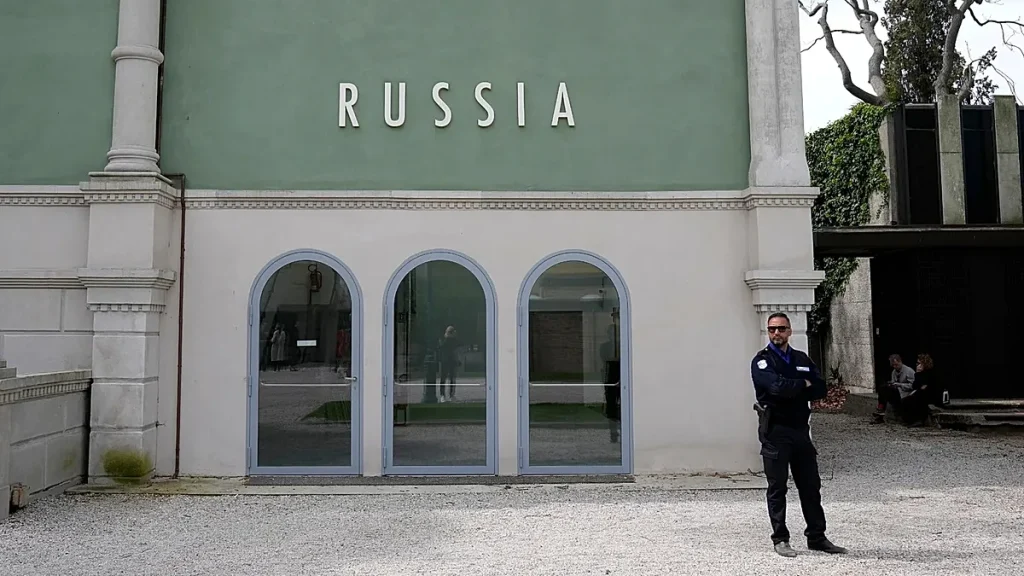
Cultural Ministry representatives visited the Biennale on Wednesday to assess the readiness of the Russian Pavilion for its return. This inspection came after the Italian government formally expressed its opposition to Russia’s inclusion in the international exhibition. The decision to withdraw the jury followed this scrutiny, highlighting the tension between political considerations and artistic autonomy. The Biennale, which traditionally serves as a platform for global cultural exchange, now faces the challenge of redefining its award process without the original panel.
Revised Award Selection and Visitor Participation
With the resignation of the jury, the Biennale announced a shift in its awarding mechanism. Instead of the jury selecting winners, the public will now decide the recipients of two key prizes: the Best Participant in the curated exhibition “In Minor Keys” and the Best National Participation among the 100 national pavilions. These awards will be presented on the closing day of the event, 22 November, marking a departure from the institution’s usual practices. The change has sparked debate about the role of expert judgment in artistic accolades and the influence of political decisions on cultural events.
Prime Minister’s Response and Political Support
Italy’s Prime Minister, Giorgia Meloni, addressed the resignations, reaffirming the government’s disagreement with the Biennale’s decision to allow Russia’s participation. She acknowledged the autonomy of the Biennale, stating,
“The government does not agree with the Biennale’s choice to include Russia, but we respect its independence.”
Meanwhile, Cabinet Minister Matteo Salvini endorsed the new approach, calling it a “bold move” that enhances the exhibition’s democratic nature. He remarked,
“Allowing visitors to decide the final outcome is a great idea. It ensures the Biennale remains truly autonomous and reflective of public sentiment.”
Salvini emphasized the importance of the change, suggesting it strengthens the event’s credibility in the face of geopolitical tensions.
EU Funding Reduction and Russia’s Participation History
Last week, the European Union reduced its financial support for the Biennale by €2 million, citing Russia’s participation as a factor. This marks the first time the EU has cut funding for the event since Russia launched its full-scale invasion of Ukraine in 2022. Russia’s absence from the Biennale in 2022 and 2024 has been notable, with the country lending its pavilion to Bolivia during the 2024 edition. The last time Russia exhibited at the Biennale was in 2019, before the current geopolitical climate intensified.
Biennale’s Defense of Autonomy
In response to the controversy, the Biennale issued a statement asserting its commitment to artistic freedom. It clarified that the organization “does not have the authority to block a nation’s participation,” adding that any country recognized by the Italian Republic may submit an application to take part. The Biennale highlighted that Russia’s pavilion, constructed in 1914 within the historic Giardini, required only a formal notification to join the exhibition. The statement continued,
“La Biennale di Venezia rejects any form of exclusion or censorship. It remains a hub for dialogue, openness, and artistic freedom, fostering connections between cultures and peoples.”
The organization expressed hope that the event could still serve as a bridge toward resolving conflicts and promoting mutual understanding.
Historical Significance and Future Implications
The Venice Biennale, established in 1895, has long been a cornerstone of the international art world, featuring a main exhibition alongside the 100 national pavilions. Each year, the jury plays a pivotal role in shaping the artistic narrative of the event, and their resignation underscores the growing influence of political dynamics on cultural institutions. While the Biennale’s new process may be seen as a compromise, it also raises questions about the balance between artistic integrity and political alignment. The decision to let visitors determine winners could redefine the event’s legacy, shifting its focus from expert curation to public engagement.
Global Reactions and Cultural Impact
Observers have noted the symbolic weight of Russia’s participation, given its recent actions in Ukraine. The Biennale’s decision to include Russia, despite political pressure, reflects its dedication to maintaining neutrality in the arts. However, the resignation of the jury signals a rift between the government and the institution, potentially affecting the exhibition’s perceived impartiality. As the event approaches, the new award selection method will be closely watched, with critics and supporters alike debating whether it strengthens or weakens the Biennale’s role as a global cultural beacon.
For now, the Biennale remains committed to its mission, even as it navigates the complexities of political influence. The shift to public voting for certain awards may invite broader participation but could also diminish the prestige traditionally associated with the jury’s role. The outcome of this year’s edition will be a testament to the interplay between art, politics, and public opinion in one of the world’s most prestigious cultural events.

