Congress comes back to Philly for special session at Independence Hall

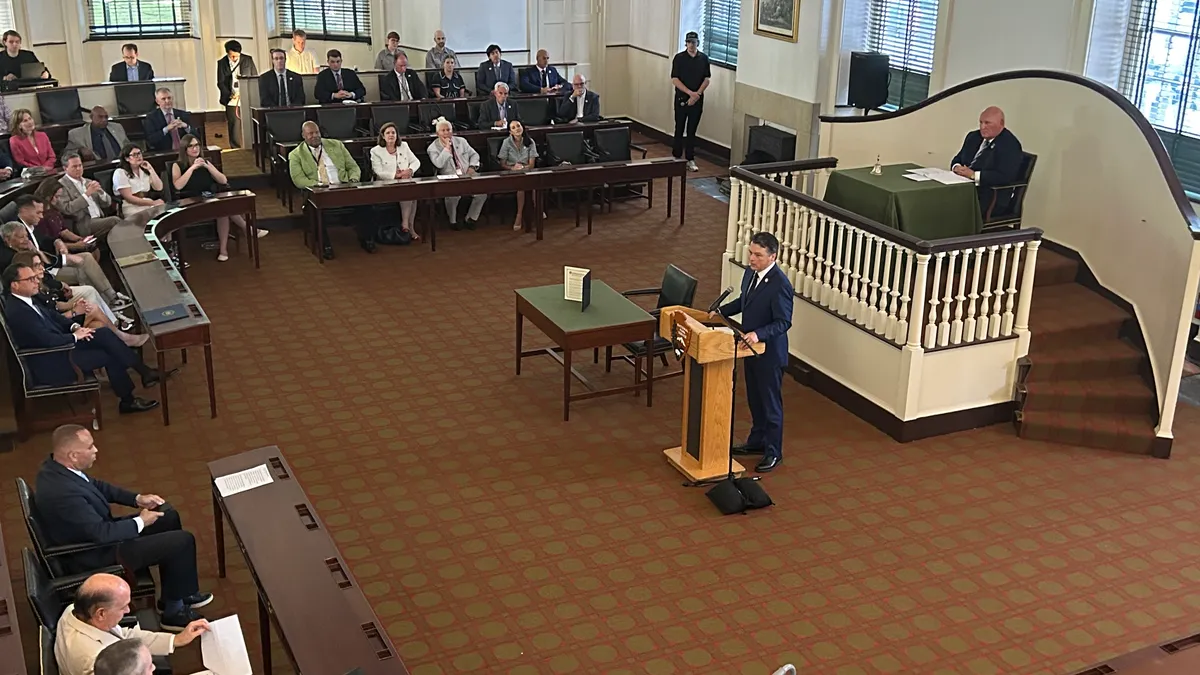
Congress Returns to Philadelphia for Historical Commemoration at Independence Hall
Cybersecarmor.com – PHILADELPHIA — July 2, 2026, saw a gathering of U.S. lawmakers reconvene at the hallowed ground where the nation’s founding ideals were first articulated. The event, held at Congress Hall within Independence National Historic Park, commemorated the 250th anniversary of the Continental Congress’s historic vote to declare independence from Britain. This location, steeped in American history, served as the backdrop for a rare bipartisan assembly, drawing attention to the symbolic significance of the occasion.
The session, organized by Philadelphia Democrat Brendan Boyle, marked only the second time since 1800 that Congress had convened at the site where the Declaration of Independence was signed. The other notable gathering took place during the Bicentennial celebrations of 1976, a year before Boyle’s birth. The event was designed to highlight the city’s pivotal role in shaping the nation’s identity, as well as foster unity among lawmakers in an era of political division.
Brian Fitzpatrick, a Republican congressman from Pennsylvania, opened the proceedings with a reflective invocation. “In this very place, an idea became a declaration,” he said. “In this very place, the work of America began.” His remarks underscored the enduring legacy of the room where the nation’s birth was proclaimed, now serving as a reminder of the foundational principles that continue to guide the country.
“Let this sacred place awaken us to the solemn charge that was proclaimed here 250 years ago… to keep America worthy of the freedom that we received,” Fitzpatrick added.
Boyle, who hails from Philadelphia and grew up in the city, emphasized the event’s dual purpose. “As a native Philadelphian, I wanted to showcase our city’s role in the fight for independence,” he stated. “But bringing Democrats and Republicans back to this historic space was also about reminding ourselves of the shared values that bind our nation, even when political differences run deep.” His district, which includes the historic Independence Hall, had long been a symbol of the city’s revolutionary past, and Boyle aimed to rekindle that spirit through the gathering.
The session took place on a sweltering day, with temperatures soaring to a record 103 degrees. Republican Rep. Brian Fitzpatrick, who co-hosted the event with Boyle, presided over the proceedings in a room that had been used by Congress from 1790 to 1800, when Philadelphia was the nation’s capital. The choice of location was deliberate, evoking the era when the country’s governance was first established and its constitution drafted.
Outside the Congress Hall, the city buzzed with activity as the “Red White and Blue To-Do” parade concluded its route. The event, which had been abbreviated due to the extreme heat, drew crowds of tourists eager to witness the historic moment. Lines formed at the Liberty Bell and Independence Mall, where visitors mingled with the echoes of the past, reflecting on the landmarks that have stood as testaments to the nation’s founding.
House Minority Leader Hakeem Jeffries, a key participant in the session, delivered a speech that highlighted the Constitution’s intent. “The Founding Fathers envisioned Congress as a separate and equal branch of government, not subordinate to the executive,” he explained. This vision, Jeffries argued, remains vital in preserving the balance of power and accountability that defines American democracy. His words resonated with those who see the Constitution as a guiding light in contemporary political discourse.
“Let’s never forget that we don’t work for anyone else — there are no kings in America — we work exclusively for the American people,” Jeffries continued, echoing sentiments frequently expressed by critics of the Trump administration.
The event also served as a platform for addressing the nation’s historical complexities. While the 1776 resolution celebrated freedom, it was crafted by white men who had yet to fully embody the ideals of liberty for all. Jeffries acknowledged this paradox, stating that the promise of freedom continues to be a beacon for progress. “America, whose Constitution was formulated by white men, struggled to live up to its founding ideals during the era of slavery and the displacement of Native Americans,” he noted. “Yet the promise of freedom remains a guiding star, urging us to strive toward a more perfect union.”
The symbolic return to Independence Hall sparked discussions about the role of historical landmarks in modern political dialogue. For many, the event was more than a ceremonial gesture; it was a call to reconnect with the past while addressing present challenges. As the lawmakers gathered in the same room where the nation’s destiny was decided, they sought to reaffirm the principles that continue to shape American identity.
Boyle’s initiative, launched two years prior, had aimed to create a moment of unity amid a polarized political climate. By assembling a bipartisan group of representatives, he hoped to bridge divides and remind Congress of its foundational purpose. The session, though brief, carried weight as it juxtaposed the nation’s revolutionary past with its current struggles to uphold the values it once championed.
As the sun set over Independence Mall, the event’s impact lingered. The blend of historical reverence and contemporary political discourse underscored the enduring relevance of the space. For the participants, the experience was a poignant reminder that the seeds of American freedom were planted in a modest hall, yet continue to inspire action and reflection in the present. The day’s proceedings, paired with the city’s vibrant cultural and historical offerings, highlighted the interplay between legacy and progress, inviting a deeper engagement with the nation’s story.