Alan Greenspan, influential economist and Fed chairman, dies at 100

Alan Greenspan, Influential Economist and Federal Reserve Chairman, Dies at 100
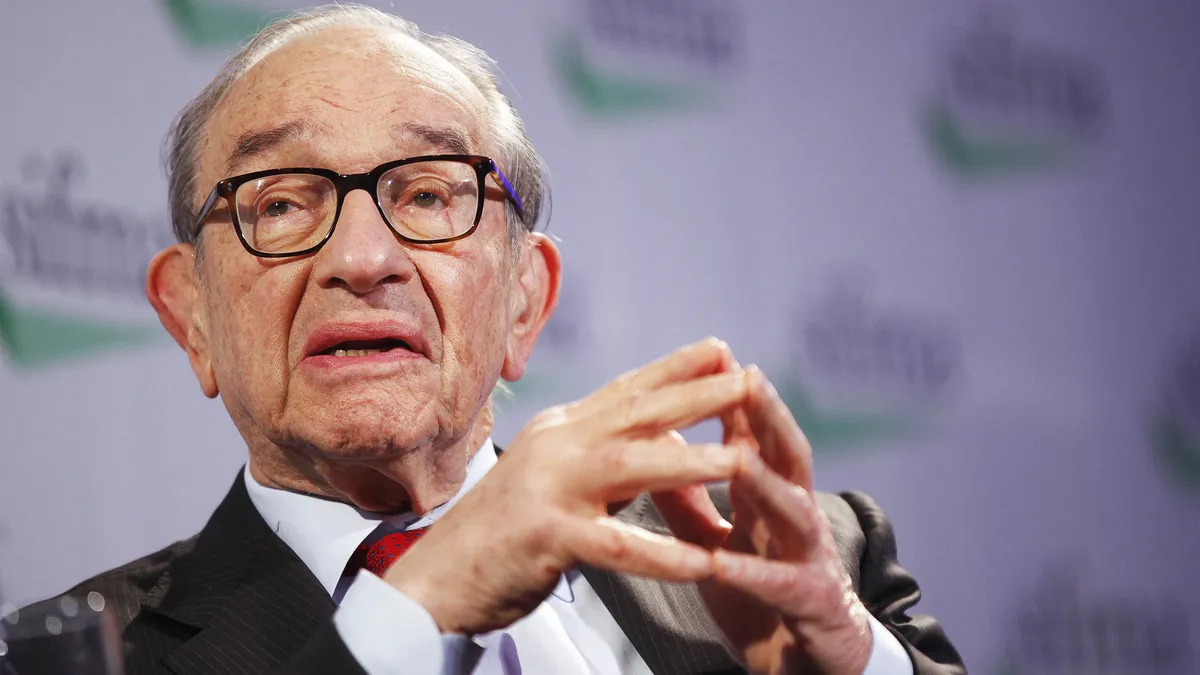
Cybersecarmor.com – Alan Greenspan, the former Federal Reserve Chairman whose economic policies shaped global markets for decades, has passed away at the age of 100. His death was announced by his wife, Andrea Mitchell, who is also a prominent NBC News correspondent. The news came as a quiet moment at their home, where Greenspan succumbed to complications of Parkinson’s disease.
Greenspan’s journey to economics was far from conventional. Born into a family with a rich musical heritage, he initially pursued a career as a musician, trained at Juilliard. However, during breaks between sets in his dance band, he began exploring economic literature, a path he later described as serendipitous. “I found that in the 20-minute breaks we’d have in between sets that I started to go to the library and read books on economics. Why? I haven’t a clue,” he once reflected in 2001.
“I finally found out that I really was looking forward not to playing during the sets but going to the 20-minute breaks, and I said, ‘If I’m doing this, I’m in the wrong business,’” Greenspan admitted. This revelation marked a pivotal moment in his career, leading him to transition from music to economics, a decision he later called his “best economic move.”
As the second-longest-serving Federal Reserve Chairman in history, Greenspan guided the U.S. economy through some of its most transformative periods. His tenure, spanning from 1987 to 2006, overlapped with the presidencies of four different leaders. During this time, he managed crises such as the 1987 stock market crash, the dot-com bubble burst, and the aftermath of the Sept. 11, 2001, attacks. His ability to adapt and respond to shifting economic tides earned him a reputation as a flexible and forward-thinking leader.
Greenspan’s legacy is defined by his role in steering the nation through the longest economic expansion in U.S. history. His belief in the self-regulating nature of markets, combined with a nuanced understanding of productivity growth, allowed the Federal Reserve to maintain a looser grip on interest rates. This approach contributed to decades of economic stability, though it later faced scrutiny during the 2008 financial crisis.
Leadership and Public Perception
During his 18 years at the helm of the Fed, Greenspan became a household name, revered for his analytical acumen and political savvy. His policies were instrumental in curbing inflation, a feat he built upon his predecessor’s work. Yet, his influence extended beyond monetary policy; he was a respected figure in global economics, often quoted in media and cited in academic discussions.
A USA TODAY survey conducted just before his retirement in January 2006 revealed his widespread approval. Of the 1,006 respondents, 65% expressed satisfaction with his performance as Fed Chairman. This support transcended political lines, with majorities of both Democrats and Republicans, regardless of income level or educational background, endorsing his leadership. Such broad acceptance underscored his ability to build consensus and his reputation for clarity and reliability.
Legacy and Criticism
Despite his acclaim, Greenspan’s tenure was not without controversy. Some economists argue that his reluctance to tighten monetary policy in the early 2000s contributed to the U.S. housing bubble. By keeping interest rates low for an extended period, he is believed to have inadvertently fueled excessive borrowing and speculative investment, which eventually led to a credit crisis and recession.
During the 2008 crisis, Greenspan faced intense public scrutiny. Lawmakers on Capitol Hill lambasted him for not adequately regulating the mortgage industry. “You had the authority to prevent irresponsible lending, and now our whole economy is paying its price,” said then-Rep. Henry Waxman, D-California, at the time. This criticism marked a stark contrast to his earlier popularity, as he had previously been seen as a stabilizing force in times of uncertainty.
“Those of us who have looked to the self-interest of lending institutions to protect shareholder’s equity – myself especially – are in a state of shocked disbelief,” Greenspan acknowledged. He admitted that his confidence in market self-regulation had been a key factor in the crisis, though he maintained that the collapse was more severe than any individual could have predicted.
Greenspan’s wife, Andrea Mitchell, paid tribute to his life and career in a heartfelt statement. “He was a giant of a man who helped shape the U.S. economy for decades under presidents of both parties, but was always honest in acknowledging his mistakes,” she said. She also highlighted his personal passions, including a deep love for baseball, tennis, golf, and music, particularly jazz. “To me he was my husband, who shaped my life from our very first date in 1984. He will be remembered for his brilliance and his kindness. Being his life partner was the joy of my life,” she added.
Greenspan’s economic philosophy was rooted in a belief that market forces would naturally correct imbalances. This perspective, while successful in many instances, was tested during the housing bubble. His early decision to maintain low interest rates, driven by optimism about productivity gains, allowed for sustained economic growth. However, as the crisis unfolded, questions arose about whether this approach overlooked the risks of overleveraging and unsustainable practices.
His death brings an end to an era of economic leadership that spanned more than two decades. Greenspan’s career, marked by both triumphs and missteps, left an indelible mark on the U.S. financial system. While his tenure as Fed Chairman is often celebrated for its role in fostering prosperity, it also serves as a reminder of the complexities inherent in economic policymaking. As the world continues to grapple with financial challenges, his contributions remain a subject of both admiration and debate.
From his unexpected foray into economics to his enduring influence on global markets, Greenspan’s life was a testament to the power of adaptability and insight. His ability to navigate the Federal Reserve through periods of turmoil, while balancing the demands of public accountability, cemented his status as one of the most influential figures in modern economic history. Though his later years were shadowed by criticism, his legacy endures as a complex blend of innovation, resilience, and humility.