
Travelling to Bosnia and Herzegovina? Here’s what visitors need to know
Travelling to Bosnia and Herzegovina? Here’s what visitors need to know
Travelling to Bosnia and Herzegovina Here – Summer travel plans are in flux, and avoiding the fear of missing out has become a priority for many. Bosnia and Herzegovina, a hidden gem in the Balkans, has recently captured the attention of travelers and digital platforms alike. A recent analysis by Tripscout, a social travel platform, has positioned the country as a standout destination in Europe, thanks to its growing social media presence and engagement. With over 1.9 million visitors recorded in 2025—a modest 0.3% increase compared to the previous year—Bosnia is quietly making waves in the tourism landscape.
Bosnia’s Social Media Success
The Most Engaging Destination Awards, unveiled in April by Tripscout, highlighted Bosnia’s rise as a top contender. These awards are determined by the platform’s “Social IQ” algorithm, which evaluates social media interactions such as likes, comments, and shares, along with the growth of online followings. While Scotland claimed two awards for its trendiest and most engaging region, Bosnia and Herzegovina emerged as the most engaging country. The accolade was driven by over 2.4 million likes across the nation’s official tourism accounts, a figure that reflects a strong digital footprint.
“Bosnia had the highest rating for overall engagement in Europe, hence their award,” Jim Brody, Global Vice President of Destinations at Tripscout, told Euronews Travel. “There was no editorial involvement in any of the award decisions. They were purely driven by the algorithm that generated that rating.”
Brody emphasized that social media serves as a powerful tool for destinations to connect directly with potential tourists. “Social platforms allow users to explore lesser-known places at their own pace, which is why Bosnia has gained traction,” he added. The country’s ability to spark curiosity through visually compelling content may have played a role in its digital ascent, even as it remains relatively under the radar in mainstream media.
A Historic Symbol of Unity
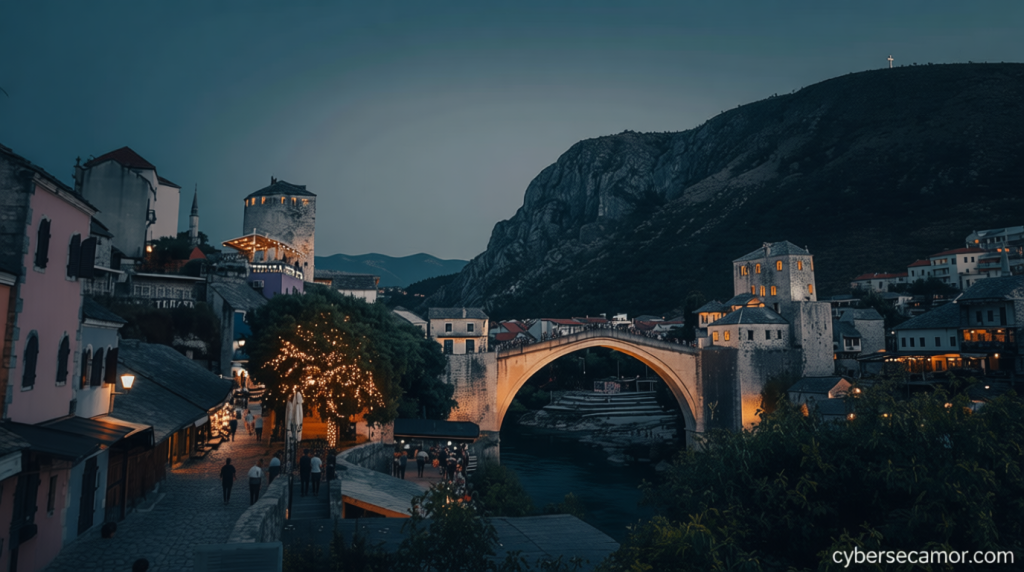
Nestled 126 kilometers southeast of Sarajevo, Mostar is a city steeped in history and symbolism. Its most iconic landmark, the Old Bridge, is a UNESCO World Heritage Site that stands as a testament to resilience and cultural harmony. Originally constructed in 1566 under the Ottoman Sultan Suleiman the Magnificent, the bridge was tragically destroyed during the 1990s conflict but has since been meticulously restored. This architectural marvel, now a vibrant focal point, represents the shared heritage of Bosnia’s Muslim, Christian, and Jewish communities, with its centuries-old architecture and surrounding structures reflecting a past where diverse faiths coexisted.
The bridge’s name, “Stari Most,” translates to “Old Bridge” in Serbian, but its story is far more profound. As a city named after the mostari, or “bridge keepers,” Mostar’s identity is intertwined with the bridge’s legacy. The reconstruction effort not only revived a physical structure but also symbolized the country’s journey toward reconciliation and international collaboration. “The reconstructed Old Bridge and Old City of Mostar is a symbol of reconciliation, international co-operation and of the coexistence of diverse cultural, ethnic and religious communities,” stated UNESCO, underscoring its significance beyond mere tourism.
Sarajevo’s Cultural Tapestry
While Mostar’s historical sites draw crowds, Sarajevo, the capital, offers a unique blend of tradition and contemporary flair. The city’s architecture, cuisine, and cultural scene are shaped by centuries of Ottoman, Austro-Hungarian, and Yugoslavian influences. For instance, the Baščaršija market, a narrow and winding quarter, remains almost unchanged since the days of its founding. Time Out travel writer John B Wills noted that the market’s charm is a direct link to the past, with its aesthetics preserving a centuries-old atmosphere.
“What you see is pretty close to what people saw in those centuries,” said John B Wills, highlighting the market’s enduring appeal.
Yet, Sarajevo’s modern pulse is equally compelling. The city has seen a surge in creative dining, with restaurants like Mala Kuhinja redefining local flavors by fusing Asian and Balkan culinary traditions. Fine dining experiences, once a rarity, now offer innovative dishes that showcase the region’s evolving gastronomic identity. Meanwhile, contemporary art spaces such as Manifesto are amplifying the city’s cultural scene, providing emerging artists with platforms to display their work and engage with broader creative networks.
Infrastructure Boosts Tourism Growth
The country’s growing appeal has led to increased investment in hospitality infrastructure. Recent years have seen a wave of new hotel developments, with international brands entering the market to meet rising demand. Marriott Bonvoy, for example, has announced the Mostar Marriott Hotel as a new addition to the Balkans, featuring 182 rooms, five restaurants, and amenities like an outdoor pool and business center. This expansion aligns with Bosnia’s broader efforts to enhance visitor experiences and support local economies.
Close to Sarajevo’s historic Baščaršija district, the Hotel NOVA Inn Sarajevo opened in February 2026 as a four-star residence. Offering eight studio-style apartments, it caters to both business and leisure travelers, with breakfast included in the room rate. Similarly, Hotel Eleven, a four-star property, made its debut in June 2025. While its 11 keys—spanning double and twin bedrooms—may seem modest, the hotel’s strategic location and amenities reflect the country’s commitment to accommodating modern travelers.
These developments underscore a shift in Bosnia’s tourism strategy. By combining historical allure with contemporary comforts, the nation is positioning itself as a destination that appeals to a wide range of visitors. Whether exploring ancient landmarks or savoring modern culinary innovations, travelers are discovering a country that is both rich in heritage and dynamic in its progress.
Looking Ahead: A Destination in the Making
As Bosnia continues to gain momentum in the digital age, its success in social media engagement suggests a growing global interest. This quiet surge in tourism is driven by a combination of factors: the revitalization of iconic sites, the preservation of traditional neighborhoods, and the introduction of new, high-quality accommodations. The country’s ability to balance history with modernity ensures that visitors will find a destination that is both timeless and evolving.
With each passing year, Bosnia and Herzegovina is redefining its place on the European tourism map. From the bustling markets of Sarajevo to the serene beauty of Mostar’s Old Bridge, the country is offering an experience that is as much about cultural discovery as it is about scenic exploration. As travelers become more attuned to the power of social media, Bosnia’s growing digital presence may well be the key to unlocking its full potential as a must-visit destination.

