
Star Wars in real life? Astronomers find 27 possible twin-sun worlds
Star Wars in real life? Astronomers find 27 possible twin-sun worlds
Star Wars in real life Astronomers – Researchers have uncovered 27 potential planets orbiting pairs of stars, using an innovative technique that shifts the focus from traditional methods. This groundbreaking discovery, detailed in a study published in the Monthly Notices of the Royal Astronomical Society, was led by Margo Thornton, a PhD candidate at the University of New South Wales and SETI Institute researcher. Unlike previous approaches, the team didn’t rely on the classic transit method—where a planet’s shadow dims a star’s light as it passes in front—instead, they analyzed minute fluctuations in the timing of stellar eclipses to infer the presence of unseen celestial bodies.
Revealing the unseen
The method hinges on the phenomenon of apsidal precession, a subtle shift in the orbital path of a binary star system over time. When two stars orbit each other, their eclipses occur at predictable intervals. However, if a planet exists in the system, it exerts a gravitational pull that alters these timings in ways that can be measured. This approach allows scientists to detect planets even when their orbits are misaligned with Earth, overcoming a major limitation of the transit method. Traditional techniques often miss such planets because they require perfect alignment for the dimming effect to be observed.
Thornton’s team studied 1,590 eclipsing binary star systems, focusing on how their orbital patterns changed across years of data collected by NASA’s Transiting Exoplanet Survey Satellite (TESS). In 71 of these systems, they noticed deviations in eclipse timing that couldn’t be explained by known physical factors. Of those, 36 showed evidence of an additional influence, and in 27 cases, the most plausible explanation was a planet-sized object. These findings suggest that the method could identify planets in systems where conventional tools fail to detect them.
“The calculation of precession was based on the change in the argument of periastron over time of the binary star, which can be determined by the exact timing of both primary and secondary eclipses,” the study authors noted. This insight opens new avenues for understanding planetary formation in complex stellar environments.
Star Wars echoes in the cosmos
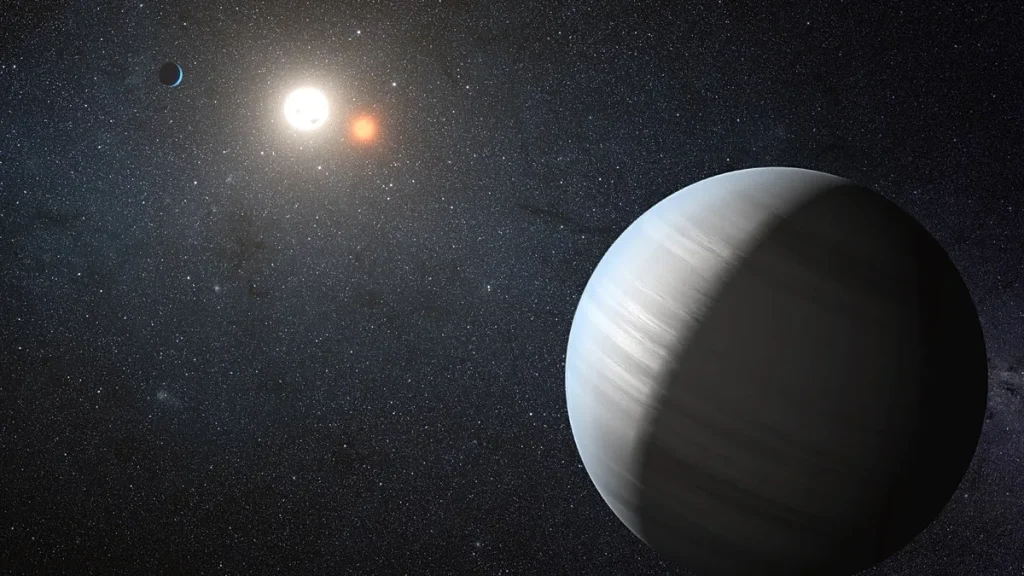
The discovery draws parallels to the fictional planet Tatooine from Star Wars: A New Hope, which is famous for its twin-sunset scenes. In reality, circumbinary planets—those orbiting two stars—are rare, with only about 18 confirmed before this study. The new method could significantly increase the number of such planets detected, particularly in systems where alignment is poor or where planets are difficult to spot using older techniques.
Many of the 27 candidates identified by the team orbit massive, hot stars. These systems are challenging to study with the transit method because the intense brightness of the stars can mask the subtle dimming caused by a planet. However, the eclipse timing analysis method proves effective even in these scenarios, offering a fresh perspective on how planets form and persist in binary systems. The implications of this work extend beyond mere detection; it provides a deeper understanding of the dynamic processes shaping such systems.
Potential for future exploration
While the sample size of 1,590 eclipsing binaries represents a small fraction of the 2 million such systems cataloged by the Gaia mission, the results highlight the vast untapped potential in the dataset. The researchers emphasized that expanding the search to include the full Gaia catalog, combined with longer observational periods from TESS, could reveal hundreds or even thousands of additional circumbinary planets. This would not only enhance our knowledge of exoplanets but also refine theories about how planets evolve in multi-star environments.
The method’s significance lies in its ability to detect planets in systems where traditional techniques struggle. For example, in cases where a planet’s orbit is tilted relative to the line of sight from Earth, the transit method can’t capture its presence. By tracking eclipse timing changes, scientists can uncover planets that might otherwise remain hidden. This could be particularly valuable for studying systems with complex architectures, such as those containing multiple stars or planets in eccentric orbits.
Thornton and her team’s work also has broader scientific applications. It allows researchers to test formation theories for circumbinary planets, trace their migration histories, and model their long-term evolution. These insights could reshape our understanding of planetary systems, especially those where gravitational interactions play a critical role. The study’s findings underscore the importance of innovative observation techniques in expanding the boundaries of astronomical knowledge.
Moreover, the method’s adaptability could lead to the discovery of other celestial objects, such as brown dwarfs or free-floating planets, that influence binary star systems. By combining this approach with existing data and future missions, astronomers might uncover a more comprehensive picture of the universe’s diverse planetary configurations. The potential for such discoveries is immense, as they could challenge current assumptions about where and how planets form.
As the researchers note, their analysis is just the beginning. The Gaia catalog holds millions of eclipsing binaries, many of which remain unexplored. With the growing capabilities of telescopes and the wealth of data available, the next step is to apply these techniques on a larger scale. This could revolutionize our ability to detect planets in complex systems, bridging the gap between science fiction and cosmic reality. The discovery of 27 possible twin-sun worlds is a milestone that redefines what we know about the universe’s hidden planets.

