
EU keeps carbon border tax unchanged despite fertiliser price crisis
EU keeps carbon border tax unchanged despite fertiliser price crisis
EU keeps carbon border tax unchanged – The European Commission has decided to maintain its carbon border tax, known as the Carbon Border Adjustment Mechanism (CBAM), as outlined in a new fertiliser support plan unveiled on Tuesday. This decision comes amid a surge in fertiliser costs and growing tensions over energy prices, exacerbated by the ongoing conflict in the Middle East. While the bloc’s carbon pricing rules have faced criticism for adding financial strain on farmers, the Commission remains steadfast in its commitment to the policy, emphasizing its role in safeguarding Europe’s climate goals.
At the heart of the debate is the perceived impact of carbon pricing on the agricultural sector. Fertiliser producers argue that the CBAM is vital in ensuring fair competition between European and international markets. They claim the mechanism shields EU industries from imports that are produced under less stringent environmental regulations, thereby requiring foreign exporters to account for their emissions. This, they say, levels the playing field and maintains the integrity of European production standards.
However, farmers and agricultural stakeholders express concern that these environmental costs are being passed on to them through higher fertiliser prices. With input costs rising sharply, many fear that the burden will eventually affect consumer prices and the overall cost of living. The Commission’s stance has been challenged by voices in the European Parliament, who argue that the current policy may be too rigid at a time when the sector is under significant pressure.
Commission defends policy amid sectoral tensions
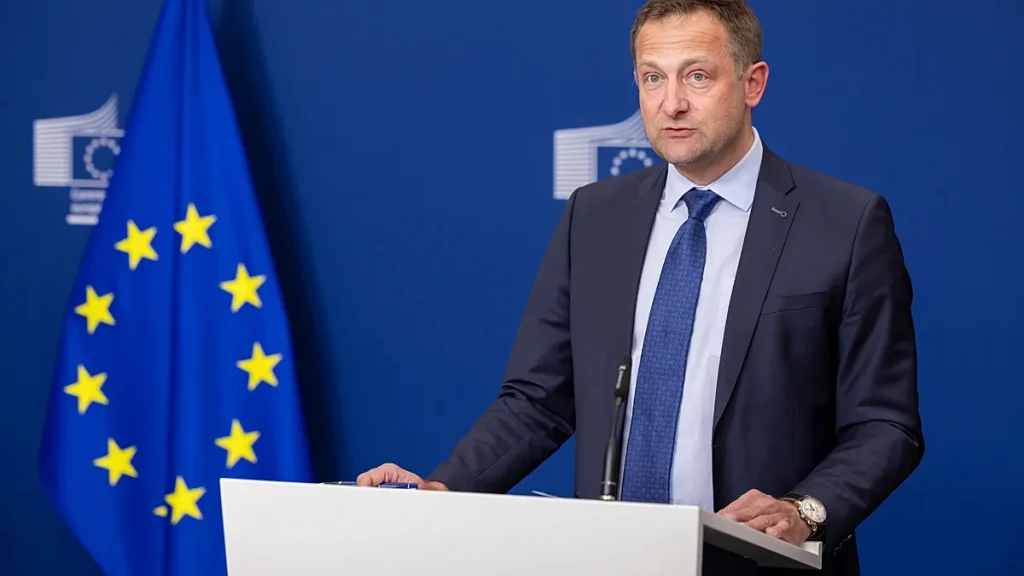
European Commissioner for Agriculture, Christophe Hansen, has defended the CBAM, calling its potential removal a “false good idea.” He highlighted the risks of undermining the mechanism, which applies to roughly 45% of EU fertiliser imports, and noted that it is essential for preserving the competitiveness of European industries. “Without CBAM, we risk facing unfair competition from third countries where environmental regulations are less rigorous,” Hansen stated during a press briefing, stressing that the policy helps prevent industries from relocating to regions with lower carbon costs.
“We have a domestic industry for fertilisers in several member states which are under pressure because they’re dealing with a situation of unfair competition coming from third countries if CBAM is not in place,” Hansen said, underscoring the need for a unified approach to carbon pricing.
The Commission’s position is further reinforced by its argument that carbon pricing is a cornerstone of Europe’s climate leadership. By taxing emissions at the border, the EU aims to incentivize global industries to adopt greener practices. Hansen emphasized that these measures are not just about protecting the environment but also about maintaining economic stability across sectors. “Carbon pricing, including revenues from the Emissions Trading System (ETS) and CBAM, is essential to preventing industries from moving to locations with less strict environmental rules,” he explained.
Yet, the Commission has acknowledged that the fertiliser sector holds a unique position in the supply chain. Hansen admitted that higher industrial costs are likely to trickle down to agricultural economics and eventually to consumer prices. This has led to calls for a more flexible approach, with the possibility of pairing carbon pricing with financial support to alleviate the burden on farmers.
In response to the growing pressure, the European Commission has pledged to conduct a thorough investigation into how ETS and CBAM costs are distributed throughout the supply chain. The focus is on understanding the mechanisms that connect fertiliser production to agricultural usage and supermarket pricing. “We need to clarify how these costs are being transmitted from factories to fields and then to consumers,” Hansen stated, indicating a willingness to refine the policy without entirely abandoning it.
Support measures and political considerations
As part of its new plan, the Commission has allocated €200 million from the agricultural major fund’s crisis reserve to help offset the rising costs for farmers. Hansen expressed intentions to at least double this amount to provide greater relief. Additionally, the EU is set to offer targeted “exceptional support” to the most affected agricultural producers, aiming to stabilize their operations during this challenging period.
These measures come as part of a broader effort to strengthen the EU’s climate policies while addressing immediate economic concerns. The Commission has also announced plans to mobilize more funds under the EU budget to reinforce agricultural research, which could lead to innovations that reduce reliance on costly inputs. However, the exact figures and allocation methods are still under discussion, pending negotiations between the EU co-legislators—the European Parliament and the Council.
Leon de Graaf, a representative of the Business for CBAM Coalition, welcomed the decision to keep CBAM in place. “It’s a relief to see the EU executive holding the line on this policy instead of creating exceptions for fertilisers,” he said, emphasizing that weakening CBAM could send mixed signals to industries globally. De Graaf argued that the mechanism ensures fairness by requiring all producers, whether domestic or foreign, to account for their carbon emissions.
Meanwhile, Irish MEP Billy Kelleher (Renew Europe) has called for a temporary suspension of CBAM, citing its adverse effects on farmers and food inflation. “Rising fertiliser prices are putting enormous pressure on both farmers and the cost of living,” Kelleher said during a parliamentary session in Strasbourg. “We need to ease the burden on the sector in the short term to avoid long-term economic damage.”
Despite these calls for flexibility, the Commission remains determined to uphold its carbon pricing framework. Hansen’s remarks during the press briefing suggested that the EU is prepared to combine CBAM with subsidies, state aid, and market protections to support politically sensitive sectors. This approach reflects a balance between environmental goals and economic pragmatism, as the Commission seeks to maintain climate leadership without destabilizing the agricultural economy.
As the debate continues, the EU’s decision to keep CBAM intact signals a commitment to long-term sustainability, even at the cost of short-term economic adjustments. The challenge now lies in ensuring that the policy’s benefits are realized without further straining the agricultural sector. With the crisis reserve and new support measures in place, the Commission aims to provide a safety net while navigating the complexities of global trade and climate policy. The outcome of these discussions will be critical in shaping the future of Europe’s carbon pricing strategy and its impact on food production and prices.

