
End of conflict in the Middle East or recession in Europe, IMF warns
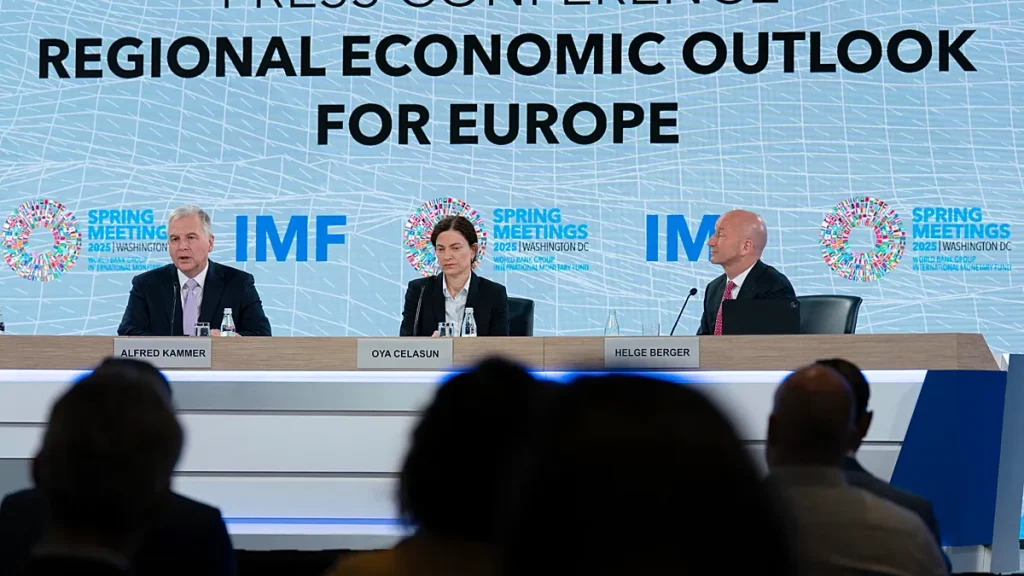
IMF Alarms Over Europe’s Economic Future Amid Middle East Uncertainty
End of conflict in the Middle – The International Monetary Fund (IMF) has issued a stark warning about the European Union’s economic trajectory, highlighting two potential scenarios: either a resolution of the Middle East conflict or a looming recession. The latest IMF report underscores how the ongoing war in Iran and the blockade of the Strait of Hormuz have intensified energy supply challenges, creating a ripple effect across the bloc’s financial stability. While the European economy has shown resilience, the institution cautions that it is now more vulnerable to external shocks, particularly those tied to energy disruptions. This has forced the IMF to revise its projections, emphasizing the need for urgent policy adjustments to safeguard growth.
Energy Crisis and Its Impact on European Markets
The energy crisis, driven by the Middle East conflict, has reshaped European markets in profound ways. Oil prices have climbed by approximately 70%, while gas prices remain about 45% higher than pre-war levels. These increases, though less severe than the 2022 spike, are still projected to hinder economic expansion. The IMF’s analysis reveals that Europe’s reliance on renewables—accounting for over 50% of electricity generation—has mitigated some of the damage, but this shift alone is not enough to counteract the broader challenges. The report stresses that the energy shock continues to exert pressure on growth, demanding coordinated efforts to stabilize the situation.
Reforms as a Path to Recovery
Despite the hurdles, the IMF urges Europe to prioritize structural reforms. Key recommendations include completing the EU single market by integrating power grids more effectively, deepening financial unity, and accelerating productivity gains. These measures are seen as essential to reducing dependency on volatile energy sources and fostering a more robust economic framework. The report also highlights the importance of maintaining momentum in energy transitions, with the European Commission’s grids initiative—a proposal unveiled in December—being described as a critical milestone. However, the success of these reforms hinges on their implementation, requiring sustained political will and strategic alignment.
High Inflation and Geopolitical Uncertainty
Europe’s economic outlook is further complicated by persistent inflation, which remains elevated due to ongoing energy and supply chain disruptions. The IMF’s projections are heavily influenced by geopolitical developments, noting that a brief Middle East conflict could limit the damage to European economies, while a protracted crisis risks pushing the continent into recession. This duality underscores the fragile balance between energy security and economic stability. European industry, for instance, has already paid double to triple the energy costs of U.S. and Chinese counterparts, creating a structural vulnerability that the IMF warns could worsen if not addressed.
Policy Priorities and the Role of the Emissions Trading System
Amid these challenges, the IMF calls for a strategic focus on energy reform, particularly the European Union’s Emissions Trading System (ETS). This market-based mechanism, which had faced near collapse, is now viewed as a vital tool for advancing the adoption of wind and solar power. The report cautions that abandoning the ETS could derail progress toward decarbonization, reversing years of effort to transition away from fossil fuels. At the same time, the IMF emphasizes that the ETS must be supported by consistent policies to ensure its effectiveness in the long term.
Political Agreements and Energy Transition Challenges
The European Commission President, Ursula von der Leyen, has placed the energy transition at the forefront of the bloc’s agenda, urging the Parliament and Council to reach a political consensus on the grids package by summer. This initiative, which aims to modernize electricity infrastructure, is expected to dominate policy discussions in the coming months. However, the report warns that without careful planning, the energy transition could become a source of internal conflict, as competing priorities vie for attention and resources. Revamping grids and storage systems is not only a technical challenge but also a political one, requiring cooperation across member states.
Industrial Strategies and Supply Chain Diversification
The IMF report also evaluates the Commission’s proposed Industrial Accelerator Act (IAA), identifying it as a valuable instrument for bolstering European industry. The act includes measures to diversify supply chains, which the IMF supports as a way to reduce exposure to global disruptions. Yet, the report highlights potential risks associated with “Made in Europe” procurement rules and conditions tied to local value creation. While these policies aim to protect strategic sectors, they could inadvertently distort markets and undermine Europe’s competitive edge. The IMF advocates for a balanced approach, ensuring that such interventions are temporary and targeted to avoid long-term economic consequences.
Pre-War Foundations and Current Pressures
Before the war in Iran disrupted global energy markets on 28 February, Europe was already contending with high energy prices. The IMF notes that this pre-existing condition has compounded the current crisis, creating a scenario where both temporary and structural factors threaten economic resilience. The report underscores that the energy price gap is now a structural issue, not a transient imbalance, and calls for policies that address this head-on. This includes not only technological advancements but also regulatory frameworks that incentivize efficiency and innovation in energy sectors.
Competition Rules and Climate Commitments
Looking beyond energy, the IMF warns against common policy missteps that could weaken Europe’s economic position. These include relaxing competition rules, adopting uncoordinated industrial strategies, or scaling back climate commitments. Each of these actions, while seemingly beneficial in the short term, risks undermining the broader goals of economic stability and sustainability. The report stresses that markets must be allowed to function effectively, with interventions reserved for situations where they are absolutely necessary. This principle applies equally to energy and industrial policies, where targeted support is crucial to avoid over-reliance on subsidies or protectionist measures.
A Call for Disciplined Decision-Making
Valdis Dombrovskis, the EU’s Economy Commissioner, echoed the IMF’s concerns during a press conference following a meeting of eurozone finance ministers. He emphasized that the bloc cannot afford to repeat past errors, advocating for temporary and focused support measures that do not inflate aggregate demand. “The economic impact will depend on how the conflict in the Middle East evolves, especially in terms of energy supplies and infrastructure,” Dombrovskis stated, underscoring the interdependence between geopolitical stability and European prosperity. His remarks highlight the need for adaptive policies that respond to both immediate crises and long-term structural challenges.
Conclusion: Navigating Uncertainty with Strategic Vision
As Europe grapples with the dual threats of energy insecurity and economic stagnation, the IMF’s report serves as a timely reminder of the urgency required to address these issues. The path forward demands a blend of short-term resilience and long-term planning, with energy reform at its core. By completing the internal energy market, maintaining the ETS, and refining industrial strategies, the EU can reduce its vulnerability to external shocks. However, success will depend on avoiding policy pitfalls and ensuring that all interventions are grounded in sound economic reasoning. The coming months will be critical, as the bloc seeks to balance its political objectives with the pressing need for economic stability.

