
As trade war with China looms, how can the EU defend itself?
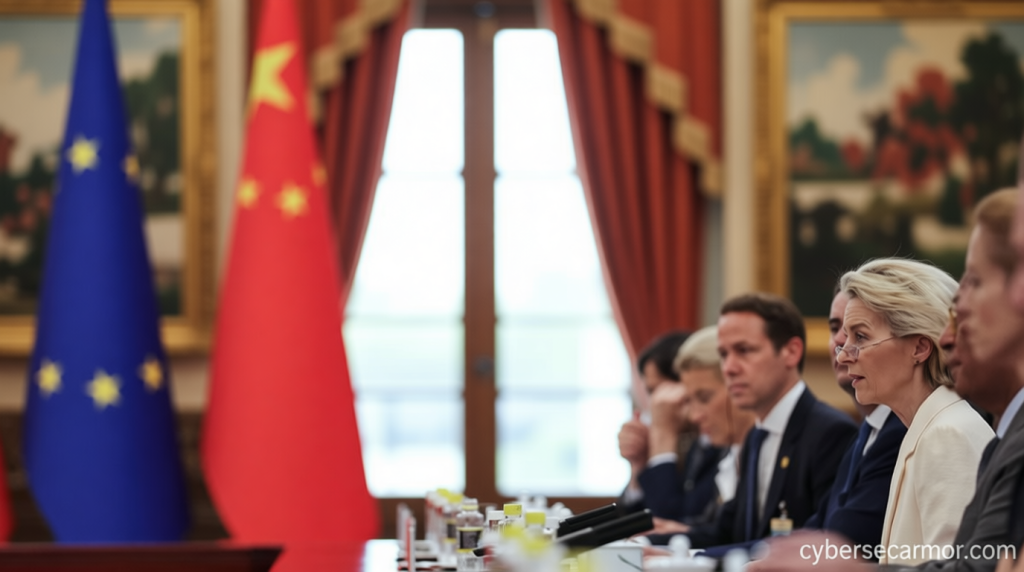
As Trade War with China Looms, How Can the EU Defend Itself?
As trade war with China looms – The European Union faces mounting pressure as Chinese exports flood its market, posing a threat to thousands of jobs and industries. To counter this, the European Commission is intensifying its efforts to shield domestic production from the consequences of China’s surplus manufacturing. Recent customs data reveals that Beijing’s trade surplus with the EU-27 reached $113 billion in the first four months of 2026, a significant increase from $91 billion in the same period of 2025. This marks a $22 billion rise over the past 12 months, while the EU’s overall trade deficit with China hit €359.9 billion in 2025. These figures underscore the urgency of the situation, as China has escalated its threats of retaliation against EU regulations that restrict access to the single market for its firms.
Strategies to Mitigate Economic Vulnerability
The EU’s dilemma is compounded by China’s aggressive tactics, including blocking European companies from engaging with the Commission during investigations into foreign subsidies. This move has intensified calls for a coordinated response, with EU Commissioners set to discuss the issue on 29 May. The focus is on restoring a fair trade environment, but the path forward remains complex. Three key strategies are emerging as potential solutions to address the imbalance.
1. Reducing Reliance on Chinese Components
One approach is to diversify supply chains and limit dependence on Chinese-made parts. According to a Financial Times report, the Commission is considering a plan to mandate that EU companies source critical components from at least three separate suppliers. The goal is to set thresholds—ranging from 30% to 40%—for single-country sourcing, ensuring a broader distribution of supply. This initiative follows China’s 2025 restrictions on rare earths and semiconductor exports, which are vital to EU sectors like green energy, automotive, and defense. By promoting regional suppliers, the EU aims to create resilience against potential disruptions from China’s overcapacity.
However, implementing such a strategy requires careful coordination. The EU must balance the need for economic independence with the risk of increasing costs for industries reliant on Chinese components. The Financial Times highlights that this plan is still in development, with discussions ongoing among policymakers. The idea is to foster a more sustainable trade model, but challenges remain in ensuring compliance without stifling innovation or competitiveness.
2. Tariffs on Strategic Sectors
Another avenue involves imposing tariffs on specific industries vulnerable to Chinese competition. The Commission’s economic security strategy, unveiled in December 2025, outlines plans to introduce new tools by September 2026 to safeguard EU industries from unfair practices. EU Trade Commissioner Maroš Šefčovič emphasized the bloc’s determination, stating,
“We will fight tooth and nail for every European job, for every European company, for every open sector, if we see they are treated unfairly.”
This sentiment reflects the Commission’s intent to level the playing field, but the execution of such measures depends on the approval of EU member states and the European Parliament.
A recent decision to double tariffs on global steel imports, primarily sourced from China, has already been endorsed by EU nations. This move targets the overcapacity in China’s steel industry, which has led to a flood of cheap products in Europe. The chemical sector is now under scrutiny, with imports from China surging by 81% over the past five years. Yet, the EU’s chemical industry remains export-dependent, as China is its fourth-largest market. This creates a paradox: while the sector faces pressure from Chinese goods, it also relies on sales to Beijing, complicating efforts to impose trade barriers without risking retaliation.
Philipp Sauer, a trade expert at Cefic, the European chemical industry lobby, warned of this dilemma.
“As an export-oriented industry, the European chemical sector generates over 30% of its sales abroad. That creates a risk of retaliation from third countries.”
His comments highlight the need for a nuanced approach, balancing protectionist measures with the imperative to maintain trade relationships. The chemical industry’s dual role as both a consumer and producer of Chinese goods means any significant action could have broader economic implications.
3. Anti-Dumping and Anti-Subsidy Measures
The Commission’s third option focuses on targeting Chinese companies suspected of undercutting prices through dumping or unfair subsidies. This approach allows the EU to impose duties on imports whose prices fall below domestic levels, effectively countering price undercutting. However, the process is time-consuming, as investigations can take up to 18 months. The DG Trade, responsible for handling these cases, is already overwhelmed, with a backlog of cases. Sauer noted that a third to half of ongoing investigations involve the chemical sector, illustrating the scale of the challenge.
While anti-dumping duties offer a direct tool for price stabilization, their effectiveness hinges on timely implementation. The Anti-Coercion Instrument, often dubbed the “trade bazooka,” serves as a last-resort measure, enabling the EU to impose strict restrictions on Chinese imports in response to economic coercion. This could include limiting access to public procurement or export licenses. Yet, the use of this instrument requires a qualified majority of member states, a condition that is not certain. National governments may resist such measures due to their economic ties with China.
For instance, Germany has opposed recent tariffs on Chinese electric vehicles, arguing that they could harm the automotive sector. Similarly, Spanish Prime Minister Pedro Sánchez, who has visited China four times in three years, advocates for closer cooperation with Beijing to secure major investments. These divergent views underscore the EU’s internal fragmentation, with some nations prioritizing trade relations over protectionist policies. The Commission must navigate these differences while ensuring a unified front against Chinese economic influence.
The broader implications of these strategies extend beyond immediate economic concerns. By adopting measures to counter China’s trade dominance, the EU risks provoking retaliatory actions that could harm its own exports. Additionally, the Commission faces the challenge of aligning member states’ interests, which remain split on the best way to engage with China. As the bloc debates its options, the pressure to act decisively grows, with the potential for a trade war that could reshape global economic dynamics. The outcome will depend on the EU’s ability to balance protectionism, diplomacy, and industrial resilience in the face of China’s expanding footprint in European markets.

