
Trump jokes that the US Navy will takeover Cuba ‘almost immediately’ on the way back from Iran
Trump Jokes That the US Navy Will Take Over Cuba ‘Almost Immediately’ on the Way Back From Iran
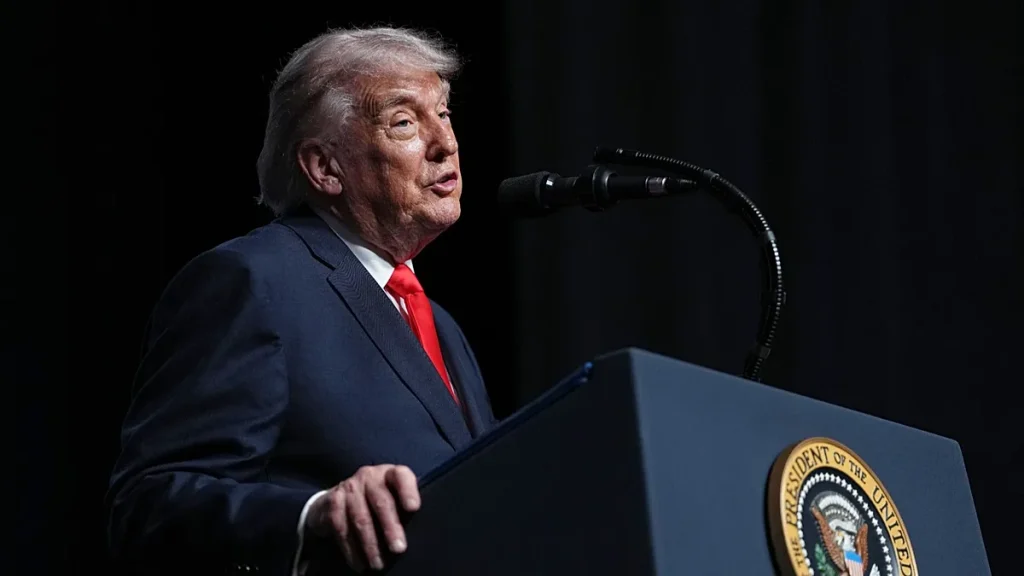
Trump jokes that the US Navy – On Friday, US President Donald Trump made a humorous remark during a speech at the Forum Club of the Palm Beaches, a non-profit event where he was invited as a keynote speaker. The president humorously suggested that his nation’s naval forces would seize control of Cuba as they returned from their mission in Iran. This statement, delivered with a mix of confidence and levity, sparked speculation about potential military actions in the Caribbean nation.
Trump’s comments highlighted a broader narrative of tension between the United States and Cuba. He claimed that his military would “take over (Cuba) almost immediately,” implying that the island nation would be a strategic target during the transit back from Iran. The president emphasized his commitment to completing tasks, stating, “Now Cuba’s got problems. We’ll finish one first. I like to finish a job. On the way back from what we’ll do… on the way back from Iran, we’ll have one of our big, maybe the USS Abraham Lincoln aircraft carrier—the biggest in the world—will have that come in. Stop about 100 yards offshore, and they’ll say, ‘thank you very much. We give up’.”
Trump’s suggestion of military involvement in Cuba echoes months of diplomatic pressure and economic measures targeting the country. His administration has consistently accused Havana of supporting Venezuela’s former leader, Nicolas Maduro, through security personnel. This came after Washington’s intervention in January 2026, which led to Maduro’s capture and the collapse of his government. In exchange for financial and oil support, Cuba allegedly provided logistical aid to Maduro’s regime, a claim Trump has repeatedly underscored.
The US’s actions have had a tangible impact on Cuba’s economy, particularly in the energy sector. Following the January operation, the island nation faced severe oil shortages, disrupting vital industries and crippling healthcare services. The UN has raised alarms over this crisis, warning that the US sanctions have pushed Cuba to the brink of a humanitarian disaster. With limited access to oil imports, the country has struggled to maintain its infrastructure and meet daily needs.
In a new development, Trump announced additional sanctions against Havana on Friday, expanding the scope of economic pressure. The executive order targets a range of individuals and entities within Cuba’s communist-led system, including those in energy, defense, and financial sectors. It also names Cuban officials accused of human rights violations or corruption. Those on the list will be barred from entering the United States, a measure aimed at isolating key figures in Havana’s leadership.
The Cuban Foreign Minister, Bruno Eduardo Rodríguez Parrilla, condemned the latest sanctions as a form of “collective punishment.” In a post on X, he stated, “We firmly reject the recent unilateral coercive measures adopted by the United States government. These actions demonstrate an intention to impose, once again, collective punishment on the Cuban people.” The minister added that the timing of the sanctions was deliberate, coinciding with May 1, a day when millions of Cubans marched to protest the US blockade and the ongoing energy crisis.
“It is no coincidence that these measures were announced on May 1, the very day that millions of Cubans take to the streets to denounce the US blockade and the energy siege,” wrote Rodríguez Parrilla. “These measures are extraterritorial in nature and violate the United Nations Charter. The US has no right whatsoever to impose measures against Cuba or against third countries or entities.”
He further criticized the Trump administration for its dual approach to foreign policy, accusing it of interfering in Cuba’s affairs under the guise of combating injustice and protecting democracy. Meanwhile, the US government has been repressing its own citizens, according to Rodríguez Parrilla. “While the US government represses its own people in the streets, it seeks to punish ours, who are heroically resisting the US imperialism’s attacks,” he wrote.
Despite the escalating rhetoric, the White House has urged Cuban leaders to engage in negotiations with Washington. Officials have emphasized the urgency of dialogue, warning that failure to cooperate could lead to more severe consequences. However, Cuban President Miguel Díaz-Canel has maintained a firm stance, refusing to negotiate under what he described as “hostile terms.” He insisted that Havana would only enter discussions on the basis of mutual respect, equality, and the preservation of its sovereignty.
Historically, the US and Cuba have had a contentious relationship, marked by periods of military confrontation and economic sanctions. The current tensions are part of a larger pattern of diplomatic maneuvering, with Trump’s administration continuing to leverage its influence to shape Havana’s policies. The president’s comments about the Navy’s potential role in Cuba underscore his belief in the effectiveness of military power as a tool for geopolitical pressure.
Critics argue that the recent sanctions are not only a continuation of past policies but also a means of strengthening US dominance in the region. By targeting key sectors of the Cuban economy, the administration aims to weaken Havana’s capacity to resist its influence. This strategy, however, has been met with fierce opposition from Cuban officials, who see it as an attack on their national independence and a disregard for international law.
As the situation unfolds, the broader implications of Trump’s remarks remain a topic of debate. While some view the potential military action as a symbolic gesture, others see it as a calculated move to assert US control over Cuba’s affairs. The comments, delivered during a public event, reflect the president’s willingness to use humor to underscore serious geopolitical intentions, blurring the line between political theater and strategic diplomacy.

