
Fading Echo: Can independent gaming studios survive AI – and battle for a better future?
Fading Echo: Can Independent Gaming Studios Survive AI – and Battle for a Better Future?
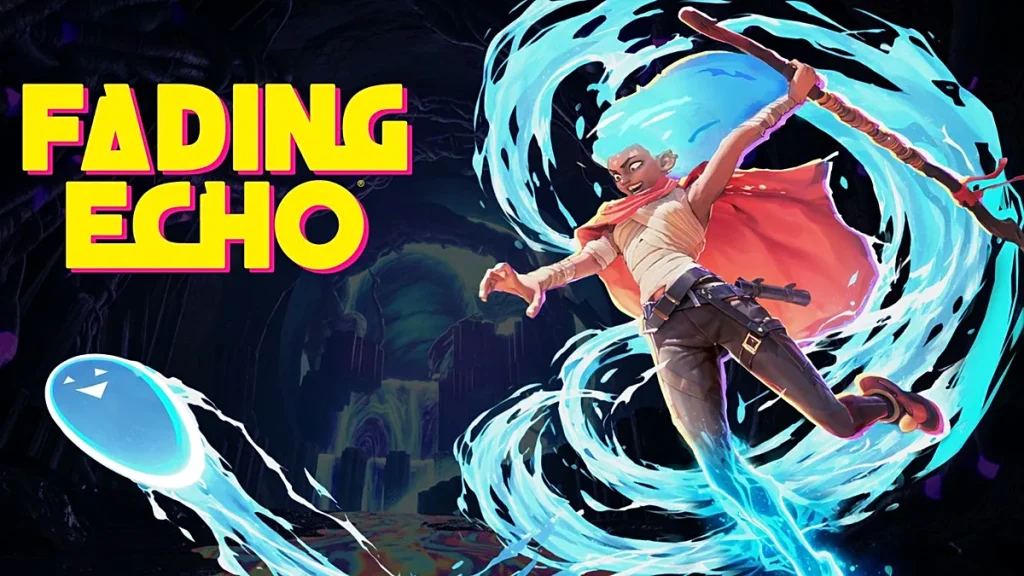
Fading Echo – Reality is fraying. The world teeters on the brink. Time is slipping away. These phrases might sound alarmist, but they’re a fitting prelude to Fading Echo, the debut title from Emeteria, an independent game development studio based in Lyon, France. Set for release this fall across PC, PlayStation 5, and Xbox Series X|S, the game already stirs anticipation with its comic-book aesthetic and narrative that bridges human and aquatic identities. Its premise is as bold as its visuals: players step into the shoes of a character capable of morphing between land and sea, tasked with salvaging the remnants of civilization and forging a new path forward.
The Fusion of Art and Narrative
The game’s artistic direction, inspired by comic strips, sets it apart in a market saturated with sleek, hyper-realistic graphics. This choice isn’t just stylistic—it reflects the game’s core philosophy. As Elise Marchouba, Senior Producer at Emeteria, explains, the visual storytelling is integral to the experience. “The world has collapsed, and all realities have shattered,” she says. “You travel through these fragmented dimensions, gathering water to restore your stronghold and escape the island.” The act of bringing water back into the game’s central hub becomes both a literal and symbolic mission, a metaphor for renewal in a broken world.
While the game’s themes are undeniably environmental, its narrative has evolved from a direct message to a more subtle commentary. Marchouba notes that the original vision was more explicit, focusing on ecological collapse. “It started as a tabletop RPG, like Dungeons & Dragons,” she recalls. “But as we adapted it to a video game, we realized we needed to balance our message with gameplay that felt organic.” The concept of ‘Corruption’—a mechanic where players accumulate power but risk destruction—was a point of internal debate. “We wanted to be clear about our stance,” she says, “but we also didn’t want to overwhelm players with ideology. It’s about making the game engaging and letting the message seep in quietly.”
Challenges in the Indie Game Landscape
The gaming industry is under pressure. As artificial intelligence reshapes development processes, independent studios face an uphill battle to remain relevant. AAA publishers, with their vast budgets and marketing power, dominate the scene, leaving smaller teams to carve out niche spaces. Emeteria, founded after the closure of Blizzard’s French studio, embodies the resilience of indie developers. Marchouba shares that the studio was born from a desire to continue the legacy of titles like Overwatch and World of Warcraft without the constraints of a larger corporate structure.
Emeteria operates as a hybrid model, blending development with publishing. While many studios focus on creating games and then seek publishers, this studio integrates both functions. “We’re embedded developers,” Marchouba says. “We build the game and then sell it, but we also handle the publishing side ourselves.” This approach allows for greater creative control, though it comes with its own set of challenges. The studio’s publishing arm, based in Paris, collaborates with global teams, including a newly announced partnership with a studio in Madagascar. “This is the first game from Madagascar to hit consoles,” Marchouba mentions, highlighting the studio’s commitment to global expansion.
Reimagining the Game Experience
The transition from tabletop to video game was not without hurdles. The original concept, a narrative-driven RPG, had to adapt to the demands of digital platforms. “We kept the core principles, but we transformed them into a more interactive format,” Marchouba explains. “The idea of exploring fractured realities and restoring balance is still there, but now it’s experienced through gameplay rather than just storytelling.” This shift required careful consideration of how to translate abstract themes into tangible mechanics.
Marchouba describes her role as a Senior Producer as akin to designing the framework of a car before adding wheels. “It’s about making sure all the pieces fit together,” she says. “If you put the tires on first, the frame might not hold up. But if you get the structure right, the rest can be built upon.” Her focus is on ensuring the game’s vision is both cohesive and accessible. “We don’t want to be too rigid,” she emphasizes. “The player should feel the message without being told what to think.” This philosophy aligns with a broader trend in the industry—games increasingly prioritizing layered narratives over simple, linear progression.
As the world grapples with existential crises, the gaming industry mirrors this complexity. Marchouba points out that the current era demands more than just entertainment; it seeks reflection. “It’s hard to start work without discussing the state of the world,” she admits. “Our lead writer, for instance, constantly weaves environmental concerns into the story, but in a way that feels natural.” This balance between artistic ambition and player engagement is a hallmark of independent studios navigating an ever-evolving landscape.
The Future of Indie Gaming
Despite the challenges, Emeteria remains optimistic. The studio’s unique approach—blending development with publishing—offers a blueprint for survival in an AI-driven era. “We’re not just fighting against the giants,” Marchouba says. “We’re creating something that can stand on its own.” Her words underscore a broader movement among indie developers to push boundaries, both in design and storytelling. “Games are becoming more than just escapism,” she notes. “They’re platforms for dialogue, for change.”
With Fading Echo on the horizon, the question isn’t just about survival—it’s about possibility. Can small studios, with their agility and creativity, carve a space in a world increasingly dominated by algorithmic efficiency? Emeteria’s journey suggests the answer lies in embracing complexity, staying true to vision, and ensuring that the message is felt, not forced. As the game prepares to launch, it serves as a testament to the enduring power of independent storytelling in a fractured reality.

