
Eurovision crisis: Protesters in Serbia urge boycott of contest over Israel’s participation
Eurovision Crisis: Protesters in Serbia Urge Boycott of Contest Over Israel’s Participation
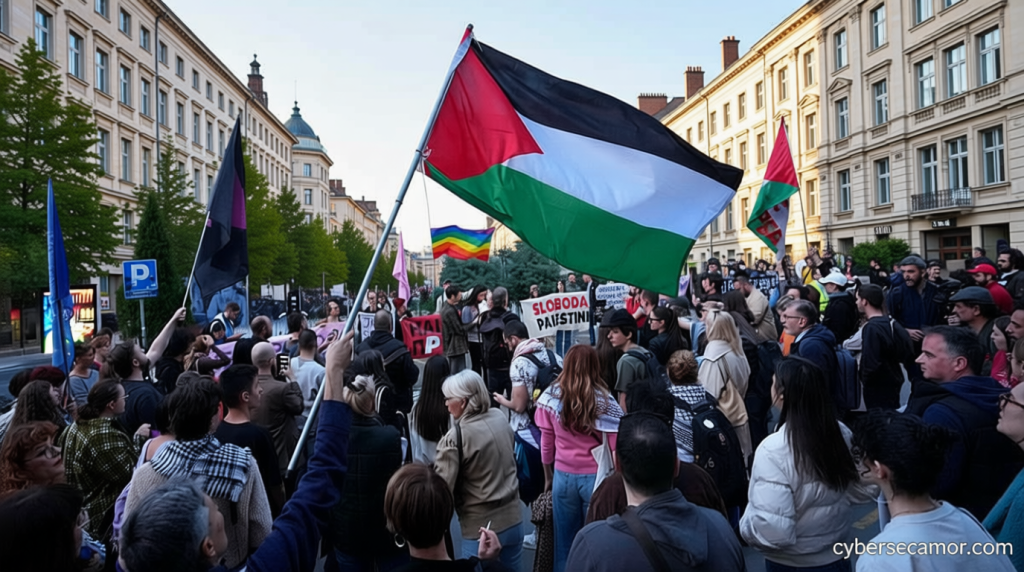
Eurovision crisis – The Eurovision Song Contest is at the center of a growing political storm, with demonstrators in Belgrade, Serbia, demanding that the country withdraw from the event due to its decision to include Israel as a participant. This comes as the 70th edition of the competition, set to take place in Vienna from 12 to 16 May 2026, faces intense scrutiny over its alignment with Israel’s policies. The protests, which occurred outside the Serbian state broadcaster RTS, highlight a deepening divide between the contest’s cultural mission and its perceived role in endorsing Israeli actions in the Gaza Strip.
A Call for Defiance Amidst a Controversial Year
The backlash against Eurovision has intensified this year, with activists arguing that the event has become a symbol of complicity in Israel’s alleged genocide. Demonstrators waved Palestinian flags and chanted slogans condemning the country’s military operations, emphasizing their belief that the contest should serve as a platform for defending human rights rather than legitimizing aggression. Their message is clear: by allowing Israel to compete, Eurovision risks undermining its own values, particularly its reputation as a unifying celebration of music and culture.
At the heart of the controversy is the European Broadcasting Union’s (EBU) December 2025 decision to grant Israel a spot in the contest. This choice has prompted several countries to take a stand, including Slovenia, Spain, the Netherlands, Iceland, and Ireland. Each of these nations has decided to either withdraw from the event or cease broadcasting it, marking a rare moment of collective dissent among participants. For the first time since 1961, Spain’s RTVE has announced it will not air the contest, while Ireland’s RTÉ has gone further, declaring its refusal to broadcast or participate at all.
Slovenia’s RTV Slovenia has opted to replace Eurovision with a series of films showcasing Palestinian narratives, a move that underscores the nation’s solidarity with the cause. “We will not be broadcasting the Eurovision Song Contest,” said Ksenija Horvat, director of RTV Slovenia, in an interview with AP. “We will be airing the film series ‘Voices of Palestine,’ featuring documentaries and cinematic works that highlight the struggles of the Palestinian people.” Meanwhile, the Netherlands and Iceland have chosen to proceed with their usual coverage, though the decision has sparked debate about their commitment to the contest’s values.
Global Impact and Hypocrisy Accusations
The crisis has drawn international attention, with critics accusing Eurovision of hypocrisy for allowing Israel to compete while excluding Russia from the event since its full-scale invasion of Ukraine in 2022. This contrast has intensified the backlash, as some see the contest as a political tool rather than a purely artistic endeavor. The EBU’s stance has been questioned, with activists arguing that the organization’s support for Israel’s participation undermines its role as a neutral cultural platform.
Eurovision, the world’s largest music event, has historically drawn over 166 million viewers annually. However, this year’s edition has become a flashpoint for political expression, with artists and fans alike calling for action. An open letter signed by thousands of musicians, including groups like Massive Attack and Sigur Rós, as well as individuals such as Brian Eno and Nadine Shah, has urged supporters to boycott the event until the EBU takes a stronger stance against Israel’s actions. The letter, organized by the No Music for Genocide movement and the BDS campaign, highlights the growing role of artists in shaping public opinion on global issues.
“As musicians and cultural workers within the EBU, we reject the use of Eurovision to whitewash and normalize Israel’s genocide, siege, and brutal military occupation of Palestine,” the letter stated. It specifically called on the EBU to ban the Israeli broadcaster KAN, which the organizers accuse of complicity in the conflict. This plea for solidarity with Palestinian causes has resonated with fans and creators alike, further fueling the movement against the contest’s current direction.
Israel’s Position and the Contest’s Legacy
Despite the criticism, Israel has maintained that its actions in Gaza are justified and denies allegations of genocide. The country’s participation in Eurovision has been a point of pride, with its entry by the metal band Lavina receiving widespread acclaim. However, the protest in Serbia has reminded audiences that the contest’s support for Israel may come at a cost, particularly for nations that prioritize human rights over geopolitical alliances.
The 70th anniversary of Eurovision has added a layer of historical significance to the current dispute, with many viewing the event as a symbol of unity. Yet, the protests have exposed a fracture in that unity, as some nations choose to align themselves with the Palestinian cause rather than remain neutral. The decision to host the contest in Vienna, Austria, has also drawn attention, with the city’s role as a neutral ground highlighting the tension between cultural celebration and political statement.
As the competition approaches, the question remains: can Eurovision retain its status as a unifying event while accommodating the diverse perspectives of its participants? The controversy has not only tested the contest’s neutrality but also its ability to balance artistic expression with political responsibility. With the final set for 16 May 2026, the outcome of this crisis may shape the future of the event, determining whether it will continue as a symbol of global unity or become a battleground for ideological divides.
Meanwhile, the EBU faces mounting pressure to address the concerns raised by its members. The union’s decision to include Israel in the contest has sparked debates about its priorities, with some arguing that the organization should prioritize the rights of the Palestinian people over the interests of a single nation. As the protests continue to gain momentum, the Eurovision crisis serves as a reminder of the power of music to transcend borders and ignite conversations about justice, peace, and human rights.

