Julia Louis-Dreyfus reveals ‘tons’ of tension on ‘Seinfeld’ set

Daftar Isi
Behind the Laughter: Julia Louis-Dreyfus Opens Up About Creative Friction on the Seinfeld Set
Cybersecarmor.com – For nearly three decades, the behind-the-scenes mythology of Seinfeld has been defined by one image: four friends cracking jokes in a writers’ room, everything clicking into place with effortless ease. On September 1, Julia Louis-Dreyfus shattered that tidy narrative. Speaking on the “Friends Keep Secrets” podcast hosted by Benny Blanco, Lil Dicky, and Kristin Batalucco, the 65-year-old actress confirmed that the production of NBC’s landmark sitcom was far from frictionless — and that the cast and showrunners regularly clashed over creative direction.
Batalucco pressed the question directly: were there tensions behind the curtain? Louis-Dreyfus did not hedge, soften, or deflect.
“Of course. Yes. Tons.”
The host’s visible disbelief prompted the eleven-time Primetime Emmy winner to elaborate. She framed the friction not as personal animosity but as an inevitable byproduct of ambition.
“Yeah. I mean, it’s hard to do anything really well, and it takes a lot of work, and you’re going to butt heads.”
Different Visions, Shared Objective
What Louis-Dreyfus described was less a feud than a recurring creative disagreement. The cast members, each bringing their own comedic instincts and interpretive choices, frequently found themselves at odds with the writers’ room over where a scene should land. She acknowledged that arguments did occur, though she stressed that every party involved was ultimately steering toward the same destination: making the show as sharp and funny as possible.
This dynamic is not unusual in long-running comedy productions, but it carries particular weight here because Seinfeld occupied a singular position in television history. Airing from 1989 through 1998 across nine seasons, the series restructured the sitcom format by stripping away laugh tracks, sentimental resolutions, and conventional character arcs. Its creators, Jerry Seinfeld and Larry David, built a show about the minutiae of social interaction — the held elevator door, the misplaced coat, the awkward dinner invitation — and treated those micro-moments with the gravity of a prestige drama. That ambition, Louis-Dreyfus noted, was “not the norm at the time in terms of structured television,” and it generated a particular kind of creative pressure that no prior comedy had demanded of its performers.
“An Air of Freedom”
Despite the friction, Louis-Dreyfus painted the collaborative environment as unusually liberating. Coming out of Saturday Night Live, where performers operate within a rigid sketch format and a single writer’s vision, she found the Seinfeld writers’ room to be a space where improvisation and personal comedic voice were welcomed rather than suppressed.
“We had our own idea and [the creators] had their own idea of exactly what they wanted to do, which was not the norm at the time in terms of structured television. So I think there was an air of freedom because of that. We had a lot of fun making it.”
She described the cast’s off-set relationship in deliberately casual terms — “just being friends together and just hanging out” — before immediately qualifying the statement:
“That sounds as if it was just hanging out. It was a lot of work to make the show. But what I mean was we were all, like, kids.”
The metaphor of childhood captures something real about the ensemble’s dynamic. Four performers in their late twenties and early thirties, working twelve-hour days in a Manhattan studio, bonding over shared meals and shared exhaustion. The creative disagreements, in her telling, were less like workplace conflict and more like siblings arguing over who gets the last slice of pizza — intense in the moment, quickly dissolved by the next take.
Elaine Benes and the Architecture of a Character
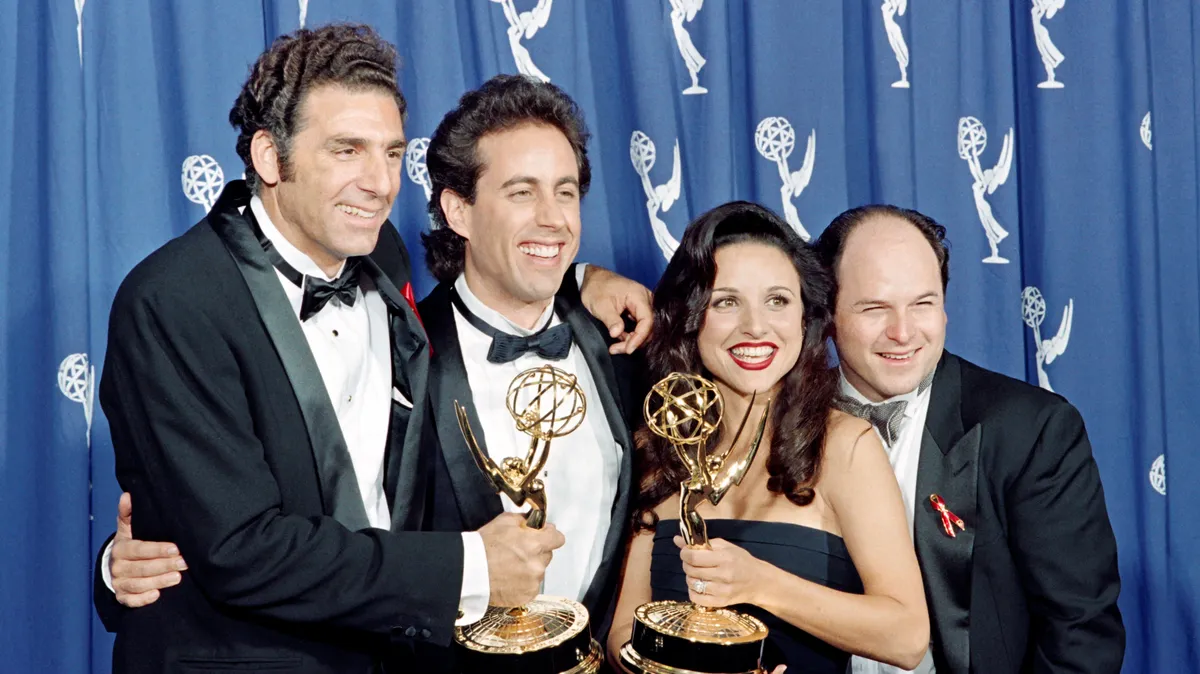
For nine seasons, Louis-Dreyfus inhabited Elaine Benes, the independent, frequently exasperated woman orbiting Jerry Seinfeld’s neurotic comedian. The character existed in a constellation with Kramer (Michael Richards), the physically ungovernable neighbor, and George (Jason Alexander), the perpetually anxious best friend. Elaine’s ex-girlfriend status to the titular character gave the writers a recurring engine of romantic tension that never resolved into conventional coupling, keeping the ensemble locked in a state of perpetual social negotiation.
Playing that role demanded a specific comedic register: Elaine was not the straight man, not the clown, not the schemer. She was the audience’s surrogate — the person who says aloud what everyone in the room is thinking but no one dares voice. Louis-Dreyfus, who had honed her timing and physicality on SNL, brought a precision to that register that the writers’ room both relied upon and occasionally pushed back against, producing the very creative tensions she described on the podcast.
A Career That Outgrew the Friction
The disagreements of the late 1990s have long since faded into the background of a career that continued to expand well beyond the NBC studio lot. Louis-Dreyfus went on to earn further small-screen acclaim with Veep, Curb Your Enthusiasm, and Arrested Development, roles that allowed her to flex a broader comedic range than the tightly scripted sitcom format permitted. More recently, she stepped into the Marvel Cinematic Universe as Valentina Allegra de Fontaine, a shadowy figure pulling strings behind the superhero spectacle — a role that trades the rapid-fire verbal sparring of Elaine Benes for slow-burn menace and institutional power.
Her Golden Globe and eleven Primetime Emmy wins underscore a career built on sustained excellence across decades and genres. The podcast revelations do not diminish that achievement; if anything, they humanize it. The friction she described is the sound of craft being pushed past its comfort zone, the creative equivalent of muscle soreness after a demanding workout. For a show that redefined what a sitcom could be, a little behind-the-scenes tension was the price of admission — and, by Louis-Dreyfus’s own account, a price the cast paid willingly, repeatedly, and ultimately with affection.
Related Reading
Frequently Asked Questions
What is Julia Louis Dreyfus reveals tons of tension?
Julia Louis Dreyfus reveals tons of tension is the main topic of this guide. The article explains the context, practical details, and next steps readers should understand.
Why does Julia Louis Dreyfus reveals tons of tension matter?
Julia Louis Dreyfus reveals tons of tension matters because readers are looking for a useful answer, not just a short summary. Good content should match search intent and help them decide what to do next.