This El Niño is shocking. But is it a ‘super’ event?

Daftar Isi
When the Pacific Heats Up: Why Everyone Wants a Bigger Word for This El Niño
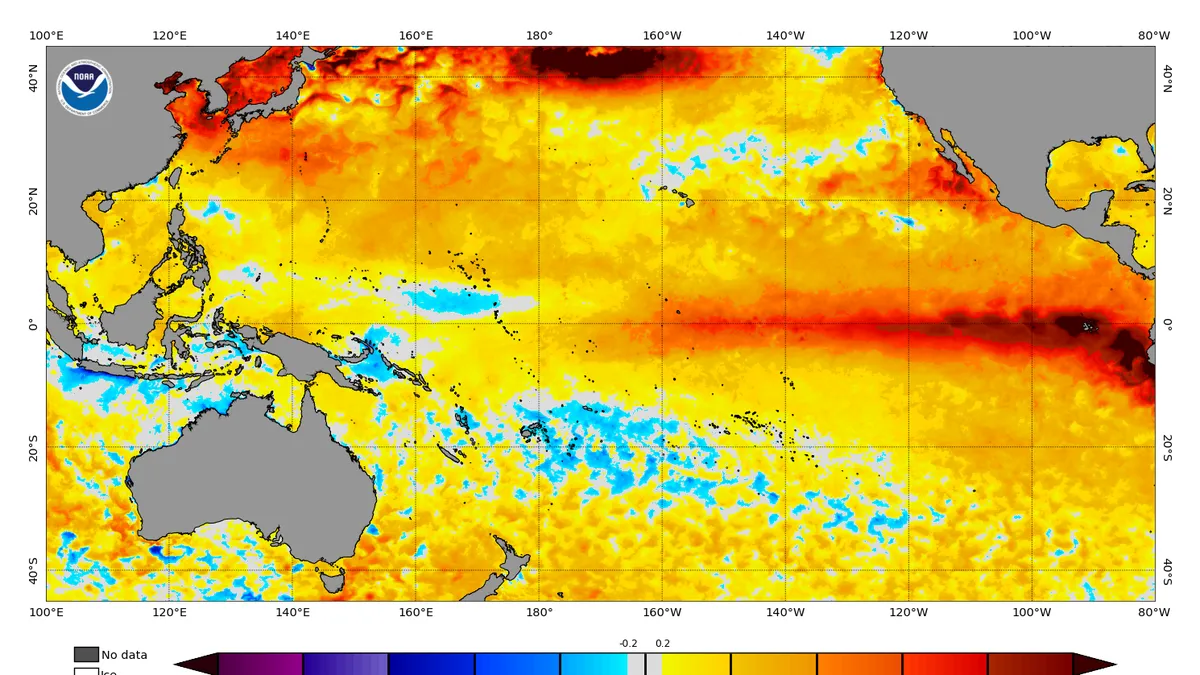
Cybersecarmor.com – Shark populations are shifting their ranges. Sea surface temperatures across the eastern Pacific are climbing at rates that alarm oceanographers. One tropical cyclone after another is spinning up in waters where such activity is unusual. Taken together, these signals point toward an El Niño event that many forecasters believe will reach unprecedented intensity by the latter half of 2026. The question now dominating climate discourse is not whether the phenomenon is happening — it is — but what we should call it.
The Vocabulary Problem
Social media feeds, science blogs, and news desks have erupted with increasingly theatrical labels. “Monster.” “Mega.” “Mind-blowing.” One headline went so far as to invoke a “flamethrower.” The impulse is understandable. Humans have long attached names to fires, hurricanes, and winter storms. The ferocious 2015–2016 El Niño earned the moniker “Godzilla” as the public struggled to find a frame of reference against the equally powerful 1997–1998 episode. That nickname eventually bled into peer-reviewed literature.
Yet the official language remains deliberately restrained. The National Oceanic and Atmospheric Administration classifies El Niño episodes into four tiers — weak, moderate, strong, and very strong — based on a three-month running average of sea-surface temperature anomalies. Under that framework, the appropriate descriptor for the current event is simply “very strong.” No capital letters. No exclamation marks. No Godzilla.
“Very strong,” however, carries none of the visceral punch of a Category 5 hurricane or an EF-5 tornado. That gap between bureaucratic precision and public appetite for drama is what drives the adjective arms race.
Scientists Weigh In
The most frequently floated informal term is “super” El Niño. Science communicators have pushed back, noting that it is not an official NOAA designation and should not be capitalized as though it were. Still, as the Pacific continued warming through the summer months, some researchers who had initially resisted the word began to soften their position.
“Especially if this event meets or exceeds the peak levels seen in previous El Niño years, maybe we will need language to differentiate it,” said Emily Becker, a research professor at the University of Miami’s Rosenstiel School of Marine, Atmospheric, and Earth Science.
Michael Mann, director of the Penn Center for Science, Sustainability & the Media at the University of Pennsylvania, had been skeptical of the term before the event fully materialized. His view shifted once the data confirmed the trajectory.
“Now that the event has materialized, it’s fair to characterize it in those terms,” Mann said. “It does look like it will potentially be the largest El Niño event on record.”
What History Actually Shows
Michael McPhaden, a recently retired NOAA senior scientist who spent more than four decades studying El Niño dynamics, cautioned against inventing an entirely new category.
“There have been three what we would call extreme El Niño events in the past 50 years,” he said, citing the episodes of 1982–83, 1997–98, and 2015–16. “This event we’ll get to in 2026–27 will rival those, if not exceed those, in magnitude.”
The broader implication of his remark is striking. If the current episode tracks to the upper end of projections, the planet will have experienced three major El Niño events within a single decade — a cadence with no parallel in the roughly 150 years of instrumental ocean-temperature records.
Adam Rainear, an associate professor of communication and media at West Chester University of Pennsylvania, noted that the scarcity of comparable events makes public comprehension difficult.
“We don’t have a lot of comparisons for this situation,” Rainear said. “We’ve only had a few really extreme El Niños that we can point to. Without a tangible way to create your comparison, how do you know if this El Niño is any worse?”
Why the Label Matters Less Than the Impact
Rainear added that, in practice, the specific name attached to a weather event plays a minor role in shaping public risk perception. NOAA’s hurricane communication strategy illustrates the point: forecasters explicitly urge residents in threatened areas to focus less on the storm’s category number and more on the concrete impacts — storm surge, rainfall totals, wind fields — that will affect their particular community. The agency works closely with sociologists to calibrate its messaging, and the National Hurricane Center has redesigned its forecast-cone graphic and other public products to reduce confusion and overconfidence.
The same principle applies here. Whether the 2026–27 El Niño is called “very strong,” “super,” or something more creative, the practical stakes remain identical: amplified rainfall over the southern United States and South America, heightened drought risk across Southeast Asia and the western Pacific, disrupted fisheries, and elevated global temperatures that compound the warming trend already underway. Communities along the Pacific coast, in monsoon-dependent regions of Asia, and in drought-prone parts of Africa and southern Africa will feel the effects regardless of the adjective chosen for the headline.
The naming debate, in other words, is ultimately a question of communication rather than physics. The ocean does not care what we call it. What it does care about — and what we should — is how prepared we are for the consequences.
Related Reading
Frequently Asked Questions
What is This El Nin o is shocking?
This El Nin o is shocking is the main topic of this guide. The article explains the context, practical details, and next steps readers should understand.
Why does This El Nin o is shocking matter?
This El Nin o is shocking matters because readers are looking for a useful answer, not just a short summary. Good content should match search intent and help them decide what to do next.