Fast-growing Hawk Fire near Reno triggers mass evacuation orders

Daftar Isi
- Over 42,000 Residents Ordered Out as Hawk Fire Surges Past 15,000 Acres Near Reno
- Emergency Declaration and Fire Trajectory
- Evacuation Scope and Public-Safety Messaging
- Regional and National Wildfire Context
- Local Disruption: Schools, Universities, and Cross-Border Coordination
- Related Reading
- Frequently Asked Questions
Over 42,000 Residents Ordered Out as Hawk Fire Surges Past 15,000 Acres Near Reno
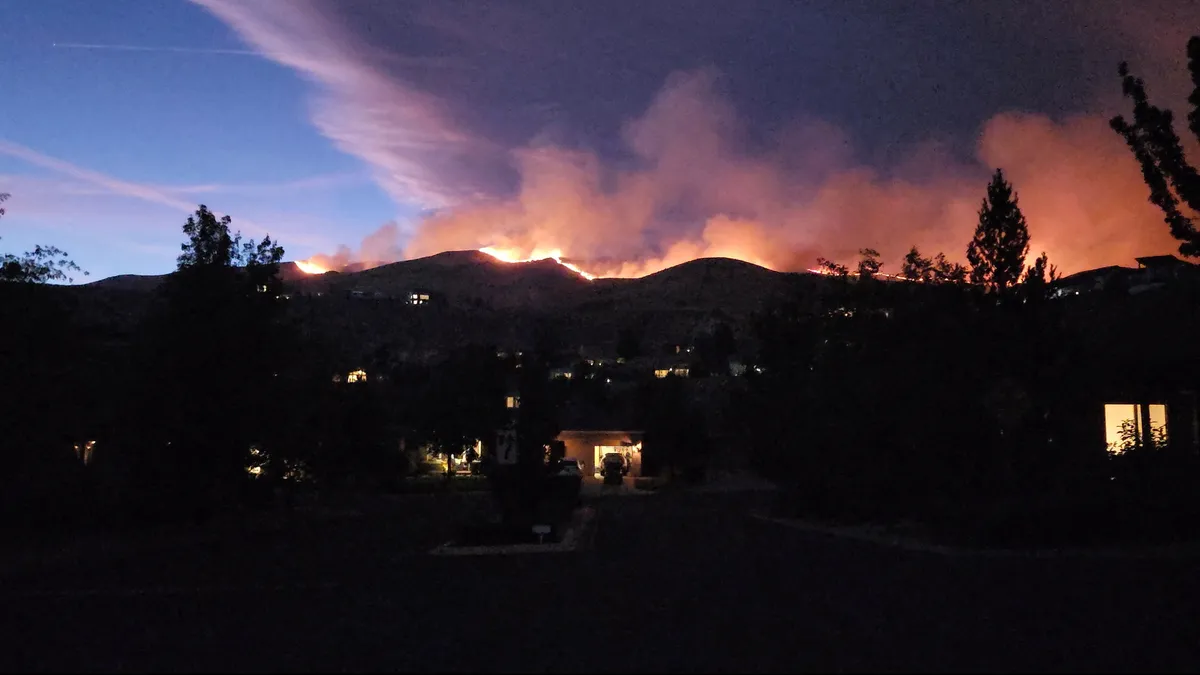
Cybersecarmor.com – The weekend brought one of the most disruptive wildfire events in recent Washoe County history. By the afternoon of Aug. 23, the Hawk Fire had consumed more than 15,000 acres of forested land northwest of Reno, Nevada, forcing over 42,000 residents to leave their homes while pushing another 40,000-plus people under evacuation warnings. The blaze, which ignited on the morning of Aug. 22 in the Peavine Peak area of the Humboldt-Toiyabe National Forest, expanded with alarming speed, transforming from a contained spot fire into a major regional emergency within roughly 36 hours.
Reno sits at the western edge of the Great Basin, where summer winds funnel through the Truckee Meadows corridor and dry out the surrounding ponderosa and lodgepole stands. That geography, combined with a summer that has already scorched millions of acres across the West, created conditions in which a single ignition can cascade into a fire of this magnitude within a single afternoon.
Human-Caused Ignition Under Active Investigation
Shane Akerson, a battalion chief with the Truckee Meadows Fire Protection District, confirmed during an Aug. 23 briefing that the Hawk Fire was human-caused. The precise mechanism of ignition remained under active investigation, and no further details about how the flames were first lit had been released as of that morning. Akerson also noted that an undetermined number of structures had been destroyed; because the fire was still actively burning, no reliable count of damaged buildings could be produced.
At least six people sustained injuries in connection with the blaze — three civilians and three first responders — though no fatalities had been reported.
Emergency Declaration and Fire Trajectory
Nevada Gov. Joe Lombardo declared a state of emergency for Washoe County, the jurisdiction encompassing Reno and the northeastern shore of Lake Tahoe. In a statement distributed through social media channels, Lombardo addressed residents directly:
“This is an active and rapidly evolving situation, and I urge everyone in the affected areas to remain vigilant and follow the direction of local officials.”
The National Interagency Fire Center’s update projected that the Hawk Fire would continue advancing toward the northeast, threatening multiple major thoroughfares, commercial structures, and critical infrastructure in the town of Stead, Nevada. Wind-driven flames had already made what the fire center’s database described as “significant runs through light, flashy fuels” over the weekend, a pattern consistent with what interagency reports labeled “extreme fire behavior.”
Evacuation Scope and Public-Safety Messaging
Per the evacuation-tracking platform Perimetermap.com, the Hawk Fire evacuation zone stretched from Interstate 80 northward to U.S. Highway 395 and westward to the Nevada–California state line — a swath that encompasses suburban Reno neighborhoods, rural ranches, and portions of the eastern Tahoe basin.
Washoe County Sheriff Darin Balaam described a tense scene on Aug. 22 in which fire overtook a neighborhood while residents were attempting to evacuate and firefighters were trying to reach them. He urged anyone still under a “be ready to evacuate” advisory to leave immediately if they could do so safely. More than 800 firefighters were deployed on the ground, supplemented by hundreds of law-enforcement personnel and members of the Nevada National Guard being staged for additional support.
Reno Police Chief Corey Sulferino posted a direct appeal on social media asking residents not to reenter evacuated zones until official orders are formally lifted, a reminder aimed at preventing traffic bottlenecks and reducing the risk of people being caught between advancing flames and inbound emergency crews.
Regional and National Wildfire Context
The Hawk Fire is at least the third major wildfire to strike northern Nevada in recent weeks. The Bug and Stallion fires, which burned earlier in the season, together consumed more than 100,000 acres in the region, leaving fuels already partially consumed and communities still recovering before this latest event arrived.
Nationally, the Hawk Fire was one of roughly 200 new wildfires reported across the United States on Saturday, Aug. 22, with large fires burning simultaneously in 18 states. Total burned acreage for the year had climbed to 7.7 million acres by that point — approximately 3 million acres above the 10-year average for the same calendar period. The convergence of above-average temperatures, below-average precipitation, and persistent wind patterns across the West has made extreme-behavior events like the Hawk Fire a recurring feature of the 2026 season rather than an outlier.
Local Disruption: Schools, Universities, and Cross-Border Coordination
Most Washoe County public schools announced closures for Aug. 24, while the University of Nevada stated in a social-media post that its operations would continue normally, noting that none of its campuses fell under evacuation warnings.
In neighboring California, Gov. Gavin Newsom said the state was monitoring the fire and coordinating with state and local agency partners along the border. He urged California residents in affected areas to follow guidance from local officials, acknowledging that smoke and ember transport do not respect state lines.
For residents of the Truckee Meadows corridor, the coming days will hinge on wind direction, humidity recovery, and the ability of ground crews to establish containment lines before the fire reaches the dense residential and commercial corridors of Stead and the eastern Reno suburbs. Until containment is achieved, officials expect evacuation orders to remain in effect and to expand if conditions warrant.
Related Reading
Frequently Asked Questions
What is Fast growing Hawk Fire near Reno?
Fast growing Hawk Fire near Reno is the main topic of this guide. The article explains the context, practical details, and next steps readers should understand.
Why does Fast growing Hawk Fire near Reno matter?
Fast growing Hawk Fire near Reno matters because readers are looking for a useful answer, not just a short summary. Good content should match search intent and help them decide what to do next.