
Instruments of the Silk Road: preserving sound and tradition
Instruments of the Silk Road: preserving sound and tradition
Instruments of the Silk Road – Music has long been an inseparable part of life across the Silk Road, serving as a bridge between communities and a medium for emotional connection. For generations, instruments have transcended their role as mere tools for performance, becoming vessels for storytelling, ritual, and cultural unity. These artifacts, from ancient times to the modern era, have shaped a shared auditory landscape that spans continents, fostering a sense of identity among diverse peoples. Today, their legacy endures through a blend of heritage preservation, oral tradition, and contemporary innovation.
Reviving Lost Sounds in Andijan
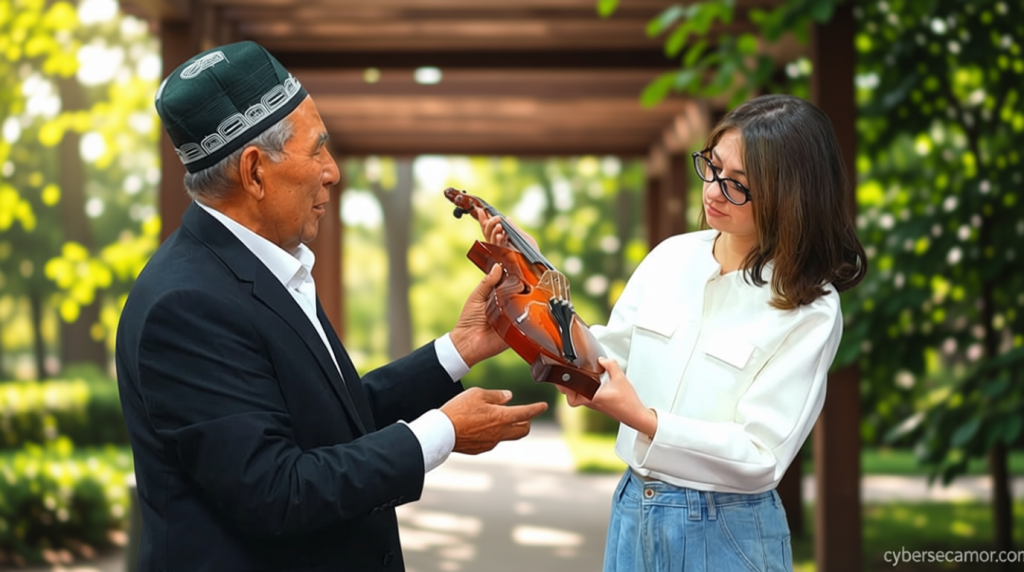
In the heart of Uzbekistan, the city of Andijan stands as a testament to the enduring power of musical craftsmanship. Here, the work of instrument makers plays a pivotal role in safeguarding the region’s sonic heritage. Master craftsman Abdumalik Madraimov, who has dedicated over five decades to this art, exemplifies the fusion of historical knowledge and modern practice. His workshop, one of the largest in the country, operates as both a production hub and a center for musical research, ensuring that traditional instruments remain relevant in today’s cultural context.
“Many instruments from history were forgotten,” explains Madraimov. “We have recreated them in modern forms and returned them to cultural life.”
The workshop’s artisans focus on instruments like the dutar, tambur, ghijjak, and doira, which have roots in the Timurid and post-Timurid periods. By studying historical records and ancient designs, they revive lost techniques and adapt them for contemporary use. Some of these reconstructed instruments now grace school classrooms and professional stages, symbolizing a dynamic dialogue between the past and present.
Madraimov’s team meticulously examines the evolution of instruments, ensuring authenticity while incorporating modern advancements. This balance allows for precise sound production without compromising the essence of traditional craftsmanship. The workshop also functions as a training ground, where apprentices learn directly from seasoned masters. This system of knowledge transfer, passed down through generations, ensures that the skills and stories behind each instrument remain intact.
Moreover, the instruments crafted here are not confined to local audiences. They are sent abroad, finding homes in international collections and sparking global curiosity. This exchange highlights the Silk Road’s lasting influence, as its musical legacy continues to resonate far beyond its original borders.
Improvisation and Emotional Expression in Surkhandarya
Further south, in the Surkhandarya region, the approach to music is distinct. Unlike the structured reconstructions of Andijan, the musical traditions here thrive on spontaneity. Bakhshi performers, for instance, do not rely on written scores but instead craft their performances through memory and improvisation. These artists weave narratives with a unique blend of poetry, rhythm, and personal interpretation, creating a living art form that evolves with each performance.
“A bakhshi does not memorise, they improvise,” says performer Shodmon Khujamberdiyev. “The dombra guides the story and the emotion.”
The dombra, a central instrument in this tradition, is more than a tool—it is a companion in the act of storytelling. Performers use it to shape the tempo, tone, and emotional depth of their narratives, ensuring that each rendition is as unique as the performer themselves. This method of transmission, rooted in listening rather than notation, emphasizes the fluidity of cultural expression.
Young bakhshi musicians learn by observing their mentors, gradually developing their own styles. This process is deeply personal, as the instrument becomes an extension of the artist’s voice. The dombra’s sound carries the weight of history while adapting to modern contexts, allowing performers to reflect both personal experiences and the collective memory of their community. Even in contemporary settings, these performances remain a vital part of cultural gatherings, linking ancient practices to present-day creativity.
Handcrafted Legacy in Karakalpakstan
In Karakalpakstan, the emphasis lies on the artistry of instrument creation. Here, the qobyz is a prime example of how traditional craftsmanship continues to thrive. Made entirely by hand, each instrument requires careful selection of natural materials—mulberry or jida wood, camel skin, and horsehair—before undergoing a precise and labor-intensive process. The timing of every step, from shaping the body to tuning the strings, is critical to achieving the desired sound quality.
“The qobyz is made from natural materials, and every detail matters,” says Marat Zhakysmuratov, a musician and craftsman who learned the trade from his father. “If the process is done correctly, the instrument can last for decades.”
Zhakysmuratov’s work reflects a broader tradition where families pass down the knowledge of instrument-making as a sacred craft. This intergenerational transfer ensures that the techniques and cultural significance of each instrument are preserved. As demand for these handmade creations grows, so does the reach of their musical identity, supported by the increasing interest of younger generations in traditional arts.
While the qobyz is a cornerstone of Karakalpakstan’s musical heritage, the region also boasts the dutar, which embodies its distinct cultural character. The combination of natural materials and time-honored methods underscores the depth of this tradition, offering a tangible link to the past. These instruments, though rooted in history, adapt to modern needs, ensuring their continued relevance in a rapidly changing world.
A Shared Language of Sound
Across the Silk Road, the preservation of musical traditions is a collaborative effort that unites regions through shared history and innovation. Whether through the precise reconstructions of Andijan, the improvisational art of Surkhandarya, or the handcrafted excellence of Karakalpakstan, each approach reflects the resilience of cultural identity. Instruments, as both artifacts and symbols, carry the weight of centuries of human experience, ensuring that the stories of the past are never silenced.

