Fall 2026 weather forecast released. When will it cool down?

Daftar Isi
El Niño’s Grip on Fall 2026: Why Cooler Weather May Be Delayed
Cybersecarmor.com – The record-shattering July that just closed out was the hottest on file for the United States, and millions of Americans are now watching the calendar with relief as autumn approaches. Yet a fresh federal outlook, published on August 20, suggests that the relief may arrive later than most people expect. A strengthening El Niño pattern is poised to keep warmth lingering well into the fall months, reshaping what was once a straightforward seasonal cooldown into a prolonged stretch of above-average heat across much of the country.
Temperature Outlook: Warmth Dominates Coast to Coast
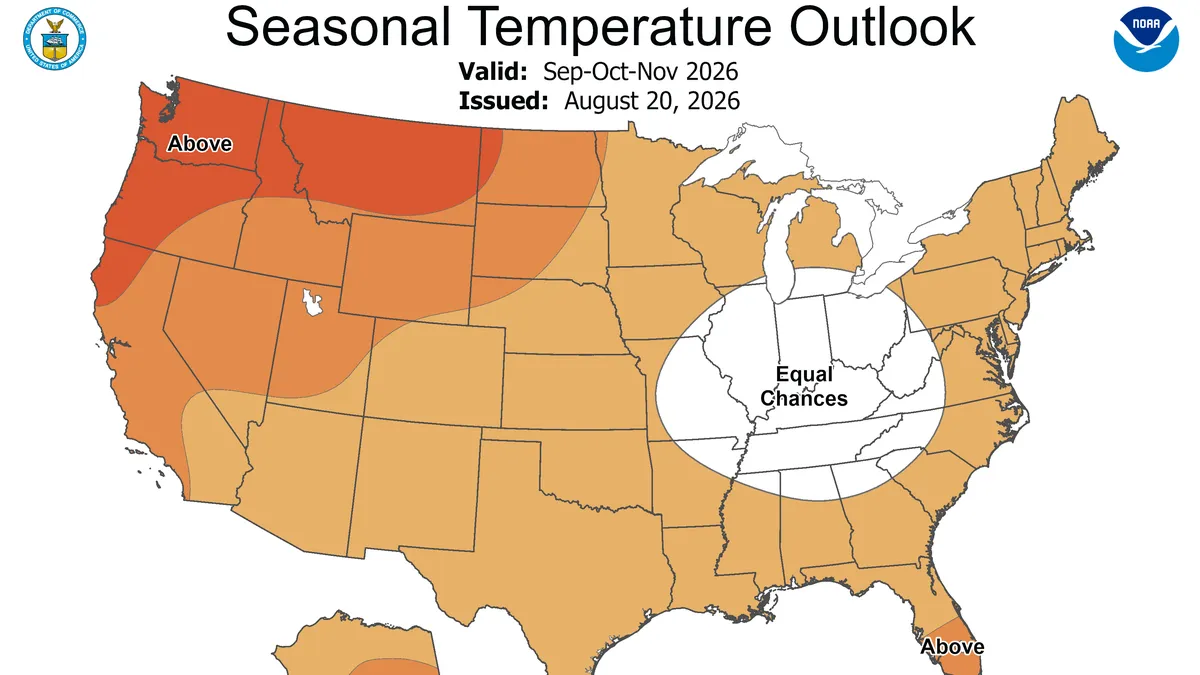
The National Oceanic and Atmospheric Administration’s Climate Prediction Center issued its September-through-November 2026 temperature map showing above-average readings expected from the Pacific coast to the Atlantic seaboard, with one notable exception. A narrow band stretching through the Ohio and Tennessee Valleys and surrounding regions carries “equal chances” for either warmer or cooler-than-normal conditions, reflecting comparatively weak warm signals in that corridor.
Scott Handel, lead meteorologist at the NOAA Climate Prediction Center, laid out the geographic scope in the agency’s online forecast:
“The September-October-November 2026 temperature outlook favors above-normal temperatures for most of Alaska as well as the western and central contiguous United States, the Great Lakes, Northeast, mid-Atlantic, Florida, and coastal areas of the Southeast and Gulf.”
The strongest warm signals — probabilities exceeding 50 percent for above-normal readings — are concentrated over southeastern Alaska, the Pacific Northwest, the northern Rockies, adjacent stretches of the northern High Plains, and northwestern California, Handel noted.
Brian Lada, a meteorologist with AccuWeather, warned that September could feel indistinguishable from late summer in the mid-Atlantic and southeastern states, where elevated temperatures will coincide with persistent humidity and warm overnight lows. For residents of those regions, the traditional “first cool snap” that once punctuated early autumn may simply not materialize on schedule.
Precipitation: A Split Nation
The companion precipitation map paints a sharply divided picture. Parts of the Northwest and Northeast are projected to run drier than average, while the Southwest and Southeast lean toward wetter-than-normal conditions.
“The greatest chances (higher than 40 percent) for above normal precipitation are indicated for much of the Southwest and adjacent areas of the Great Basin and central and southern Rockies as well as for parts of the coastal Southeast,” Handel wrote.
Conversely, a modest tilt toward below-normal rainfall is forecast across much of the Great Lakes region, the Northeast, and stretches of northern and eastern Washington State along with adjacent portions of northern Idaho and northwestern Montana. The remainder of the country falls into an “equal chances” category for precipitation totals.
El Niño as the Season’s Primary Engine
Experts identify the intensifying El Niño as the dominant forcing mechanism behind most of this fall’s weather patterns. Paul Pastelok, another AccuWeather meteorologist, explained in an email that the strength of the oceanic signal gives forecasters unusually high confidence in its influence.
“Because the signal will be very strong, the confidence level is good that El Niño will drive a majority of the weather features across the nation this fall and winter.”
Pastelok summarized the season’s headline dynamics: the very strong El Niño should deliver much-needed rainfall to the southern tier of the country, while wildfire activity in the Pacific Northwest is expected to persist into early autumn before finally subsiding.
As the season deepens and El Niño’s influence intensifies, Handel noted that the southern tier becomes the least likely region to experience above-normal temperatures, even as the broader national picture remains warm.
Cold Snaps and Seasonal Variability
For those hoping for a sharp drop in mercury readings, Handel offered a measured caveat. Cold snaps remain possible even within a season that trends warmer than average on a monthly basis.
“However, it is important to note that fall is a very changeable season and these outlooks pertain to the mean temperature for the season as a whole and not to individual cold snaps that may occur within the season. Individual cold snaps can occur even in areas where the season as a whole turns out to be warmer than normal.”
In other words, a single frigid front can still deliver a brief taste of winter in October, even if the three-month average ends up above the historical norm.
When Does Fall Actually Begin?
Two competing calendars mark the season’s start. Meteorological fall — the framework used by forecasters and the Climate Prediction Center — kicks off on September 1. Astronomical fall, tied to the autumnal equinox, arrives at 8:05 p.m. Eastern Time on September 22. The federal outlook spans all three months of September, October, and November regardless of which definition a reader prefers.
First Snow: A Mountain-Confined Event for Now
AccuWeather projects that the season’s initial snowflakes will remain largely confined to elevated terrain. Populated lowland areas are unlikely to see measurable snow until later in November, and even then, coverage will be patchy and short-lived. For most of the continental United States, the combination of El Niño-driven warmth and delayed seasonal cooling means the first true winter signal will arrive later than in a neutral or La Niña year.
The practical takeaway for households, farmers, and utility planners is straightforward: budget for extended warm-weather conditions through at least mid-October, monitor precipitation shifts in the Southwest and Southeast where above-normal rainfall could stress drainage infrastructure, and treat any isolated cold event as a temporary interruption rather than the season’s defining trend.
Related Reading
Frequently Asked Questions
What is Fall 2026 weather forecast released When?
Fall 2026 weather forecast released When is the main topic of this guide. The article explains the context, practical details, and next steps readers should understand.
Why does Fall 2026 weather forecast released When matter?
Fall 2026 weather forecast released When matters because readers are looking for a useful answer, not just a short summary. Good content should match search intent and help them decide what to do next.