
Video. Italy: Femen and Pussy Riot protest Russia’s return to Venice Biennale
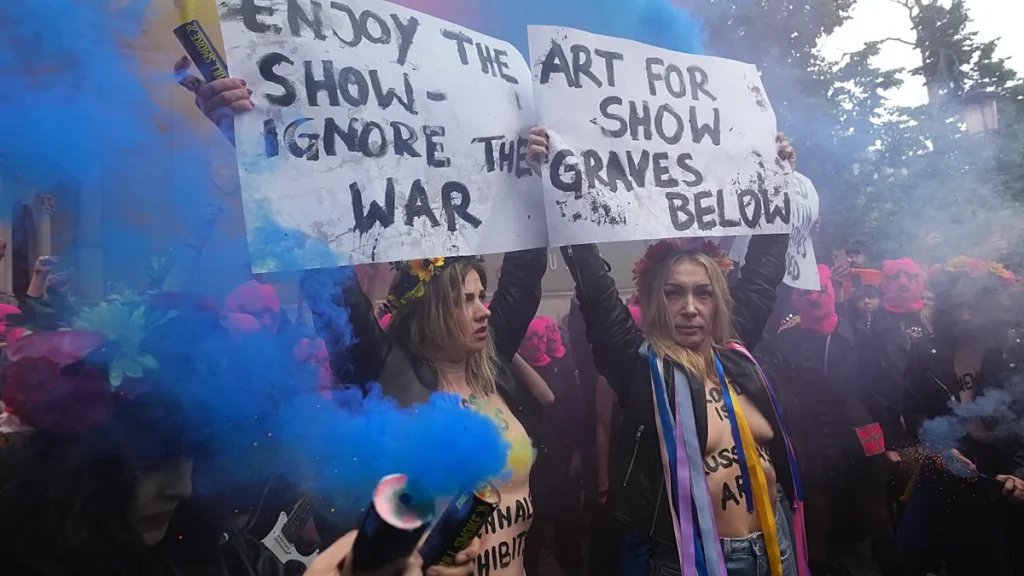
Italy: Femen and Pussy Riot Protest Russia’s Return to Venice Biennale
Italy – At the opening of the Venice Biennale, which began on 9 May and will conclude on 22 November, activists from Femen and Pussy Riot made their presence known in Venice. Their protest, held in the city’s historic streets, targeted Russia’s reentry into the prestigious art event. Using smoke flares and bold banners, the demonstrators voiced their discontent, framing Russia’s participation as a symbol of political aggression. The display was part of a broader critique of how global cultural platforms navigate international conflicts, with participants arguing that the Biennale should serve as a stage for artistic expression rather than a venue for geopolitical messaging.
The Russian Pavilion’s New Role
Despite the protest, the Biennale’s organizers confirmed that the Russian pavilion would remain open. However, they revealed a twist: the public will not have direct access to the space. Instead, performances will be recorded and displayed on screens throughout the exhibition. This decision has sparked debate about the balance between artistic freedom and political accountability, with critics questioning whether the Biennale can truly remain impartial in the face of global tensions.
The move follows the resignation of the international jury, which cited concerns over the involvement of nations under scrutiny by the International Criminal Court. The European Union added pressure, threatening to cut €2 million in funding for the event if Russia’s return was not addressed. The Biennale’s leadership, including its president Pietrangelo Buttafuoco, defended the choice, stating that “art is a neutral space” where creative expression should take precedence over political statements.
Historical Context and Geopolitical Tensions
Russia’s absence from the 2024 Biennale marked a significant shift in its cultural diplomacy. The decision came after its artists withdrew in 2022, following the invasion of Ukraine. Since 1914, the Russian pavilion has been a fixture of the event, reflecting the country’s enduring presence in the arts. Yet, its return now feels symbolic of a larger geopolitical struggle, with the Biennale serving as a battleground for ideological debates.
Protesters like Femen and Pussy Riot, known for their provocative tactics, have long used the Biennale as a platform to challenge authority. Their recent actions align with a tradition of art as a tool for dissent, even as they highlight the event’s role in amplifying political narratives. The Russian pavilion’s participation, critics argue, risks overshadowing the alleged war crimes committed in Ukraine, particularly as the International Criminal Court investigates Russia’s actions.
Supporters and Opponents in the Art World
Buttafuoco’s defense of the Biennale’s neutrality has drawn mixed reactions. While some support the idea of art remaining untouched by political currents, others view the decision as a compromise. Ukrainian officials, including those in the Ministry of Culture, have publicly condemned the return, calling it a betrayal of the event’s purpose. Similarly, several European culture ministers expressed concern, stating that cultural institutions should not ignore the realities of conflict.
Artists and curators who back the Biennale’s move emphasize the importance of maintaining the event’s international character. They argue that excluding Russia would set a precedent for cultural isolation, potentially alienating key contributors to the arts. The Russian pavilion’s return also allows for a dialogue between East and West, even if it comes at the cost of symbolic gestures of solidarity with Ukraine.
A Global Stage for Political Statements
The Venice Biennale, a cornerstone of the art world, has long been a space where political themes intersect with creativity. This year’s event is no exception, with its lineup of pavilions reflecting shifting alliances and contested narratives. Russia’s participation, while not without controversy, underscores the complex relationship between art and politics in an era of global conflict.
Femen and Pussy Riot’s protest in Venice exemplifies the growing role of activist art in contemporary discourse. Their use of smoke flares and slogans—such as “Art without war crimes!” and “Free Ukraine!”—has drawn attention to the Biennale’s symbolic weight. By staging the demonstration in the city where the event is held, the activists have highlighted the tension between the Biennale’s mission to celebrate artistic innovation and its role as a platform for political advocacy.
The closure of the Russian pavilion to the public, though a strategic choice, has raised questions about the accessibility of cultural experiences. Organizers claim the decision ensures the space remains a hub for creative works rather than a stage for political debates. However, critics argue that this approach may alienate the public, reducing the Biennale to a spectacle for elite audiences rather than a grassroots celebration of art.
The Future of the Biennale
As the Venice Biennale unfolds, the controversy surrounding Russia’s return is likely to persist. The event’s international jury, which resigned in protest, has become a focal point of discussions about the Biennale’s independence. Its decision to retain Russia’s pavilion, despite geopolitical tensions, signals a pragmatic approach to maintaining the event’s global stature.
Meanwhile, the protest in Venice has sparked a wider conversation about the role of cultural institutions in times of conflict. For some, it is a necessary step to align the arts with moral imperatives; for others, it is a demonstration of how art can transcend borders and remain a neutral ground for dialogue. The Biennale’s leadership, including Buttafuoco, has positioned the decision as a safeguard for artistic integrity, even as it faces accusations of prioritizing political convenience over justice.
Historically, the Venice Biennale has been a melting pot of cultural exchange, showcasing the diversity of global artistic voices. Russia’s return, however, adds a layer of complexity, as its participation is now tied to the broader war in Ukraine. The protest by Femen and Pussy Riot has amplified this tension, forcing the art world to confront its complicity in political narratives. Their actions have also drawn comparisons to past moments of artistic resistance, reminding the audience that the Biennale is not just an exhibition of works, but a reflection of the times.
Conclusion: Art as a Mirror of Conflict
The Venice Biennale, at its core, is a celebration of creativity and cultural exchange. Yet, its current iteration has become a microcosm of global geopolitical struggles. The decision to include Russia’s pavilion, despite protests, reflects the challenges of maintaining neutrality in an increasingly polarized world. As the event progresses, the question remains: can art remain a beacon of peace, or will it inevitably become a battleground for conflicting ideologies?
Buttafuoco’s assertion that “art is a neutral space” invites further scrutiny. While the Biennale’s leadership maintains that the event should focus on artistic merit, the symbolic weight of Russia’s return cannot be ignored. The protest in Venice serves as a reminder that cultural institutions are not immune to political influence, and their choices often resonate far beyond the confines of galleries and exhibitions. The outcome of this debate may shape the future of the Biennale, influencing how it balances artistic freedom with the demands of the international community.
In the end, the return of Russia to the Biennale is more than a logistical decision—it is a statement about the evolving role of art in global politics. Whether viewed as a bold gesture of inclusion or a concession to political pressure, the event underscores the power of culture to both reflect and reshape the world around it. As the Venice Biennale continues, the voices of activists like Femen and Pussy Riot will remain a vital part of its narrative, ensuring that the art world does not remain silent in the face of conflict.

