
Trump says Iran has ‘not yet paid a big enough price’ as he reviews new peace proposal
Trump Says Iran Has ‘Not Yet Paid a Big Enough Price’ as He Reviews New Peace Proposal
Trump says Iran has not yet paid – On Saturday, US President Donald Trump announced his evaluation of a recent Iranian proposal aimed at ending the ongoing conflict. While acknowledging the initiative, he expressed reservations about its potential to yield a meaningful agreement. “I’ll let you know about it later,” Trump remarked before departing on Air Force One, hinting at the need for further scrutiny. He also mentioned that the Iranians were expected to deliver the precise details of their plan in the coming hours.
Later that day, Trump shared a message on his social media platform, Truth Social, reinforcing his earlier sentiment. “I will soon be reviewing the plan that Iran has just sent to us, but can’t imagine that it would be acceptable in that they have not yet paid a big enough price for what they have done to Humanity, and the World, over the last 47 years,” he wrote. Despite his critical tone, he offered no specifics on the proposal’s content or the key issues that might hinder progress.
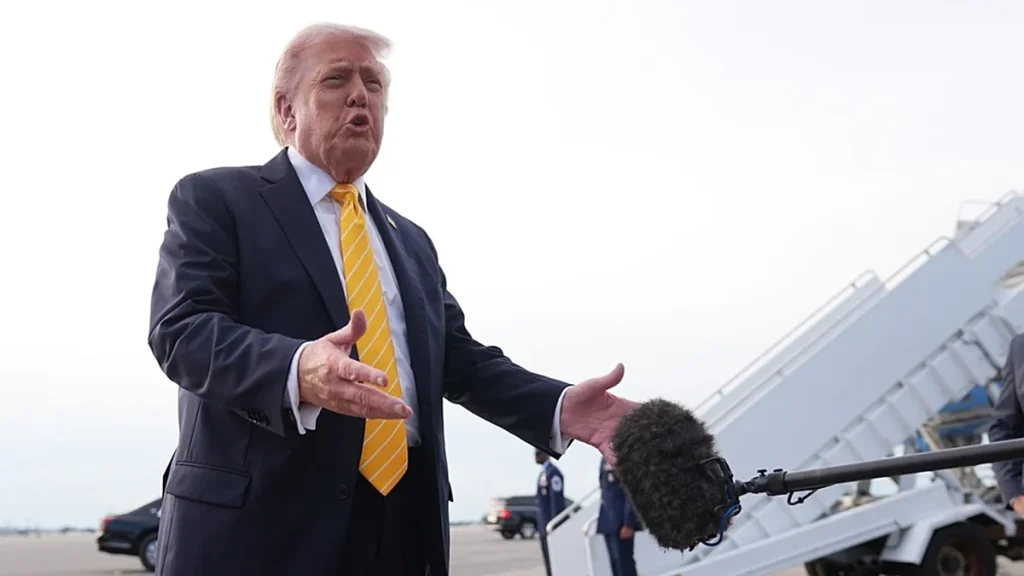
“I’ll let you know about it later,” said Trump before boarding Air Force One, adding that “they’re going to give me the exact wording now.”
Two semi-official Iranian news outlets, Tasnim and Fars, linked to the country’s paramilitary Revolutionary Guard Corps (IRGC), reported that Tehran had dispatched a 14-point proposal through Pakistan in response to a US nine-point plan. However, Iran’s state-run media remained silent on the details of the new offer, leaving much speculation about its viability. This approach aligns with past patterns, where Tehran has often released information gradually, allowing diplomatic maneuvering to unfold.
Pakistan has historically served as a neutral ground for Iranian-US talks, hosting several rounds of negotiations in Islamabad. These meetings have occasionally collapsed, as seen when the US withdrew from previous discussions after Iranian delegations cited logistical challenges, such as the long travel distance and time required for in-person talks. Trump’s latest skepticism echoes similar doubts from earlier negotiations, where the US had rejected Iranian terms as insufficient.
Despite the initial reluctance, diplomatic channels have persisted. A three-week ceasefire between the two nations appears to hold, though tensions remain high. Trump’s rejection of a prior Iranian proposal this week underscores the difficulty in bridging ideological and strategic gaps. Yet, the ongoing dialogue suggests that both sides are still willing to explore options, even as disagreements linger.
Naval Blockade and Economic Impact
Trump’s stance extends beyond the latest proposal to broader economic measures. Recently, he imposed a naval blockade on all Iranian ports in response to the country’s refusal to permit maritime traffic through the Strait of Hormuz. According to the US Navy, this action has led to the redirection of nearly 50 vessels attempting to enter or exit Iranian waters, effectively disrupting the flow of goods and commerce.
Analysts estimate that the blockade has caused Iran significant economic strain, with losses reported at $500 million per day. This figure, though contested, highlights the pressure being exerted on Tehran’s already beleaguered economy. Over the past decade, Iran has faced relentless sanctions from the US and its allies, targeting its nuclear program and human rights record. These financial constraints have limited the country’s ability to engage in trade, further complicating diplomatic efforts.
The Strait of Hormuz, a vital waterway near the Persian Gulf, is critical for global oil and gas trade, handling approximately a fifth of the world’s energy exports. Since the US-Israeli conflict began on 28 February, the strait has been partially closed, restricting access for international shipping. Iran’s suggestion to allow vessels to pass through the waterway in exchange for fees has drawn sharp criticism from Washington, which views the proposal as an attempt to exploit global markets.
“Washington warned on Friday against transfers not only in cash but also in ‘digital assets, offsets, informal swaps, or other in-kind payments,’ including charitable donations and payments at Iranian embassies, reiterating its stance that it would not allow Tehran to ‘bully the global economy’.”
Trump has consistently framed Iran’s actions as a threat to international stability. His recent statements emphasize the need for Tehran to demonstrate greater accountability for its policies over the last four decades. The president’s rhetoric suggests that the new proposal must address historical grievances, such as Iran’s nuclear ambitions and support for groups like Hezbollah and Hamas, before it can be considered a success.
Meanwhile, the international community watches closely as negotiations unfold. The US has warned shipping companies about potential sanctions if they agree to pay Iran for passage through the strait, underscoring its determination to maintain control over the waterway. This move has intensified pressure on Tehran, forcing the country to reconsider its strategy in securing economic relief.
The standoff between the US and Iran continues to shape global trade dynamics. With the Strait of Hormuz a focal point of contention, the outcome of these talks could have far-reaching implications. Trump’s insistence on a “big enough price” reflects his broader vision of using economic leverage to enforce compliance, a strategy that has defined his approach to foreign policy throughout his tenure.
As the negotiations progress, the stakes remain high. The success of the three-week ceasefire will depend on the ability of both sides to find common ground, even as Trump’s skepticism and Iran’s diplomatic maneuvering create challenges. The world remains on edge, awaiting the next developments in this complex geopolitical struggle.

